

 Lena
Lena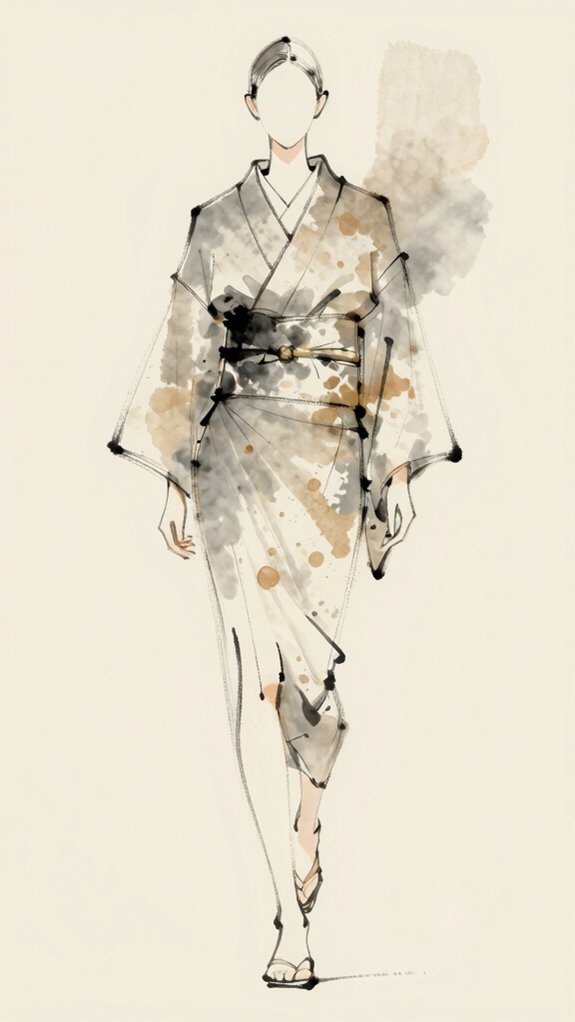
You have likely scrolled past a dozen fashion influencers today preaching “less is more,” but here’s the thing: they’re accidentally stumbling into a 500-year-old Japanese philosophy they can’t pronounce. Wabi-sabi isn’t about Marie Kondo-ing your closet into oblivion—it’s about finding beauty in that perfectly worn leather jacket, the one with creases that map your actual life. Ready to understand why imperfection might be the most radical choice you’ll make this year?
Origins of Wabi-Sabi Philosophy
While most Western fashion movements of the late 20th century screamed for attention with shoulder pads that could double as football gear and neon colors that burned retinas, Japan was quietly perfecting an aesthetic philosophy that had been germinating since the 15th century.
Wabi-sabi emerged from Zen Buddhist tea ceremonies, where masters like Sen no Rikyū stripped away excess to reveal beauty in imperfection, transience, and incompleteness. You’ll find its philosophical foundations rooted in accepting the natural cycle of growth and decay—those cracks in pottery aren’t flaws but stories.
These aesthetic principles celebrated asymmetry, roughness, and simplicity, rejecting the Western obsession with pristine perfection. This philosophy would later influence Western fashion icons like Carolyn Bessette Kennedy, whose approach demonstrated that texture becomes everything when working within a restrained color palette. It’s about finding profound beauty in what’s weathered, humble, authentic.
Core Principles in Fashion
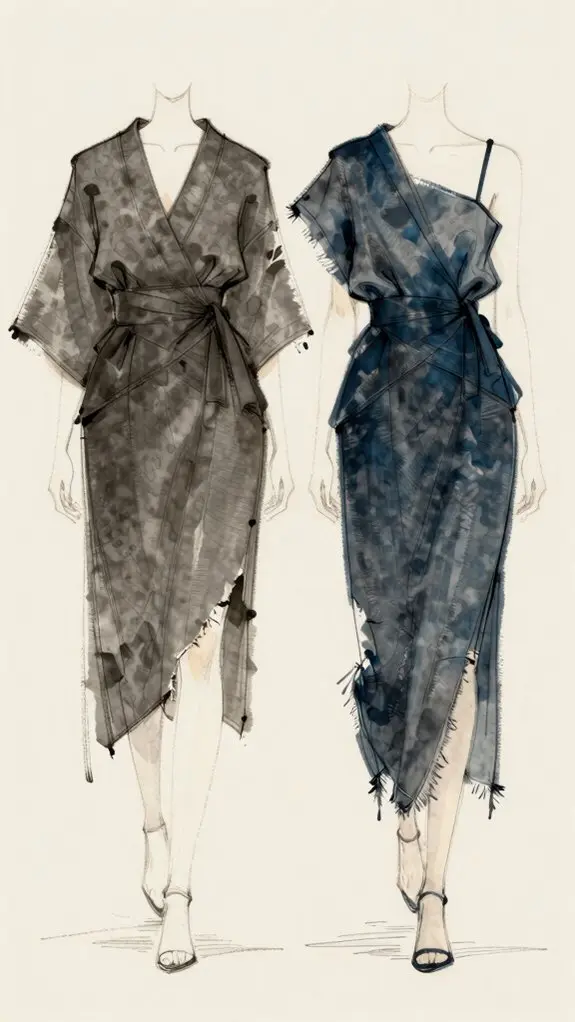
When you strip away Western fashion’s obsession with pristine newness, you’ll find wabi-sabi principles that treat a frayed hem, a faded indigo wash, or an asymmetrical drape not as flaws but as markers of authenticity. This philosophy doesn’t demand perfection—it celebrates the wrinkled linen that’s been lived in, the hand-stitched repair that tells a story, the garment that improves as it ages like a well-worn leather jacket or your favorite pair of jeans from 2015 that finally fits right.
You’re not buying into planned obsolescence here; you’re investing in pieces designed to evolve with you, where simplicity becomes a framework for personal history rather than a sterile aesthetic choice. This approach aligns with building a personal style legacy through garments that gain character over time rather than losing value.
Imperfection as beauty
The West’s obsession with perfection—those pristine runway looks, those impossibly flawless Instagram grids, those luxury goods that scream “untouched by human hands”—runs headlong into one of Japanese minimalism’s most radical ideas: wabi-sabi, the aesthetic philosophy that finds beauty in impermanence, imperfection, and incompleteness.
You’re not supposed to hide the frayed hem or disguise the asymmetrical drape. You’re meant to celebrate it. Designers like Rei Kawakubo and Yohji Yamamoto built empires on embracing flaws, treating garments as living objects that gain character through wear.
That scuffed leather jacket? It’s not damaged—it’s developing a story, appreciating patina like a well-loved teacup. This philosophy directly challenges fashion’s relentless pursuit of the unblemished, suggesting that perfection itself might be the real flaw, a sterile fantasy that denies our human messiness.
Natural aging
Wabi-sabi doesn’t just tolerate the marks time leaves behind—it insists those marks are the whole point. Your jeans shouldn’t look pristine forever. That’s not living, that’s embalming.
Fashion brands like Kapital and 45rpm have built entire collections around garments that embrace imperfections through deliberate aging techniques:
- Naturally oxidized indigo that fades uniquely to each wearer
- Hand-mended patches celebrating visible repair work
- Sun-bleached fabrics documenting years of wear
- Frayed hems left intentionally unfinished
- Distressed textures achieved through stone-washing and breakdown
You’re not buying damaged goods—you’re investing in pieces designed to celebrate imperfections as they develop character. Each worn spot, each softened edge tells your story, not some factory’s idea of authenticity. Time becomes your tailor.
Simplicity
Strip away everything that doesn’t serve a purpose, and you’ll find Japanese minimalism staring back at you—not as deprivation, but as liberation from the tyranny of more. This isn’t about owning three black turtlenecks because some guru told you to; it’s about understanding that a single, perfectly cut garment carries more weight than a closet stuffed with fast-fashion casualties.
Designers like Yohji Yamamoto and Rei Kawakubo built empires on this principle, proving that understated elegance doesn’t whisper—it commands attention through absence. You’re not sacrificing style for simplicity; you’re discovering that effortless chic emerges when every stitch, every seam, every proportion matters.
The West calls it “less is more,” but Japan’s known this truth for centuries: simplicity isn’t reduction, it’s refinement.
Key Characteristics
You’ll notice that Japanese minimalist fashion breaks from Western symmetry obsessions, embracing irregular hemlines, draped silhouettes, and shapes that follow the body’s natural movement rather than forcing it into structured boxes.
The color story here isn’t about making bold statements—think charcoal, ivory, navy, earth tones that wouldn’t look out of place in a Zen rock garden—because the focus shifts to texture, drape, and the spaces between fabric and skin.
This philosophy of celebrating delicacy, lightness, and movement shares an unexpected kinship with the design principles that have guided iconic French fashion houses for decades.
Designers like Yohji Yamamoto and Issey Miyake built empires on natural fibers (linen, cotton, wool, silk) that breathe, age gracefully, and reject the synthetic sheen of fast fashion’s petroleum-based disasters.
Asymmetry and organic shapes
While Western fashion spent decades obsessing over bilateral symmetry—matching lapels, even hemlines, perfectly centered buttons—Japanese designers were asking a more interesting question: why should the human body, an inherently asymmetrical form, be forced into mirror-image garments?
You’ll find this philosophy embedded in irregular silhouettes that drape, fold, and cascade according to gravity’s whims rather than some imagined ideal. The approach honors wabi-sabi’s celebration of imperfection:
- One-shoulder necklines that reject balance
- Hemlines that dip and rise organically
- Off-center closures that follow the body’s natural asymmetry
- Draped fabric responding to movement, not structure
- Raw materials left deliberately unfinished
This isn’t chaos—it’s a sophisticated understanding that perfection lies in embracing the body’s authentic, asymmetrical reality.
Muted color palettes
When Yohji Yamamoto sent models down the runway in 1981 wearing head-to-toe black, Parisian critics literally booed—they’d expected the vibrant spectacle that defined ’80s excess, not what looked like a funeral procession.
Yet Yamamoto’s palette wasn’t depressing; it was revolutionary. Japanese minimalism rejects the Western obsession with color as decoration, instead embracing blacks, grays, whites, and earth tones that create understated elegance through restraint.
These muted shades aren’t limitations—they’re liberating frameworks that let texture, drape, and form speak without chromatic distraction. You’ll notice how Comme des Garçons and Issey Miyake similarly relied on neutral palettes that communicated effortless sophistication, proving that color’s absence can be fashion’s most powerful statement.
It’s wabi-sabi applied to hue: finding beauty in what’s missing.
Natural textiles
Cotton, linen, silk, wool—Japanese designers treat these materials like sculptors treat marble, with reverence for inherent properties that synthetic fibers can’t replicate. You’ll notice how handwoven fabrics carry imperfections that tell stories, how vegetable dyed fibers age gracefully instead of degrading into chemical stains.
These textiles breathe with you:
- Raw silk retains its irregular slubs, celebrating the silkworm’s natural rhythm
- Linen wrinkles become character marks, not fashion crimes
- Hemp cloth softens through wear, rewarding patience
- Organic cotton shows authentic texture variations
- Wool maintains thermal intelligence without synthetic intervention
The tactile experience matters here. When you run your fingers across naturally processed cloth, you’re connecting with centuries of craft traditions that fast fashion obliterated. It’s not nostalgia—it’s acknowledging that some innovations weren’t improvements.
Notable Designers
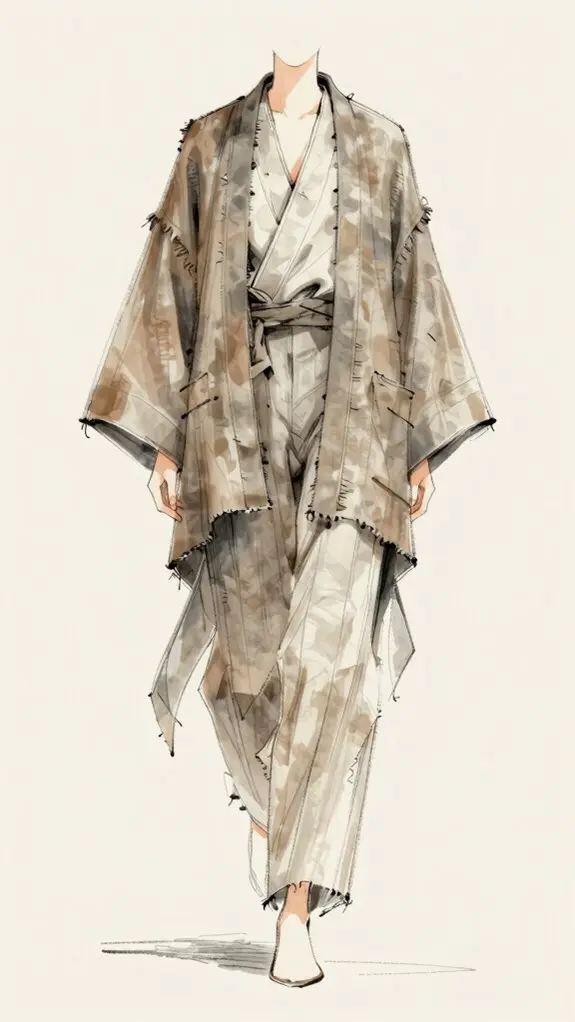
The big three of Japanese minimalism—Yohji Yamamoto, Rei Kawakubo, and Issey Miyake—didn’t just show up in Paris during the early 1980s with their deconstructed black garments and call it a day. They fundamentally challenged Western fashion’s obsession with body-con silhouettes, bringing diverse design perspectives rooted in wabi-sabi philosophy.
Yamamoto draped asymmetrical poetry onto bodies, Kawakubo turned Comme des Garçons into architectural rebellion, and Miyake folded pleats into sculptural experiments that honored traditional artisan skills while embracing technology. You’ll notice how each designer approached emptiness differently—Yamamoto’s romantic darkness, Kawakubo’s confrontational gaps and bumps, Miyake’s mathematical precision.
They weren’t trying to be minimal for minimalism’s sake. They were translating centuries of Japanese aesthetics into clothes that questioned everything you thought fashion should be. Their influence echoes in today’s minimalist aesthetic, where neutral palettes, simple silhouettes, and quality basics continue to prioritize intentional design over excess.
Application in Modern Wardrobes
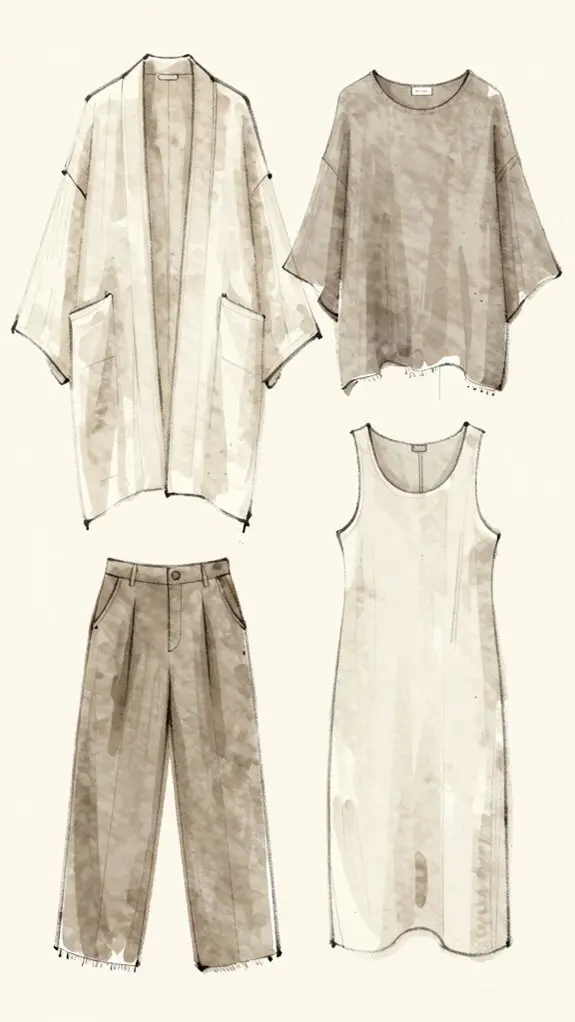
So you’re probably wondering how clothes that look like architectural experiments translate to your actual closet, where you need something to wear to brunch without looking like you’re cosplaying a 1982 Comme des Garçons runway show.
Wabi-sabi fashion isn’t about costume—it’s about conscious consumption habits that actually make getting dressed easier. You build a foundation of quality basics, understanding that ethical manufacturing practices cost more upfront but won’t disintegrate after three washes.
Quality over quantity isn’t just a philosophy—it’s the difference between a wardrobe and a landfill audition.
- Neutral color palettes (black, grey, navy, cream) that mix effortlessly
- Natural fabrics like linen, cotton, and wool that age beautifully
- Oversized silhouettes you can layer without looking bulky
- Statement pieces with interesting textures or asymmetrical cuts
- Quality construction details (reinforced seams, proper hems)
Tonal dressing in multiple shades creates sophisticated visual interest while maintaining the minimalist aesthetic that wabi-sabi celebrates. You’re investing in pieces that improve with wear, not fighting planned obsolescence.
Sustainable Fashion Connection
Because Japanese minimalism was accidentally eco-conscious decades before “sustainable fashion” became a marketing buzzword, the philosophy aligns almost perfectly with what environmentalists have been screaming about since fast fashion turned clothing into disposable garbage. You’re already practicing conscious consumerism when you buy one $300 linen shirt instead of fifteen $20 polyester nightmares from Shein.
Slow fashion isn’t just about production timelines, it’s about wearing clothes until they become extensions of yourself, then mending them, then passing them down. Issey Miyake‘s pleated pieces from the ’90s still look contemporary because quality transcends trends. This investment strategy of choosing timeless, high-quality pieces over trend-focused fast fashion purchases embodies the wabi-sabi approach to building a lasting wardrobe.
The wabi-sabi acceptance of wear, fading, and patina means you’re not tossing perfectly good garments because they show signs of actually being worn. Revolutionary concept, right?
Frequently Asked Questions
What’s the Difference Between Wabi-Sabi and Other Minimalist Fashion Styles?
Unlike Western minimalism’s obsession with sterile perfection, wabi-sabi celebrates imperfect asymmetry, embracing the beauty you’ll find in worn edges, frayed hems, irregular cuts.
While Scandinavian minimalism chases crisp lines and monochrome uniformity, wabi-sabi fashion invites natural textures, raw linen, hand-dyed fabrics with color variations. It’s not about Marie Kondo-ing your wardrobe into identical black turtlenecks—it’s about honoring time’s passage, finding elegance in garments that show their history, their humanity.
How Much Does Authentic Wabi-Sabi Inspired Clothing Typically Cost?
Ironically, embracing imperfection costs you a fortune. You’ll drop $200-$800 for a single wabi-sabi piece, sometimes more, because artisanal material selection—hand-loomed linen, naturally dyed cotton, raw silk—doesn’t come cheap. Factor in local production costs from Japanese ateliers or small European workshops, and you’re basically paying premium prices for clothing that’s supposed to celebrate simplicity and worn beauty.
Brands like Moyuru, Arts & Science, and 45R know you’ll pay for authenticity, and honestly, they’re right.
Can Wabi-Sabi Fashion Work for Formal or Corporate Environments?
You’ll struggle with formal dress codes, honestly. While wabi-sabi‘s neutral palettes, natural fabrics, and understated silhouettes *can* translate to office appropriate pieces—think well-cut linen blazers, raw silk shirts, textured wool trousers—the aesthetic’s embrace of visible mending, irregular hems, and deliberate imperfection reads as sloppy in most corporate settings.
Conservative industries especially won’t appreciate your artfully frayed seams. Save the authentic philosophy for creative workplaces or adapt it subtly through texture and drape rather than distressed details.
Where Can I Buy Genuine Wabi-Sabi Fashion Pieces Online?
You’ll find genuine pieces through unique online wabi-sabi boutiques like Muji, Fog Linen Work, and SOU•SOU, which ship internationally. Platforms like Etsy connect you with local artisan wabi-sabi fashion brands, though you’ll need to vet sellers carefully—authenticity matters.
Try Garmentory for curated independent designers, or explore Japanese marketplaces like Rakuten. Honestly, Instagram’s become surprisingly useful for discovering small-batch makers who embrace imperfection, natural dyes, and handwoven textiles without the pretentious markup.
Does Wabi-Sabi Fashion Suit All Body Types and Ages?
Absolutely—wabi-sabi fashion’s genius lies in its body positivity through loose, unstructured silhouettes that drape rather than cling, celebrating your natural form instead of demanding you conform to arbitrary standards.
The aesthetic’s age inclusive design works beautifully whether you’re twenty or seventy, since it prioritizes authenticity, natural textures, and timeless pieces over trend-chasing.
You’ll find the philosophy actually rejects fashion’s usual body-shaming gatekeeping, embracing imperfection, asymmetry, and the beauty of aging gracefully.
Conclusion
You’re not just buying clothes—you’re entering into a conversation with time itself. Wabi-sabi transforms your wardrobe into a living archive, where each scuff mark, fade, and fray becomes punctuation in your personal narrative. It’s the antidote to fast fashion’s disposable amnesia, asking you to slow down, notice, appreciate. Your worn-in jeans aren’t falling apart; they’re becoming themselves, and honestly, so are you.
Have any thoughts?
Share your reaction or leave a quick response — we’d love to hear what you think!
-
 0
0 -
 0
0 -
 0
0 -
 0
0 -
 0
0 -
 0
0