

 Lena
Lena
You’ve likely scrolled past a dozen “vintage-inspired” dresses this week without realizing they’re sanitized versions of 1950s fashion’s most complicated era. Christian Dior’s 1947 New Look didn’t just resurrect hemlines and waistlines after wartime austerity—it engineered an entire aesthetic of contradiction, wrapping women in yards of fabric that simultaneously celebrated and constrained them. The real story behind those charming polka dots and bullet bras? It’s far more calculated than your Pinterest board suggests.
Post-War Fashion Context
When World War II finally ended in 1945, American fashion didn’t just change—it exploded into something entirely new, something that had been bottled up through years of fabric rationing, utility clothing, and making do with last season’s hemlines.
You’ve got to understand: those post-war social norms weren’t accidentally restrictive. They were deliberately constructed to send women back home after they’d proven themselves perfectly capable in factories and offices. Christian Dior’s 1947 “New Look,” with its cinched waists and voluminous skirts requiring yards of precious fabric, became the uniform of renewed femininity.
These gender expectations manifested in every seam, every petticoat, every pair of heels that made running for anything other than your husband’s martini physically improbable. Fashion became policy. After years of minimalist neutrals and wartime austerity, women embraced this return to elaborate, joyful dressing with an almost defiant enthusiasm.
Dual Aesthetics
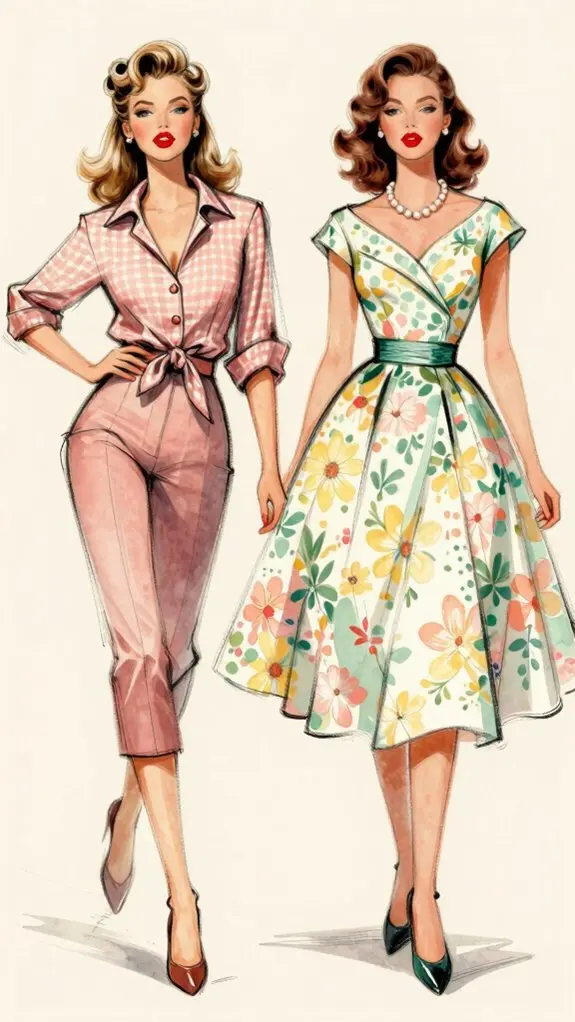
Two completely contradictory images governed 1950s femininity, and here’s the fascinating part—women were expected to embody both simultaneously.
The culture’s cruelest trick: demanding women master two opposing identities while pretending this schizophrenic standard was perfectly natural.
You’d encounter retro femininity’s split personality everywhere: the demure housewife in her apron versus the sultry pin-up in her lingerie. Betty Friedan later called this impossible standard the “feminine mystique,” that suffocating expectation that you’d be simultaneously:
- Sexually available yet morally pure
- Glamorous yet practical
- Sophisticated yet submissive
- Desirable yet domesticated
This wasn’t accidental—it was manufactured cognitive dissonance. You were supposed to channel Bettie Page’s bedroom eyes while baking casseroles, embody Marilyn Monroe’s sex appeal while scrubbing floors. The culture demanded you perform both roles flawlessly, switching between them as needed, never questioning why these identities existed or whom they actually served. Today’s coquette aesthetic draws from these romanticized notions of femininity, reinterpreting the delicate, hyper-feminine details of that era through a modern lens.
Characteristic Features
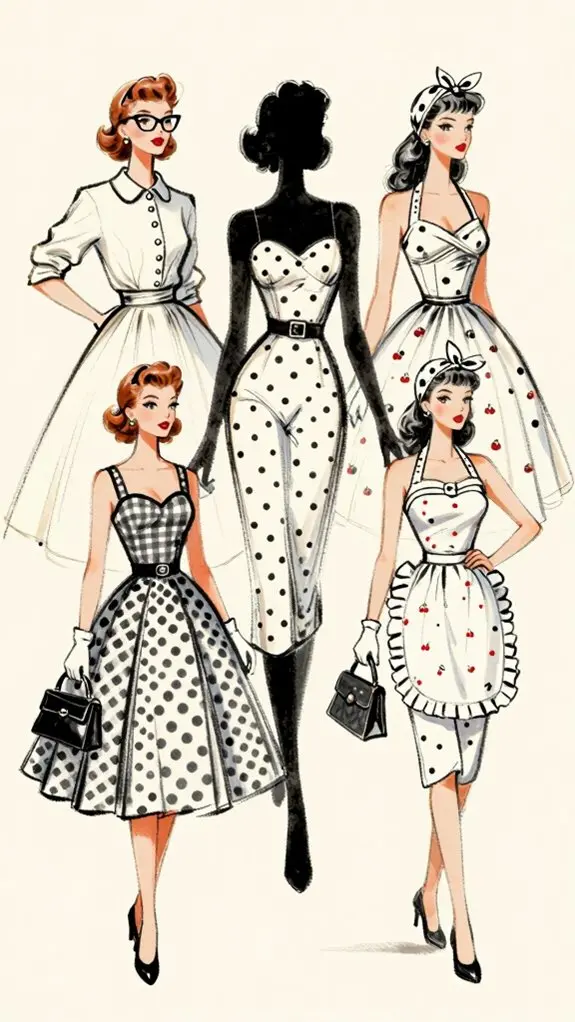
You’ll recognize ’50s housewife style instantly by its obsession with the hourglass silhouette—those cinched waists, sometimes squeezed down to an almost cartoonish 22 inches with the help of bullet bras and girdles that could double as medieval torture devices, created a look that was equal parts glamorous and physically uncomfortable.
Full skirts, often supported by layers of stiff petticoats or crinoline that rustled with every step, balanced out the tiny waist and gave women that coveted A-line shape that Christian Dior had popularized with his “New Look” collection in 1947.
And then there were the polka dots—those playful, endlessly repeating circles that showed up on everything from swing dresses to headscarves, becoming such a defining pattern that you can’t picture a ’50s pin-up or housewife without imagining at least one polka-dotted piece in her wardrobe.
Today’s fashion revives these vintage elements with a modern twist, as seen in diagonal striped maxi skirts that offer the same visual interest and movement that ’50s full skirts provided but with a cleaner, more minimal aesthetic.
Cinched waists
Nothing defined the 1950s silhouette quite like the dramatically cinched waist, that impossible hourglass curve that seemed to defy basic anatomy and, let’s be honest, probably cut off circulation to more than a few vital organs. The structured lines and dramatic curves you’ll notice in every pin-up photo weren’t accidental—they were engineered through:
- Waspie belts that compressed your midsection to dimensions that would make a Victorian fainting couch necessary
- Circle skirts that emphasized the narrowness above through sheer volume below
- Bullet bras creating that distinctive shelf-bust profile
- Strategic boning in dresses that literally sculpted your body into submission
Christian Dior’s 1947 “New Look” sparked this waist-worship, and women embraced it despite the physical discomfort, because glamour demanded sacrifice.
Full skirts
That tiny waist needed a counterbalance, and the 1950s delivered it through skirts so voluminous they required their own zip code. You’d achieve full volume through layers of starched petticoats, crinoline, and strategic engineering that made doorways your natural enemy.
The classic A line silhouettes became uniform for every self-respecting housewife, creating that iconic triangle shape from hip to hem. Christian Dior’s New Look, launched in 1947, cemented this aesthetic with skirts using up to twenty-five yards of fabric, a middle finger to wartime rationing. You’d twirl, the fabric would billow, and suddenly you’re a walking bell.
These weren’t subtle garments; they announced your presence, demanded space, transformed women into mobile architecture that refused to apologize for taking up room.
Polka dots
The polka dot wasn’t invented in the 1950s, but damn if that decade didn’t claim ownership through sheer force of repetition. You’ll find these high contrast patterns everywhere in authentic ’50s pieces, transforming simple dresses into statement-makers through nothing more than circles on fabric.
These bold prints occupied because they photographed beautifully and moved gorgeously:
- Black dots on white created maximum visual impact
- Red and white combinations shouted playful femininity
- Navy dots on pastels offered sophisticated alternatives
- Varying dot sizes added depth, texture, dimension
Want instant pin-up credibility? Throw on polka dots. They’re simultaneously innocent and suggestive, housewife-approved yet camera-ready. The pattern works because it’s geometric enough to feel structured, organic enough to feel soft—exactly the contradiction the ’50s demanded from its women.
Essential Wardrobe
Essential Wardrobe
| Garment Type | Must-Have Version | Why It Matters |
|---|---|---|
| Pencil Skirt | High-waisted wool | Creates that nipped waist without shapewear torture |
| Day Dress | Shirtwaist style | Professional enough for errands, flirty enough for dates |
| Cardigan | Cropped or fitted | Accessory essentials that finish any look instantly |
| Blouse | Peter Pan collar | Balances structured bottoms, adds feminine contrast |
You’re building authenticity, not playing dress-up. Great style is about finding pieces that make you feel confident, not blindly following trends.
Modern Styling

Modern Styling
Owning those vintage pieces means nothing if you’re styling them like a theme park employee. You’re not recreating 1955, you’re borrowing its best elements and making them work in your actual life.
- Mix eras deliberately – pair your circle skirt with minimalist sneakers or a leather jacket
- Keep hair modern – soft waves beat lacquered victory rolls every time
- Downplay one element – if you’re wearing a full petticoat, skip the pearls
- Update accessorizing details – choose streamlined bags over novelty purses shaped like telephones
The key? Inspired makeup looks that reference the era without copying it exactly. Think cat-eye liner with nude lips instead of full Technicolor face paint. You’re channeling confidence, not cosplaying. When working with delicate fabrics like lace, choosing unexpected footwear like chunky boots or sneakers creates a cool-girl contrast that keeps vintage pieces feeling fresh rather than costume-like.
Frequently Asked Questions
Where Can I Find Authentic 1950S Vintage Clothing in Good Condition?
You’ll score authentic 1950s pieces at estate sales, where grandma’s actual wardrobe awaits discovery, often perfectly preserved in tissue paper.
Antique fairs offer curated selections, though you’ll pay more for someone else’s hunting efforts. Online, Etsy and specialized vintage boutiques work, but inspect photos obsessively for moth holes, stains, and that dreaded underarm disintegration.
Local vintage shops let you touch fabric, check zippers, and avoid the heartbreak of ill-fitting mail-order disappointments. Hunt consistently, darling—good pieces vanish fast.
How Do I Determine My Correct Size in Vintage 1950S Clothing?
you’ll need your body measurements—bust, waist, and hips—taken with a cloth tape measure while wearing undergarments you’d pair with vintage pieces. Don’t trust modern sizing; vintage size charts run considerably smaller than today’s vanity sizing. A 1950s size 12 fits like a modern 4 or 6.
Cross-reference your measurements with era-specific charts from reputable vintage sellers, since manufacturers weren’t standardized back then, and you’ll find your perfect fit.
What Undergarments Are Needed to Achieve an Authentic 1950S Silhouette?
You’ll need foundation garments that create curves where nature didn’t, starting with a longline bra or corset style lingerie to cinch your waist and lift your bust. Add a waist cincher if you’re serious about that hourglass shape—think 24-inch waists weren’t just genetics, darling.
A crinoline or petticoat gives skirts their iconic volume, while high-waisted panties smooth everything. It’s structured, sure, but that’s how they achieved those dramatic silhouettes you’re after.
How Should I Care for and Store Delicate Vintage 1950S Garments?
About 60% of vintage textiles deteriorate from improper storage alone, so you’ll need proper storage methods that actually protect your investment. Store garments in acid-free tissue paper inside breathable cotton bags—never plastic, which traps moisture and destroys fabric.
For fabric preservation techniques, keep pieces away from direct sunlight, maintain consistent cool temperatures, and use padded hangers for structured pieces. Handle your treasures with clean hands, spot-clean only when necessary, and consider professional conservation for irreplaceable finds.
Are There Affordable Reproduction Brands That Offer Quality 1950s-Style Clothing?
You’ll find excellent quality reproductions from brands like Hell Bunny, Collectif, and Stop Staring!, which nail vintage fashion trends without destroying your budget. These companies understand the construction details that matter—proper bodice boning, authentic fabric weights, and accurate silhouettes—while keeping prices reasonable, usually $60-150 per dress.
Pair their pieces with retro style accessories from companies like Erstwilder or Banned Apparel, and you’ll achieve that pin-up perfection without remortgaging your house or risking genuine vintage pieces.
Conclusion
You’re not resurrecting a corpse when you wear circle skirts and victory rolls—you’re cherry-picking from history’s wardrobe, keeping what serves you, discarding what doesn’t. The 1950s offered women a gilded cage, all pretty bars and no keys. Today’s vintage revival lets you claim the aesthetic power, the unapologetic femininity, without accepting the limitations. It’s fashion as selective memory, where you control the narrative. That’s the real revolution hidden in your polka dots.
Have any thoughts?
Share your reaction or leave a quick response — we’d love to hear what you think!
-
 0
0 -
 0
0 -
 0
0 -
 0
0 -
 0
0 -
 0
0