

 Lena
Lena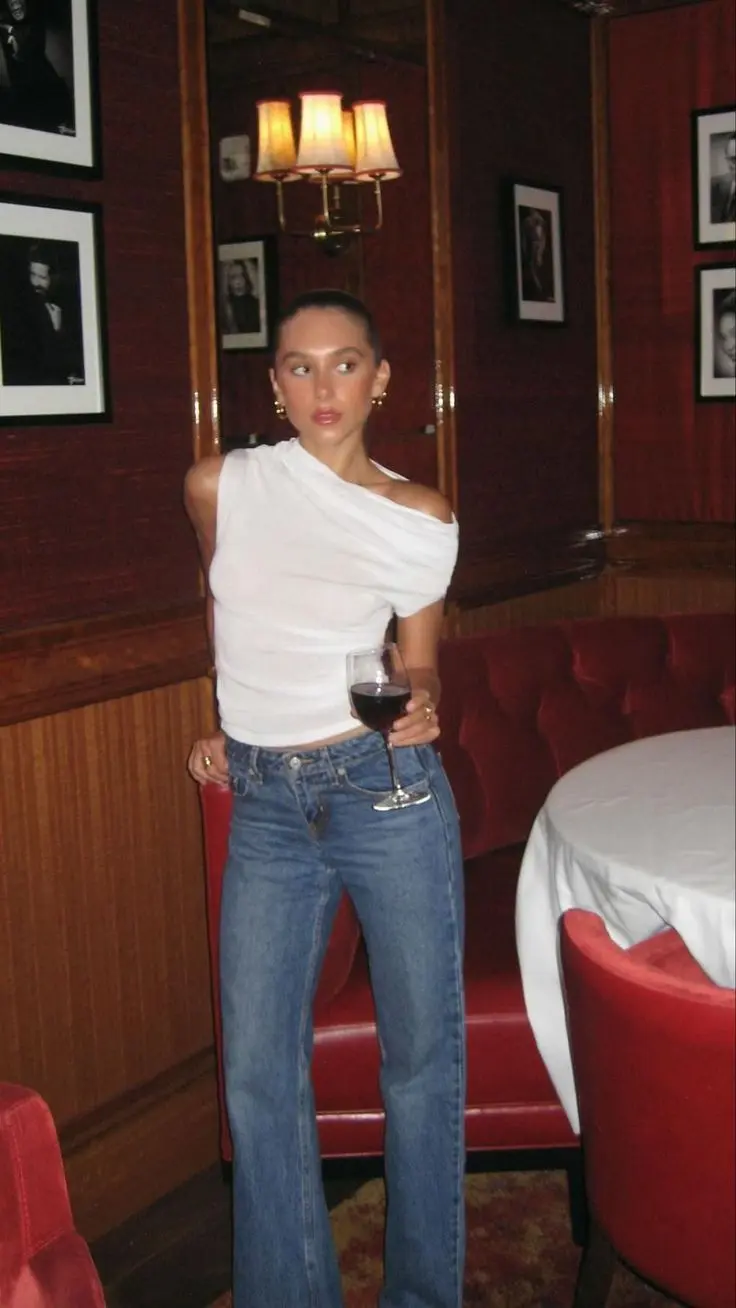
Summer dinner dressing is genuinely hard, and I don’t think we talk about that enough. You’re coming from a hot afternoon, possibly slightly damp, and you need to walk into a restaurant looking like you put thought into this — without wearing anything that will make you miserable by the second course.
The outfits I kept returning to while building this roundup share one quality: they look considered without looking effortful. That’s not the same as looking casual. It’s more specific than that. There’s a version of relaxed dressing that reads as not trying, and there’s a version that reads as completely intentional. The difference is usually one or two decisions — a belt, a necklace, the way a bag is carried.
Fabric is everything in July. Linen, satin, silk, ribbed jersey — these move through heat without fighting it. The minute you introduce structured suiting fabric or heavy ponte knit, the outfit stops working regardless of how good it looks. I kept coming back to that as a filter: if I’d hate wearing this at a terrace table in the sun, it doesn’t qualify.
Thirteen looks below, ranging from actual jeans to a black lace-detailed halter dress. I’ve tried to explain not just what the outfit is but why it works — because the pieces themselves are rarely the interesting part. It’s the logic underneath them that you can actually take somewhere.
Black Ribbed Bodysuit and Linen Trousers: The Illusion of Effort
Black ribbed tank bodysuit, black wide-leg linen trousers, flat black sandals — this is an outfit that lives or dies by its accessories, and the styling here gets it exactly right. A white cashmere scarf is draped loosely at the waist, not knotted but genuinely draped, and a long dark pendant necklace and black silk headband complete the picture.
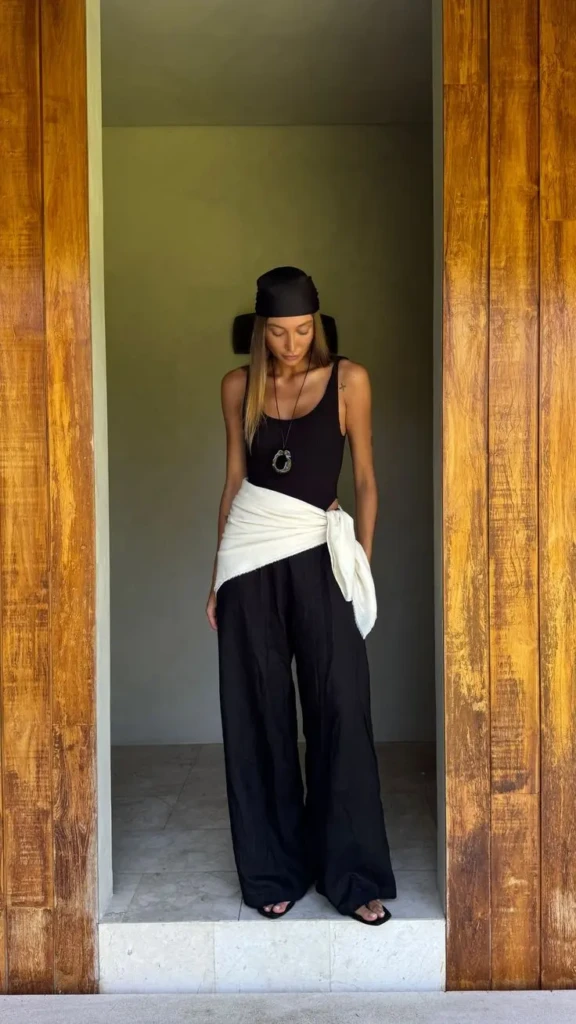
Nothing in this look is an evening fabric, which is the whole point. It reads as dinner because every single element has been chosen deliberately — the scarf placement, the pendant length, the headband. Strip out any one of those decisions and you’re back at resort day.
This is the outfit to reach for when you’ve been traveling and your wardrobe is limited. The individual pieces are all workhorses. What changes register is the intention you layer over them, not the pieces themselves.
White Crop Tank and Column Skirt with a Studded Hip Belt
White ribbed crop tank, black floor-grazing column skirt, small black shoulder bag. On its own this combination is clean but vague — it needs direction. The studded silver belt worn low on the hip rather than at the natural waist is what provides it, borrowing from 90s downtown aesthetic and depositing that energy into an otherwise minimal silhouette.
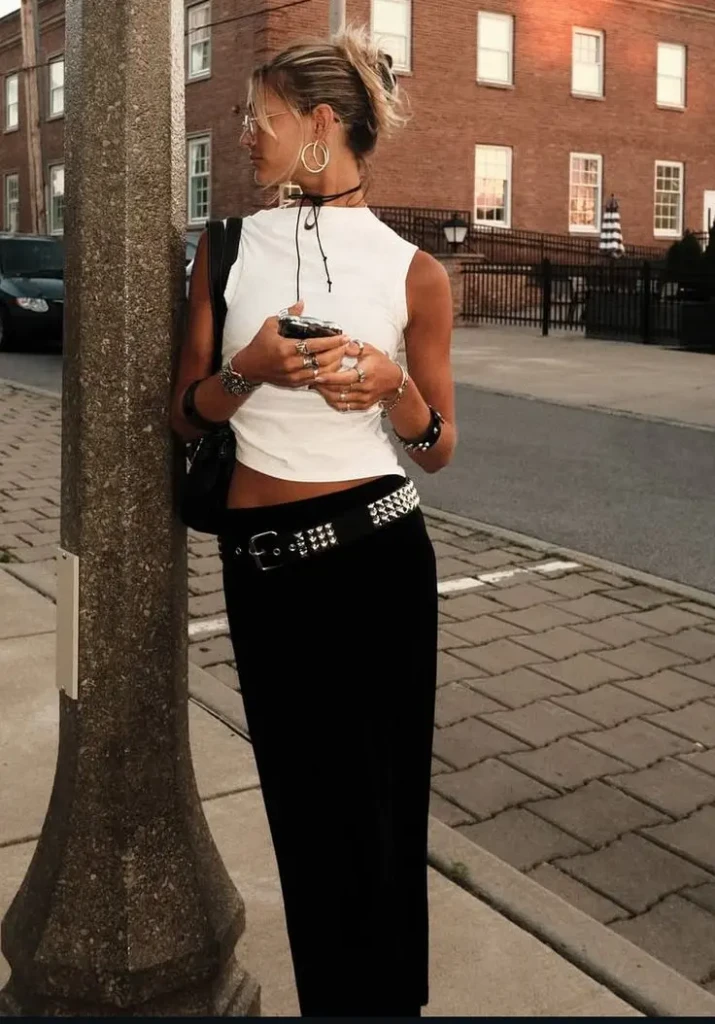
The belt trick only works with restraint. One strong piece, everything else deliberately quiet. Gold hoops, a thin choker, rings stacked across both hands — those are the right level of additional detail. Anything bolder and the belt stops being the point.
Hair matters here more than it usually does. A sleek blowout or a polished updo would cancel the specific energy the belt is creating. A messy updo — actually messy, not styled into the appearance of mess — keeps the attitude intact.
One-Shoulder Asymmetric Top and Cream Satin Wide-Leg Trousers
Black one-shoulder asymmetric longline top over cream satin wide-leg trousers, the hem cut on a diagonal that falls sharply at one hip and opens on the other. The only accessories are a thick silver cuff and a small silver bean-shaped clutch — nothing extraneous. For more on how black and ivory function together across different formality levels, the 60 black and white outfit ideas post is worth reading before you build this outfit.
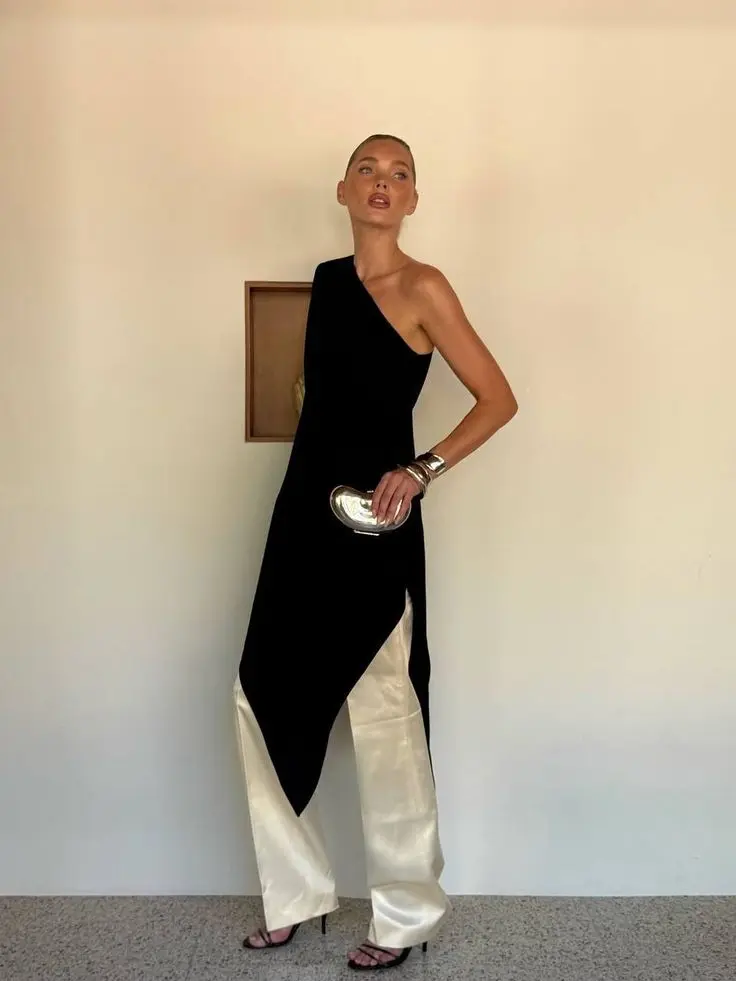
The asymmetric hem looks editorial on a hanger and completely reasonable in a real space, which surprised me. What it does is create movement in a color combination that would otherwise sit completely still. Two static pieces, one diagonal, and suddenly there’s visual tension.
The slight mismatch between the black and the ivory — they’re different temperatures, not a matched set — is what prevents this from reading as a basic monochrome look. That small imprecision is doing a lot of sophisticated work.
Dark Burgundy Leather Fringe Vest Over Cream Satin Trousers
Dark burgundy leather vest with long, close-set fringe at the hem, worn over cream satin wide-leg trousers. The fringe strands are controlled and structured — nothing shaggy or bohemian about this version — and they reach past the waist, creating movement without chaos. The leather is clean and fitted, which is entirely what separates this from the 1970s costume read.
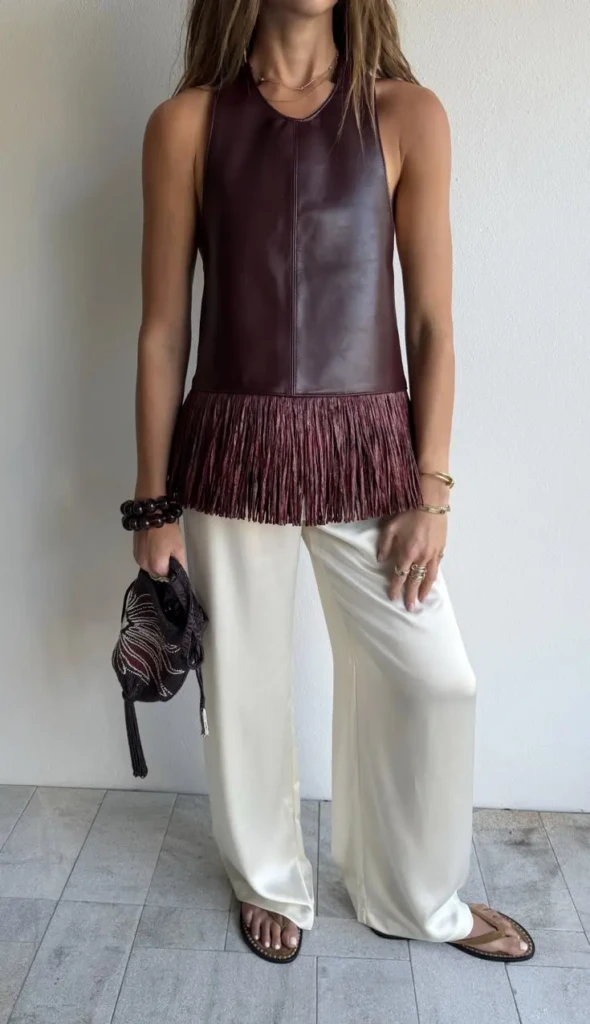
The cream satin trousers are carrying a specific responsibility here: they need to stay completely quiet so the vest reads properly. White linen or cotton would flatten the combination. Satin only, for this pairing — the finish creates the contrast that makes the burgundy sit correctly.
This is an outfit with a strong enough point of view that it doesn’t need any additional styling work. The top creates its own visual interest. Let it.
Black Sleeveless Midi Dress Worn with an Oversized Cream Quilted Tote
Black sleeveless midi dress — bateau neck, fitted bodice, A-line skirt — with cream flat pointed-toe mules and a very large cream quilted leather tote carried under the arm like a stack of folders rather than like a bag. Silver bangles, loose vintage waves. The black cocktail dress guide covers this silhouette in depth; the principle of updating a classic with one out-of-proportion element works across most of the options there.
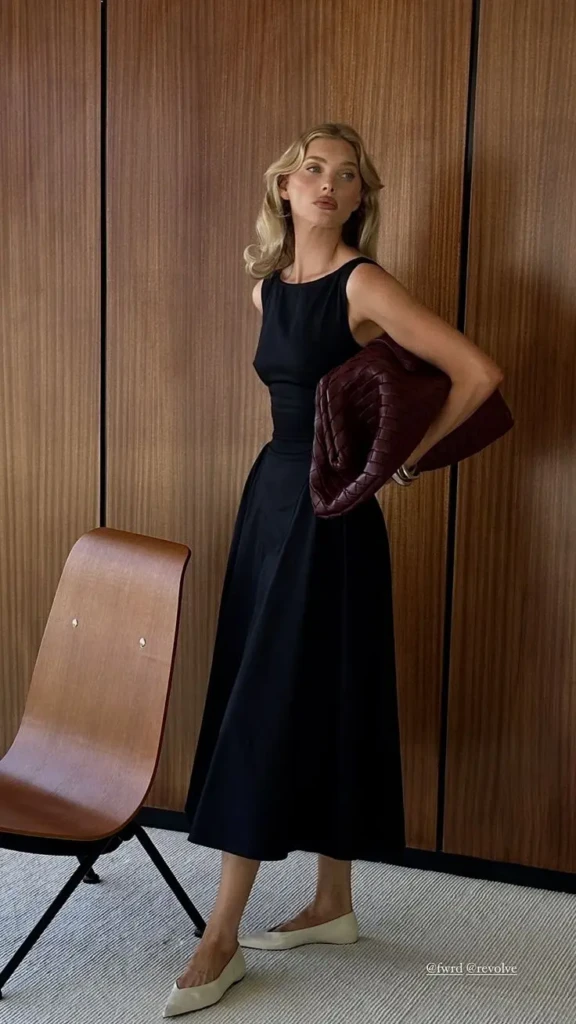
My first instinct was that this was too familiar to be interesting. I’ve seen some version of this dress for fifteen years. But the bag changes everything — it’s deliberately wrong-scaled in a context where everything else is traditional, and that one unexpected choice is what makes the whole look feel current.
The hair is doing something specific too. Loose vintage waves against a clean bateau neckline and a classic silhouette reads as effortless in a way that a sleek style wouldn’t. It softens what could otherwise feel like a uniform.
Chocolate Brown Halter Top and Cream Polka Dot Wide-Leg Trousers
Dark chocolate brown ribbed halter top with chocolate brown wide-leg trousers in a cream-on-brown polka dot — the reverse of the expected colorway, which changes everything about how the pattern reads. Technically monochromatic, but the dot pattern means the look never flattens out.
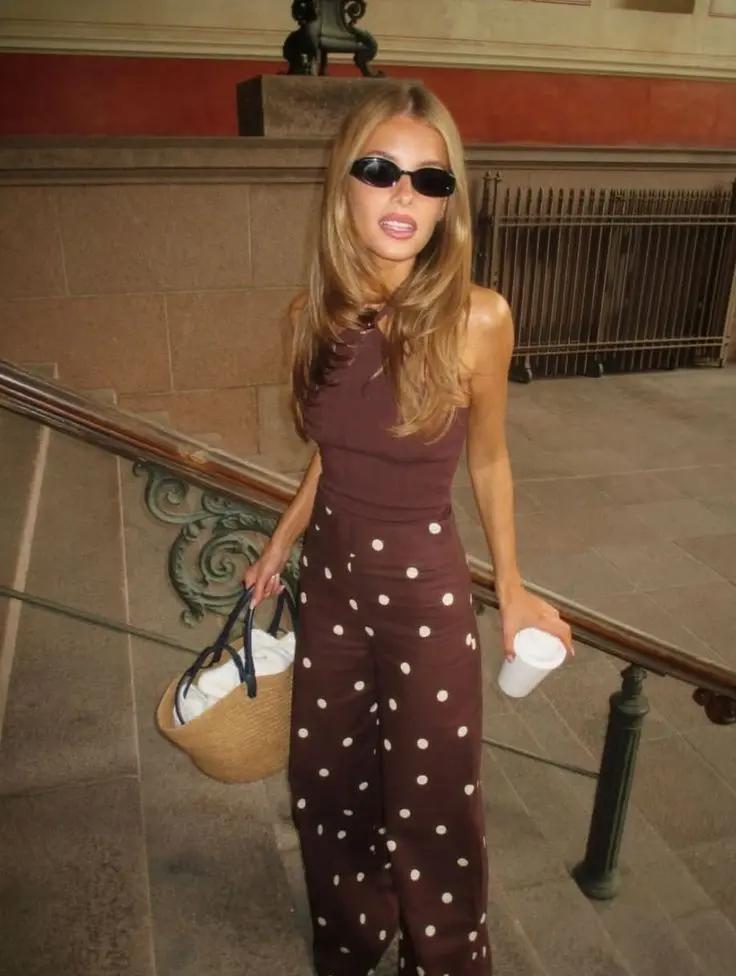
The proportions are doing specific work here. A fitted halter against wide, floor-grazing trousers creates a defined waist and a dramatic length, and that combination reads as dinner regardless of what the fabric actually is. Proportion signals occasion as strongly as material does.
“Brown halter and brown polka dot pants” sounds like nothing on paper. In person — and in photographs — it reads as textured and rich rather than patterned. This is one of those outfits you have to see to understand, which is also an argument for just trusting it.
Draped One-Shoulder White Crop Top with Medium-Wash Wide-Leg Jeans
White one-shoulder ruched crop top — gathered fabric, sculptural torso, one bare shoulder — with medium-wash low-rise wide-leg jeans. The restaurant in the photo has red leather booths and dark wood paneling. She’s holding a wine glass. The whole thing reads as genuinely appropriate.
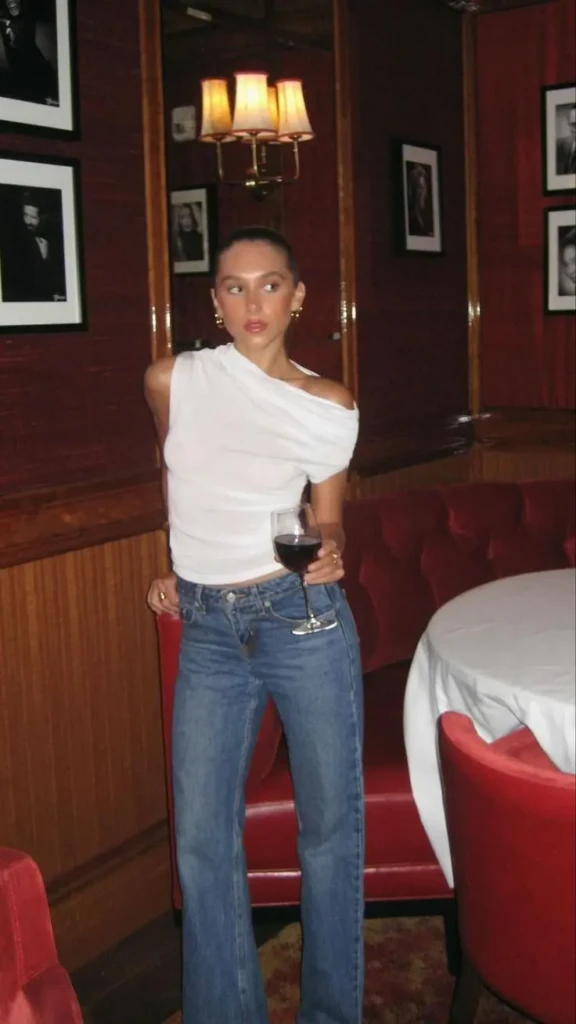
Jeans at dinner works specifically because of the top. The jeans need to be clean and the silhouette needs to feel intentional — wide-leg here, pressed enough to read as a choice — but the top is doing the heavy lifting for both pieces. A regular tee would lose it. This draped one-shoulder carries the evening register for the whole outfit.
Gold hoops, stacked rings and bracelets, hair in a sleek knot. The accessories are present but not loud. That restraint is right — the top is already doing something interesting with its shape, and the jewelry’s job is to support without competing.
Black Strapless Bandeau Top, White Palazzo Trousers, and a Large Gold Medallion Necklace
Black strapless bandeau top, white wide-leg palazzo linen trousers, large gold medallion necklace with individual coins easily 3-4cm across, gold woven pouch clutch, gold bracelets. Hotel mirror selfie, marble floors. The look is shot somewhere clearly nice.
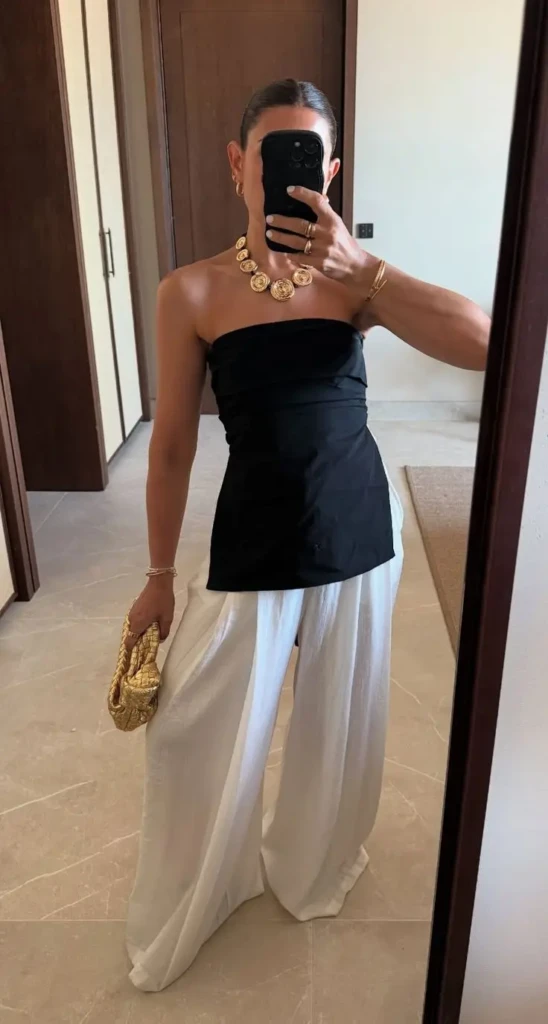
That medallion necklace is the kind of piece I usually talk myself out of at the shop. Too much, I always think. But this is the context where it’s correct: the outfit underneath is as simple as an outfit can be — graphic black and white contrast, nothing else — and the necklace becomes the entire personality of the look.
This is the version of “the jewelry is the outfit” that actually works, as opposed to the version that reads as compensation for an underplanned look. The difference is whether the base is genuinely simple or just lacking. Black bandeau and white palazzo are genuinely simple. The necklace has somewhere to land.
Polka Dot Halter Crop Top, Black Wide-Leg Flare Jeans, and a Leather Hobo Bag
Brown and cream polka dot halter crop top with the back exposed, worn with black wide-leg flare jeans and a dark chocolate leather hobo bag. Gold cuff, large gold hoops. Street photo against old stone — more urban and directional than the earlier polka dot look, less soft. I think about the classy elegant outfit guide principle here: that rich, deep tones create sophistication regardless of pattern, which is exactly what both polka dot outfits are doing.
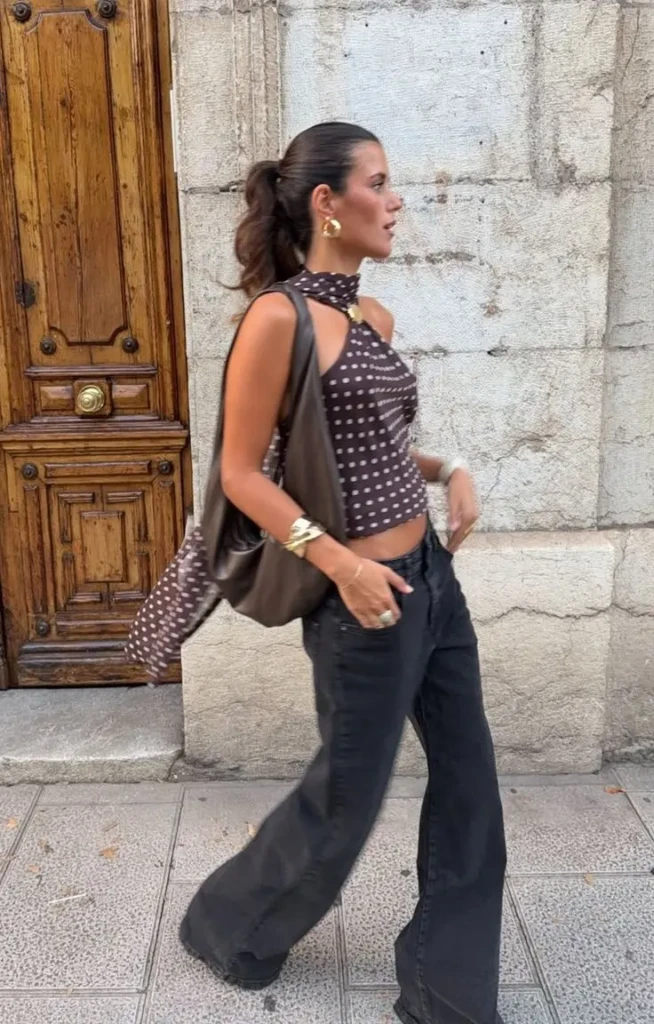
Smaller dot scale, different proportion between top and bottom, flare jeans instead of trousers — and the whole read shifts. Same pattern, completely different character. The polka dot isn’t the identity of either outfit; it’s more like a texture that happens to have a shape.
What I’d emphasize here is how much the bag grounds the look. A light-colored bag would push this outfit further casual. The dark chocolate leather hobo keeps the overall palette anchored and the whole thing reading as intentional rather than thrown together.
Black Halter Midi Dress with Lace Trim at the Neckline, Waist, and Hem
Black halter-neck midi dress with lace trim at the neckline, waist, and hem — the lace sections semi-sheer, creating visual interruptions in the solid black without introducing color. Black strappy heeled sandals. A small structured black top-handle bag. Gold clip earrings, one thin bracelet.
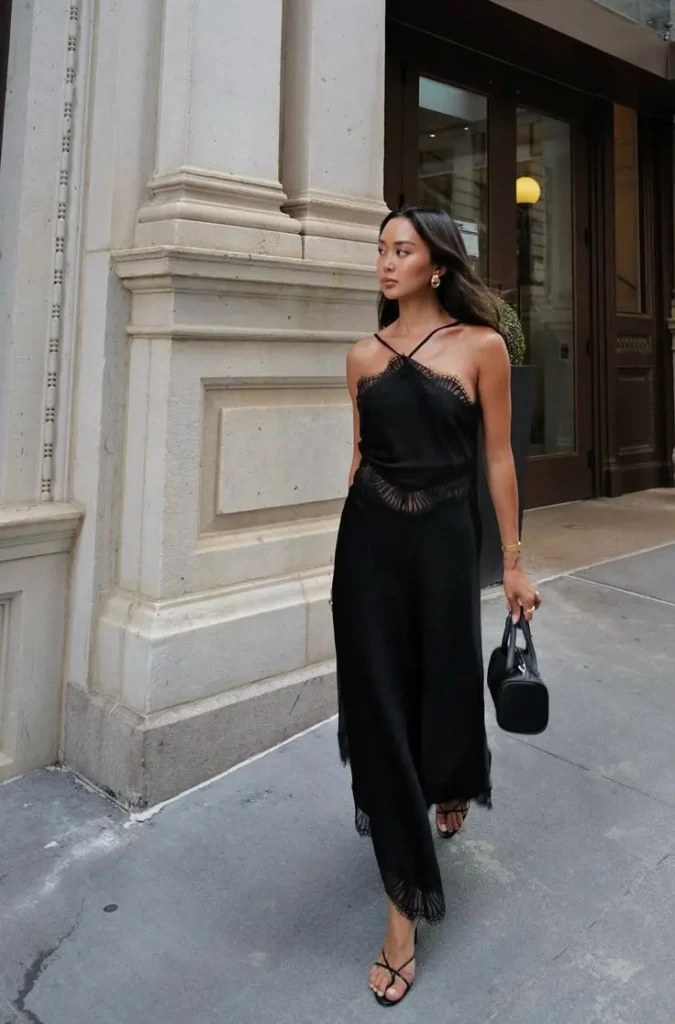
This is the most conventionally dinner-appropriate outfit in the collection, and the lace trim is what keeps it from being merely conventional. Without the lace it’s a solid black halter midi — fine, but not interesting. With it, there’s a specific character: something between 1930s Hollywood and current luxury minimalism.
The jewelry restraint here is the correct call, not the default one. One thin bracelet and clip earrings when the dress already has this much going on at the neckline, waist, and hem. Any more and you’d be fighting the dress rather than wearing it.
Oxblood Floor-Length Vest Worn Open Over Cream Linen Trousers, Belted
Dark oxblood sleeveless turtleneck vest — floor-length, with a slit, worn open — over cream wide-leg linen trousers, a thin leather belt cinching everything at the natural waist. Small natural raffia clutch. Ivory wide bangle. For elevated summer pieces that support this kind of layered styling, the luxury summer capsule covers the investment end of the category.
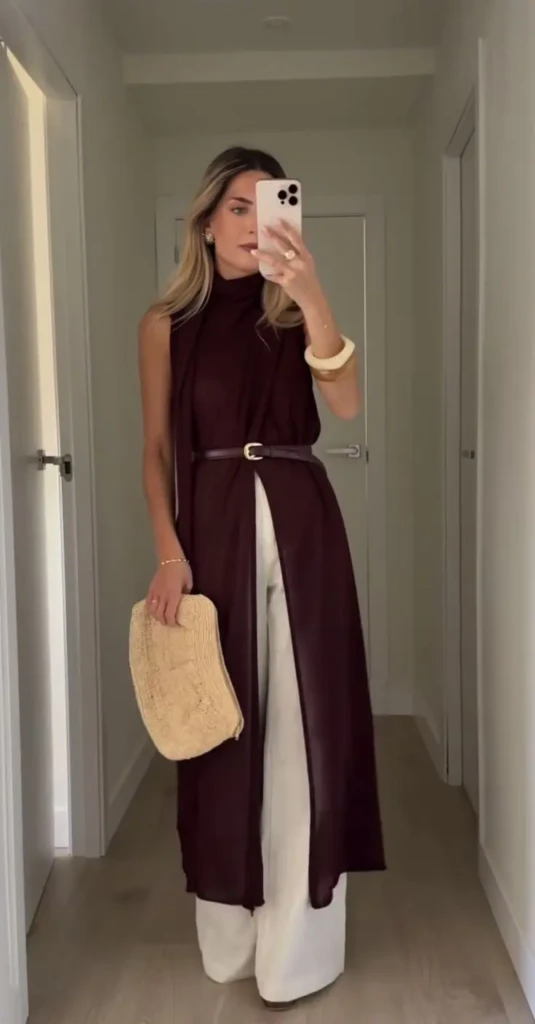
My first reaction was confusion. A floor-length vest worn open and belted over trousers — why not just wear the trousers with a regular top? And then the color logic clicked. That specific dark burgundy-to-black depth against the cream linen, with cream showing at the sides as the vest falls open, creates a layering effect that neither piece achieves alone.
The raffia clutch is the only summer signal in what is otherwise a serious, almost architectural palette. It’s doing exactly the right amount of work — one seasonal note, nothing else needed. If you swapped it for a leather clutch the outfit would feel slightly airless.
Khaki Strapless Peplum Top with White Bermuda Shorts and Kitten Heel Slingbacks
Khaki-olive structured strapless peplum top — pleated panels, a defined waist, construction that holds its shape without a body inside it — with white Bermuda shorts cut to mid-thigh with a pressed crease. White pointed-toe kitten heel slingbacks. Small black structured bag. Gold chain choker.
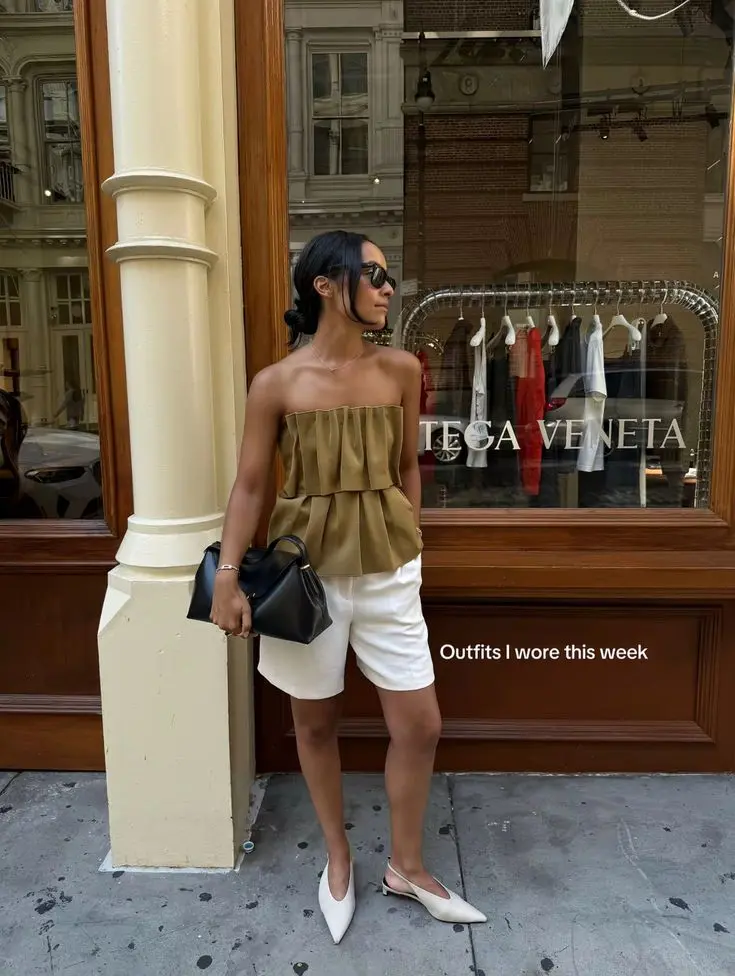
This is the shortest silhouette in the collection and the most casual-adjacent, and it earns the dinner context specifically because of the peplum top. The construction removes the look from the category of “shorts outfit” entirely. The Bermuda length matters just as much — anything shorter and the proportion shifts, and not in the right direction.
The kitten heel is not a generic choice here. A flat would lose the formality that justifies this at a dinner table. A block heel would compete with the architectural quality of the peplum. Five centimeters, pointed toe, slingback strap. That specific shoe at that specific height is what the outfit needs.
Polka Dot One-Shoulder Wrap Top and Wide-Leg Jeans at an Outdoor Café
Black one-shoulder polka dot wrap top with a tie waist, medium-wash wide-leg jeans, white kitten heel mules, black quilted bag. Outdoor café table, glass of white wine, the Eiffel Tower in the background. She’s laughing. The photo wasn’t taken to showcase the outfit.
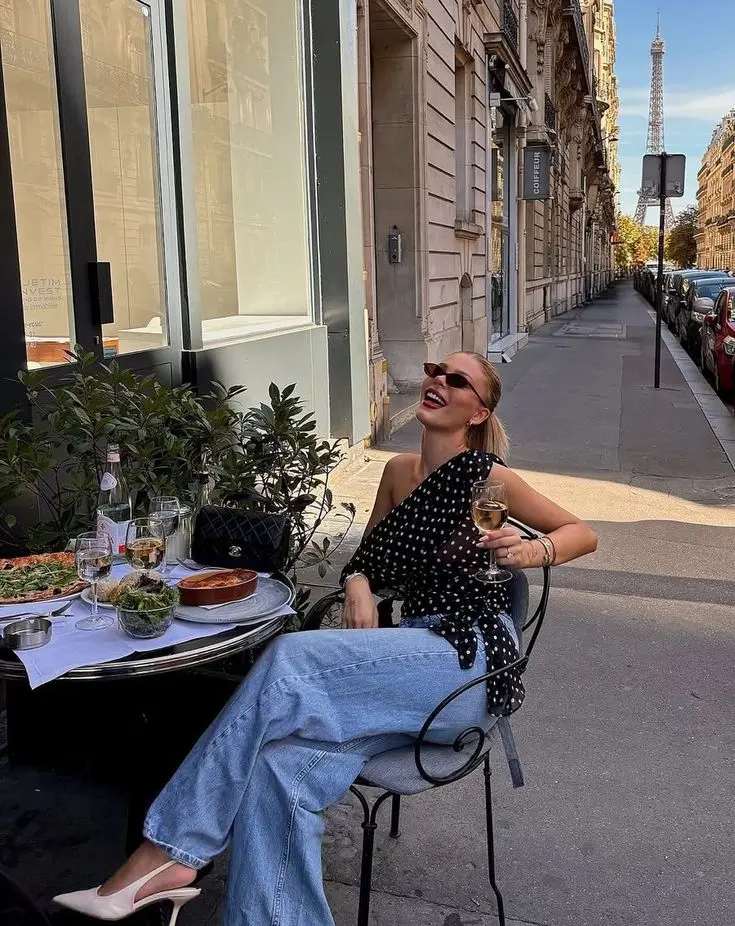
I saved this one for last because it’s the least optimized look in the collection and the most instructive for that reason. The top is a pattern we’ve seen, the jeans a silhouette discussed earlier, the shoes and bag both classics. Nothing here is surprising. And it’s completely right.
The actual conclusion I keep landing on after going through all thirteen of these: the summer dinner outfit that works best is the one where you arrive at the table not thinking about what you’re wearing. When the clothes are doing their job, you stop adjusting and you’re just present. That’s what good gets you — not a stunning outfit, just one that disappears in the best possible way.
What I Actually Learned From All of This
Going through a hundred saved images and keeping thirteen: a few things I didn’t expect to conclude.
The temperature rule matters more than the formality rule. A dress that reads as “evening” but traps heat will ruin the dinner. Wide-leg linen trousers and a deliberate top will not.
One strong accessory does more than several medium ones. The studded belt. The gold medallion necklace. The asymmetric hem. Pick one thing to make the case and let everything else support it.
The shoe determines the register more than the top or dress. You can take almost any of these outfits and shift their evening-appropriateness up or down two full levels by changing the shoe. The pointed kitten heel is the most reliable signal for “dinner” in warm weather. Strappy heeled sandals signal “evening.” Clean flat sandals signal “dinner only if everything else is very precise.”
Linen, silk, satin, and structured cotton are the summer dinner fabrics. Everything else is negotiating against the heat.
FAQ
What should a woman wear to dinner in summer?
Breathable fabric with a silhouette that reads as intentional is the starting point — wide-leg linen or satin trousers with a structured or draped top, a clean midi dress in black or another deep tone, or a simple monochrome look anchored by one strong accessory. The shoe matters more than most people realize: a kitten heel or strappy sandal signals dinner in a way that a flat sandal rarely does, even when the rest of the outfit is identical.
Can you wear jeans to a summer dinner?
Yes, but the top has to carry the evening register for both pieces. A draped one-shoulder, a ruched crop, or a structured bustier will pull wide-leg or straight-cut clean jeans up to dinner level. This works better at bistro-style or casual restaurants than in formal dining rooms, and the jeans need to be clean and the silhouette wide enough to feel chosen rather than default.
What colours work best for summer dinner outfits?
Black and dark chocolate brown are the strongest options — both read as evening without requiring heavy fabric, both photograph well, and both work across a wide range of accessories and shoe colors. Cream and ivory work well in minimal combinations as a contrast. The pairings that appear most consistently: black with cream or ivory, deep burgundy with cream, and dark chocolate brown worn monochromatically.
How do you dress up for dinner when it’s hot?
Choose fabric over structure — silk halter dresses, satin wide-leg trousers, and linen column skirts read as dressed up without trapping heat. Use jewelry to signal occasion rather than adding clothing layers; one substantial piece elevates a simple outfit significantly. Keep silhouettes either very fitted or very fluid, because the middle ground of structured-but-breathable is where summer dinner dressing tends to fail.
Is a black dress always safe for a summer dinner?
It’s reliable rather than safe, and the distinction matters. A black sleeveless midi or halter dress works across almost every dinner context, but it needs one element that makes it specific to you — a deliberately oversized bag, a strong piece of jewelry, an unexpected shoe. Without that, it reads as a uniform rather than an outfit.
How do you make a simple crop top and trousers look like a dinner outfit?
The trousers need to be floor-grazing and the fabric needs to earn it — satin or linen rather than cotton jersey. Then one accessory has to signal the register: a chunky cuff, a long pendant necklace, or a metallic clutch. The shoe closes the argument; a heeled sandal or kitten mule does work that no flat can replicate here.
What bags work for summer dinner outfits?
Small structured bags and slim clutches in black, gold, cream, or dark chocolate leather are the most versatile. A woven or raffia clutch adds a summer-specific note without casualizing the look. Avoid large canvas totes at dinner even if they’re technically luxe — the silhouette reads as daytime regardless of the brand.
Can you wear polka dots to a summer dinner?
Yes, when the colorway works against you — dark ground with a lighter dot rather than white ground with a colored dot, which reads as more casual. Both polka dot looks in this roundup use cream-on-brown or brown-on-cream, which means the pattern reads as texture and richness rather than decoration. Proportion matters too: fitted top against wide trousers keeps the silhouette dinner-appropriate regardless of the print.
What jewelry works best for summer dinner outfits?
One substantial piece — a large medallion necklace, a thick cuff, or oversized hoop earrings — does more than several modest pieces combined. In summer especially, where the goal is to look put-together without wearing much fabric, jewelry carries the formality signal that layers would provide in cooler months. Gold reads warmer and more relaxed; silver reads cooler and sharper. Match the metal temperature to the palette of the outfit.
Have any thoughts?
Share your reaction or leave a quick response — we’d love to hear what you think!
-
 0
0 -
 0
0 -
 0
0 -
 0
0 -
 0
0 -
 0
0