

 Lena
Lena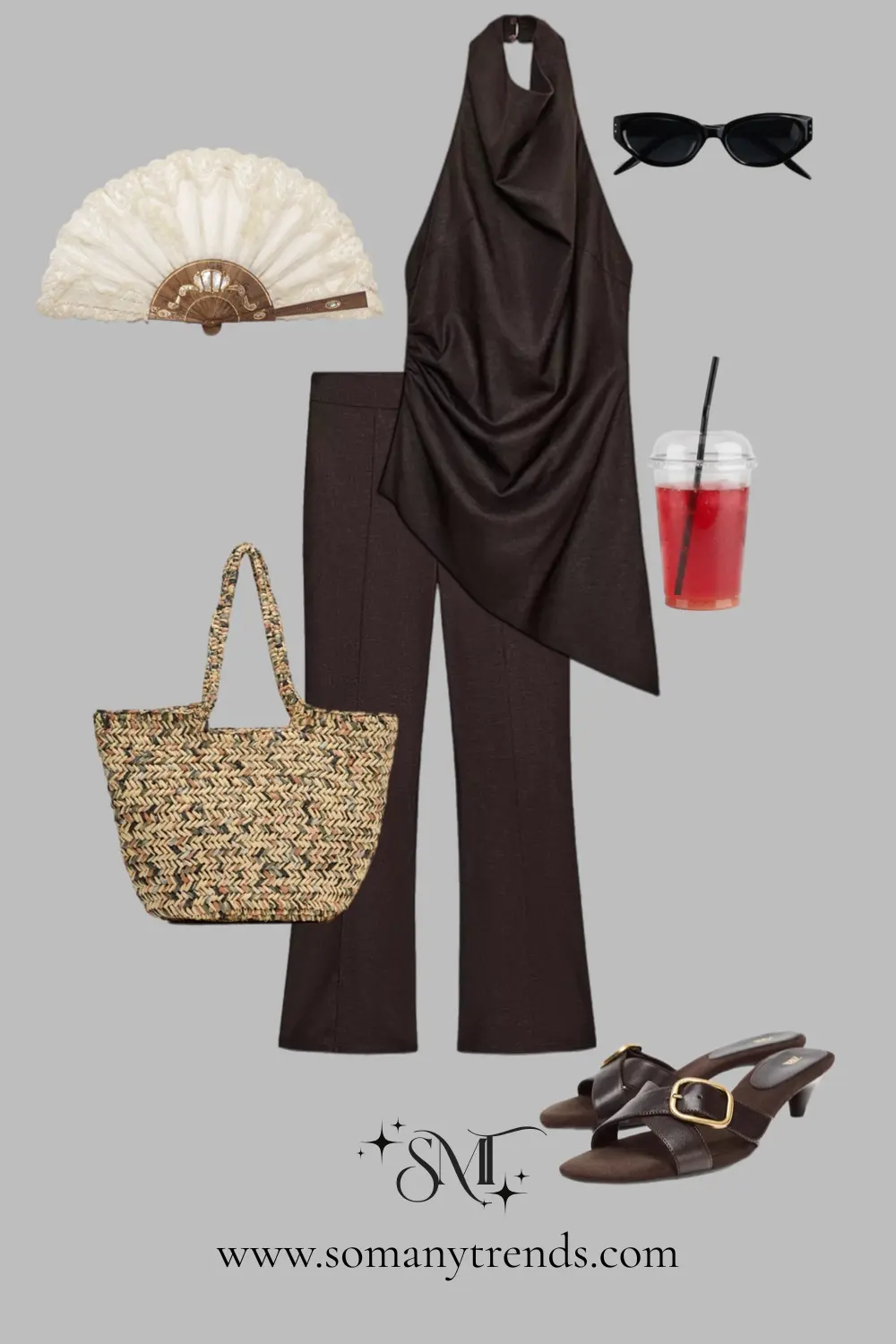
Italian summer dressing has one rule that actually matters: you should look like you spent zero time thinking about it, which means you spent the right amount of time thinking about it. The palette runs warm — burnt terracotta, dusty mauve, espresso brown, bleached cream — and the silhouettes are either very fluid or very precise, never awkward in between. There’s almost no embellishment. The details that exist are deliberate: a single coin sandal, a woven leather bag, a lace hem that catches the light.
The heat is a real constraint, not an aesthetic choice. July in Rome or the Amalfi Coast means temperatures above 30°C for most of the day, uneven stone underfoot, and the near-constant calculation of how much fabric you can reasonably wear before regretting it. Linen and cotton do the work. Structured cuts give you the polish. The accessories — and there are never more than two at once — carry the personality.
What I kept noticing while putting this roundup together is how consistent the formula actually is across very different looks. Dark top, light bottom. Fluid dress, structured bag. Natural fiber, one metal moment. The specific pieces change but the logic doesn’t, and once you see it you can apply it to almost anything already in your wardrobe. These 17 outfits are useful precisely because they show the same principles working across different colors, occasions, and body temperatures.
A note on accessories before we get into it: the Italian summer aesthetic almost never mixes more than two materials at once. Straw paired with leather, or raffia paired with metal — not all three at the same time. That restraint is exactly what separates a look that reads as effortlessly Italian from one that reads as heavily assembled. I started applying that single edit to my own wardrobe and immediately understood why certain combinations clicked and others didn’t.
This post contains affiliate links. If you buy something through these links, I may earn a small commission at no extra cost to you. I only recommend pieces I’d actually wear.
What Makes This Different From Just “Summer Style”
The Red Slip Maxi With Gold Earrings and a Wicker Tote
A saturated coral-red slip dress in a maxi length creates immediate visual impact without any layering — the color does all the work before you’ve added a single thing. The flip flops are a deliberate choice here, not a lazy one; heel height would formalize this in a direction that’s not the point, and the entire logic of the outfit is ‘I look like this effortlessly,’ which requires more editing than wearing more things.
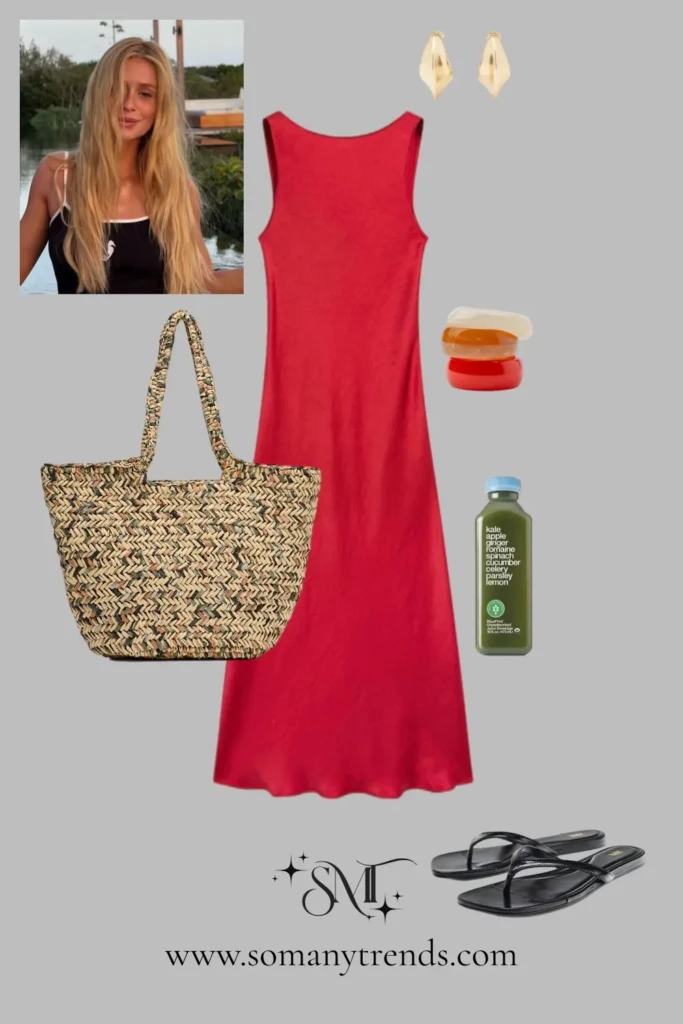
The tote’s woven texture is what prevents this from reading as beachwear. Opt for a structured wicker shape rather than a floppy canvas tote — the proportion matters against a fluid maxi length, and a rigid silhouette gives the outfit its backbone. A sculptural gold earring is the only other addition you need; anything more and the edit starts to unravel.
This dress earns its place in a packing list because it works from morning market to evening passeggiata without a single swap. The key is the depth of the red — a coral-adjacent saturated tone reads warmer and more wearable than a true fire-engine red, which would be harder to accessorize and harsher in direct sun. Deep coral against sun-warmed skin in Mediterranean light is genuinely one of the best color combinations available.
Cornflower Blue and Sand Linen Separates With Brown Sandals
Cornflower blue functions as a near-neutral when placed next to sand — the two tones share enough warmth to avoid actual contrast, so what looks on paper like a blue-and-sand pairing reads in real life as a single cohesive column of muted color. Who What Wear’s May 2026 piece on linen trends dominating this summer specifically flags this palette as one of the season’s most wearable directions, and they’re right. Brown sandals and a matching wicker tote pull the earthy undertone through the accessories and that’s exactly when it clicks.
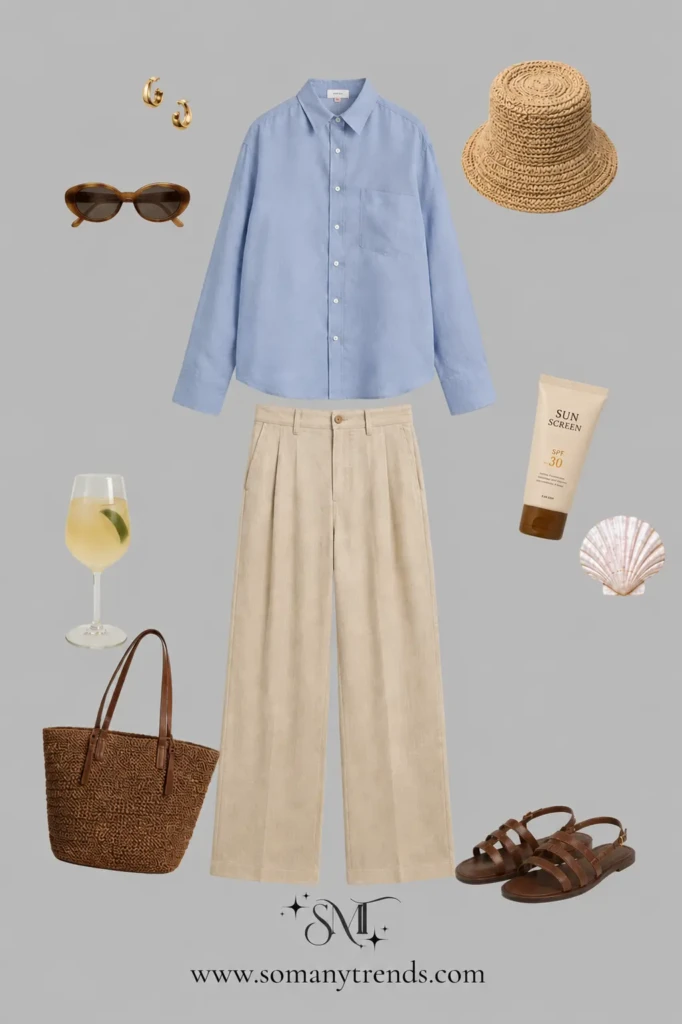
linen separates do this best: the wrinkle becomes part of the texture story rather than something to fight, and that’s possibly the most useful mindset shift for anyone packing linen. If you’re trying to keep linen smooth you’ve already lost — the lived-in drape is the point, not a failure state. Roll your pieces rather than folding flat and shake them out when you arrive; the creases that remain are the right ones.
Proportion is specific here: wide-leg linen trousers work best hitting at the ankle, around 28 inches inseam for someone 5’5″. Too long and the fabric bunches at the shoe; too short and you lose the column effect that makes the silhouette read as intentional. The cornflower blue shirt tucked loosely keeps the waistline readable without requiring a belt, which would introduce a third material into what’s already a precise two-piece edit.
Mauve Linen Vest and Bermuda Shorts Co-ord With Kitten Mule
A tonal co-ord in dusty rose is one of those combinations that photographs beautifully and actually works in real heat — the bermuda-length shorts allow airflow while the structured vest reads as intentional dressing rather than an afterthought. Italian Fashion Sourcing’s SS2026 trend report noted that linen bermuda shorts with a structured vest are among the strongest co-ord formats coming out of Italian ready-to-wear this season, and this mauve linen version demonstrates exactly why: the matching fabric reads as a considered choice rather than a casual set.
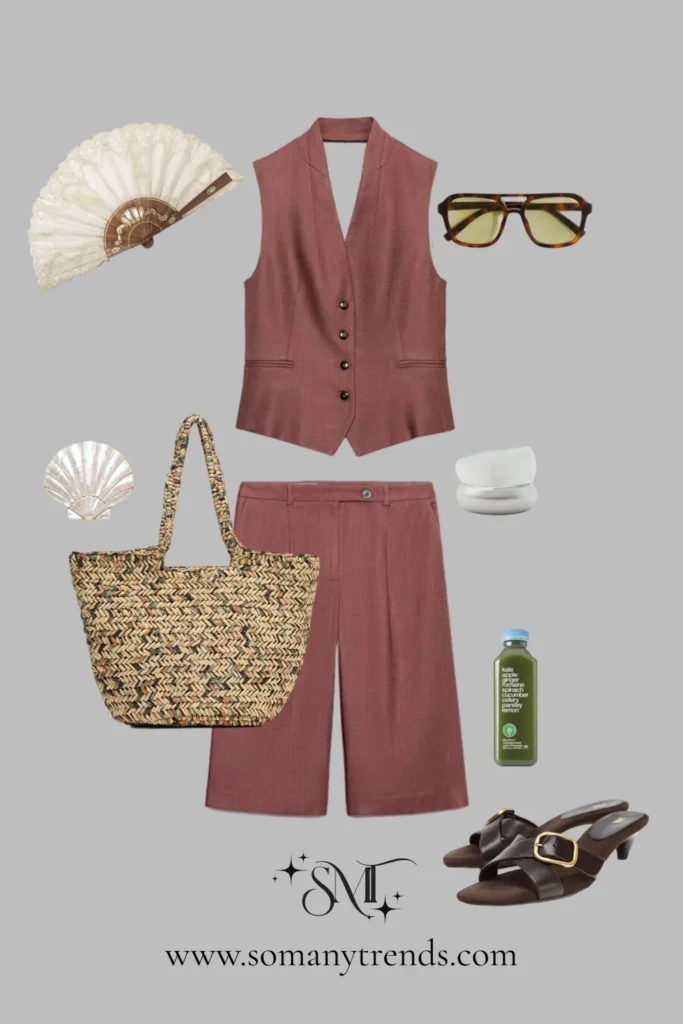
The kitten heel mule is doing specific work in terms of both proportion and practicality. At 1.5–2 inches, it extends the leg line at a height that handles uneven stone without drama — which is a real consideration when you’re navigating centuries-old streets. The kitten heel silhouette also keeps this looking polished rather than resort-casual, which matters when the shorts are bermuda-length rather than a true mini.
Dusty rose and mauve in linen have a quality that flat photography slightly undersells: in actual sunlight, against warm stone and terracotta walls, the tone picks up a peachy warmth that makes the whole outfit glow. It’s a shade that earns its keep outdoors. Pair with tortoiseshell sunglasses rather than black frames — the warm brown undertone in tortoise aligns with the mauve better than anything cooler.
Head-to-Toe Espresso Brown Halter and Flare for Aperitivo
Head-to-toe espresso brown sounds like it shouldn’t work in July — and I genuinely didn’t expect it to — but the draped asymmetrical halter introduces enough movement and visual softness to prevent the monochrome from feeling heavy. The slight flare of the trousers adds a 70s ease that reads specifically Italian coastal, and the overall effect is exactly right for an outdoor aperitivo: polished enough for a restaurant, relaxed enough that you’re not overdressed. For anyone building a beach vacation wardrobe that looks expensive, one tonal dark look goes considerably further than three printed ones.
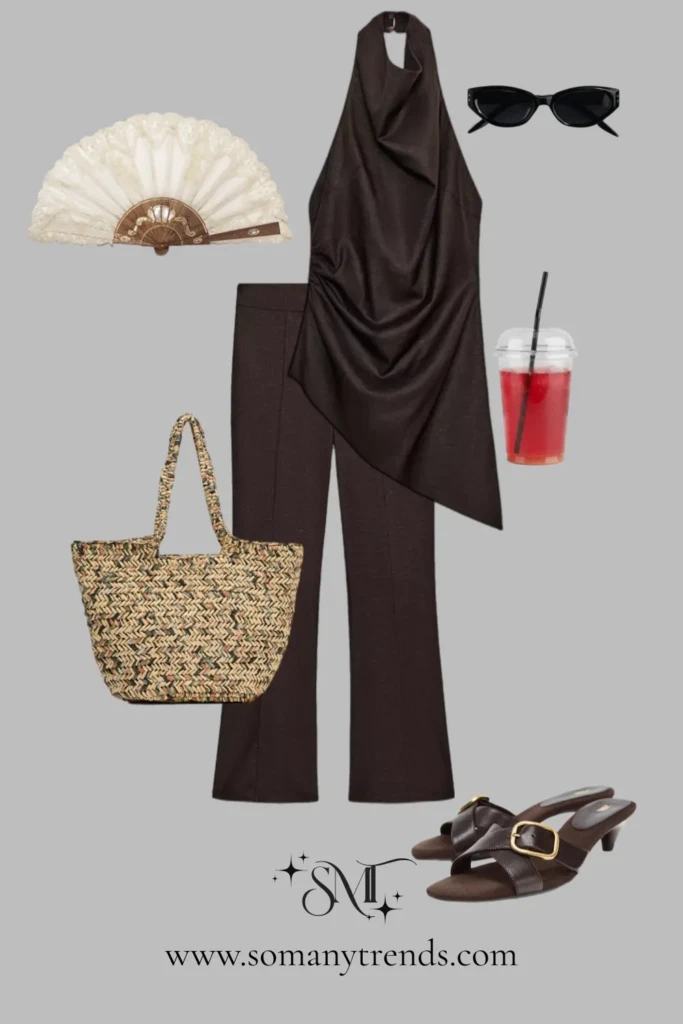
Fabric choice is not optional for this silhouette. The trousers need structure — avoid jersey entirely, because jersey won’t hold the flare and the whole proportion collapses. Crepe or lightweight suiting holds the shape properly even in humidity, and it drapes cleanly from the hip rather than pulling. The investment in the right fabric is what makes this a dinner outfit rather than just brown trousers.
The asymmetrical halter neckline is worth seeking out specifically because it introduces a diagonal line across the bust that adds interest without requiring jewelry. A simple gold chain would work if you want one, but it isn’t necessary — the drape does the styling for you. Keep shoes within the brown family, either a matching mule or a nude-to-skin sandal, to maintain the tonal logic from shoulder to floor.
Chocolate Linen Shirt Over Cream Pleated Shorts: The 10-Minute Outfit
Dark-over-light color blocking — chocolate linen shirt open over cream pleated shorts — is deceptively simple and genuinely wearable for a full day of walking. The belt threading through the shorts keeps the proportion clean even with the shirt untucked, which is the small structural move that prevents this from looking like you just grabbed whatever was closest. Raffia bucket hat and straw tote add the Mediterranean texture note without any planning.
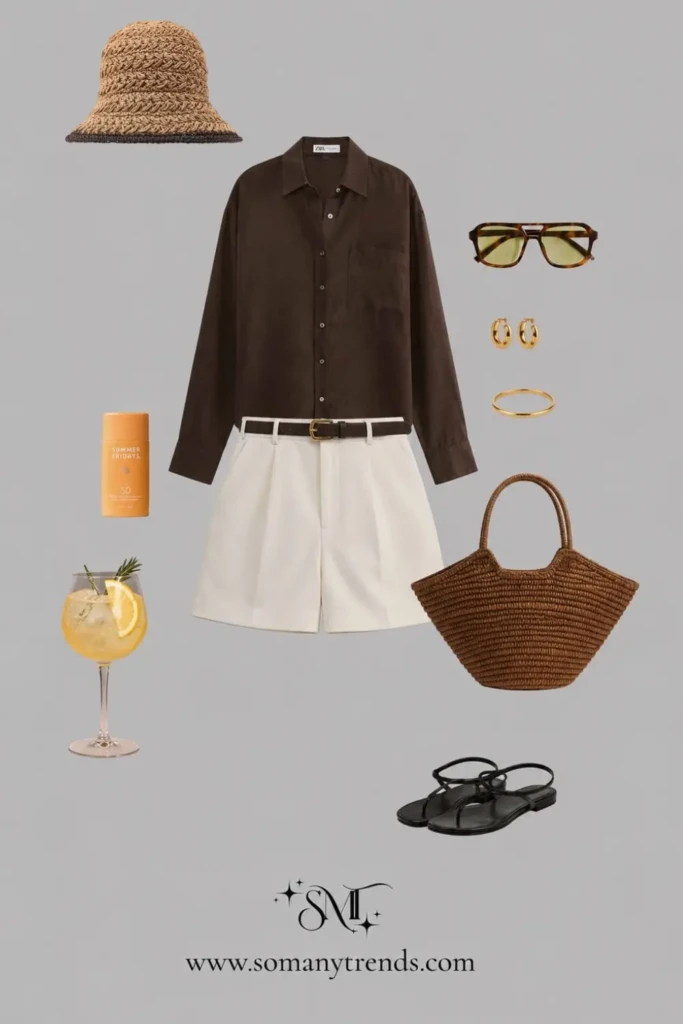
This is the kind of combination that takes ten minutes to put on and reads as curated, and those two things rarely overlap, which is exactly why it keeps appearing. The key is the linen shirt being open rather than buttoned — a buttoned dark shirt over light shorts would read as two separate pieces; open, it works as a layer that unifies the silhouette. The chest opening also solves the temperature problem, because you’re getting airflow without removing the shirt entirely.
The raffia bucket hat is functional well beyond its aesthetic contribution: in direct summer sun above 30°C, head coverage makes a genuine difference to how long you can walk comfortably. A structured raffia bucket rather than a floppy sun hat keeps the proportions in line with the rest of the outfit, which is fairly tailored through the shorts. Match the hat’s natural tone to the straw tote and the look coheres without any extra effort.
Cream Satin Wide-Legs and Black Bomber Jacket for Italian Evenings
Italian evenings drop about 8–10 degrees compared to the afternoon — that specific temperature gap where a jacket is necessary but a coat would be absurd. Cream satin wide-leg trousers reflect enough light to feel festive without requiring sequins or embellishment; the black bomber-style jacket adds warmth without destroying the silhouette. Black and cream appears in nearly every classy summer outfit roundup for good reason: the contrast is timeless without tipping into formal.
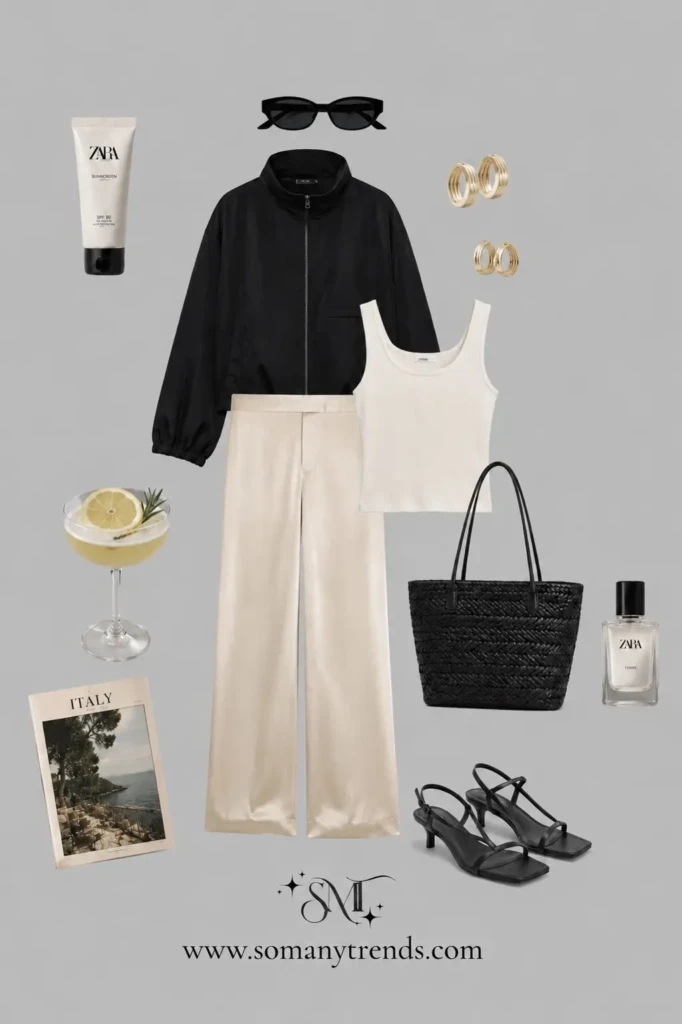
The strappy black kitten heel ties the jacket to the bottom half, creating a visual anchor at the floor that connects the two halves of the outfit without a belt. That connection point matters when you’re working with a high-contrast color combination — without it, the cream trousers and black jacket can read as two unrelated pieces rather than a deliberate outfit. The heel height keeps you mobile on cobblestones while adding just enough elevation to lengthen the trouser line.
For evenings below 22°C, a lightweight harrington jacket at around 200g fabric weight is enough. Below that temperature you’ll want something with a real lining — a thin bomber won’t cut it past midnight in shoulder-season Italy. The bomber silhouette works specifically because it ends at the hip rather than the waist, which means it doesn’t interrupt the wide-leg trouser’s long line the way a cropped jacket might.
White Poplin Shirt and Ivory Lace-Hem Shorts With Gold Heeled Sandals
The lace-trimmed hem is the one detail that saves this from reading as a basic — white-on-ivory is a tonal combination that requires the fabric to do the work, and cotton poplin against softer lace creates enough texture contrast to be interesting without trying. Gold heeled sandals at roughly 3 inches elevate this to lunch-ready without losing the ease. The styling logic looks too simple on paper, then the actual image lands and you understand it immediately.
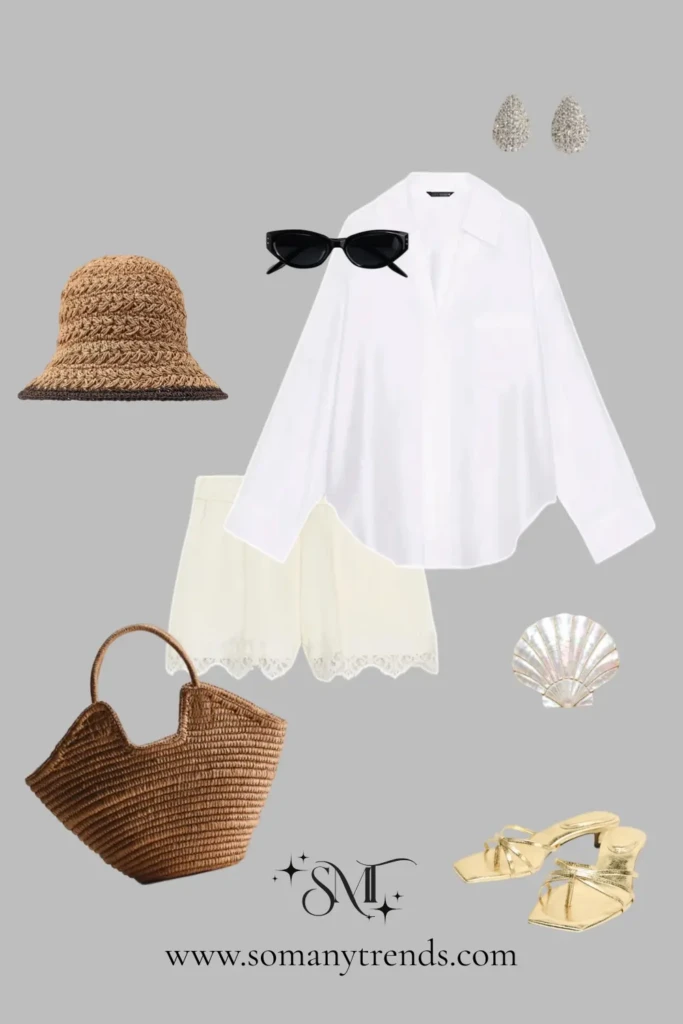
That gap between first impression and actual result is the most Italian thing about this outfit. It doesn’t announce itself. It lands. The white poplin shirt works best slightly oversized — tucked loosely at the front only, leaving the back hem out — which creates a soft drape at the waist without needing a belt. The lace hem should be visible below the shirt hem, so a true half-tuck keeps that detail accessible.
Gold heeled sandals at this height are doing proportional work: they elongate the leg enough to balance the visual weight of the poplin shirt, which has a stiff, full silhouette. A flat sandal would work too but the outfit reads slightly more put-together at 3 inches. If you’re navigating uneven ground, look for a block heel rather than a stiletto — same visual effect, considerably more stable on ancient stone.
Chocolate Satin Halter Bow Top, Cream Trousers, and Thin White Belt
Dark top, light bottom, thin belt to define the waist: this is the formula that gets saved and re-saved because it actually works across body types and temperatures. The chocolate satin halter adds that specifically Italian glamour — not casual, not dressed up, somewhere deliberate in between — and the bow detail at the neck is the one moment of personality that keeps this from reading as a uniform. The thin white leather belt threading through cream trousers does proportional work: it breaks the expanse of light fabric and gives the eye somewhere to land. This formula also translates perfectly to South of France summer dressing — the tonal logic crosses borders easily.
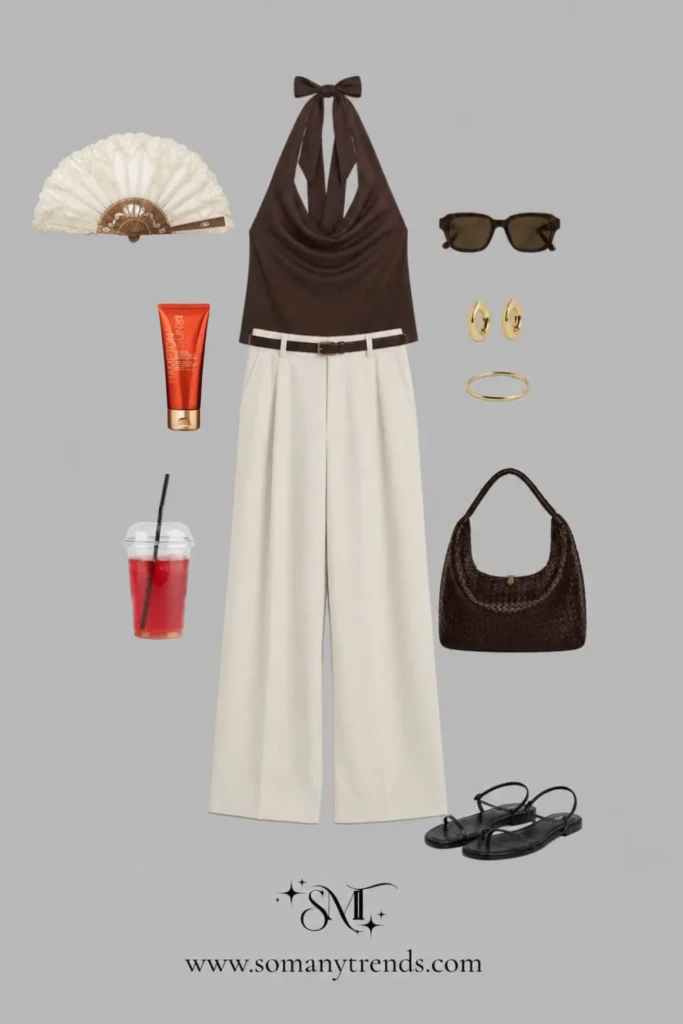
The dark woven bag pulls the brown back through the accessories without matching exactly, which is exactly the right amount of coordination. Exact bag-matching reads as dated; total mismatch reads as unconsidered. A dark woven or basketweave bag in a similar brown family hits the middle point — it echoes without being a mirror. That’s one of the moves that consistently separates Italian-looking from heavily assembled.
Something worth noting about accessory restraint: the Italian summer aesthetic almost never mixes more than two materials in the accessories — straw or raffia paired with either leather or metal, but not all three. This outfit demonstrates it cleanly. The woven bag is the natural fiber; the thin leather belt is the smooth material; the halter bow introduces a subtle shine. Three elements, each from a different texture register, and nothing competes.
Large-Print Floral Mini Dress With Raffia Hat and Black Beaded Bag
Florals that work in this context share a specific quality: the scale is medium to large, the background color reads as neutral or skin-adjacent, and the accessories pull the least-obvious color from the print rather than the dominant one. The black beaded crossbody and flip flops reference the darkest outlines in the print rather than the dominant pink — that’s exactly what keeps the look from becoming costume-y. The raffia hat adds the natural fiber note that grounds any highly printed dress.
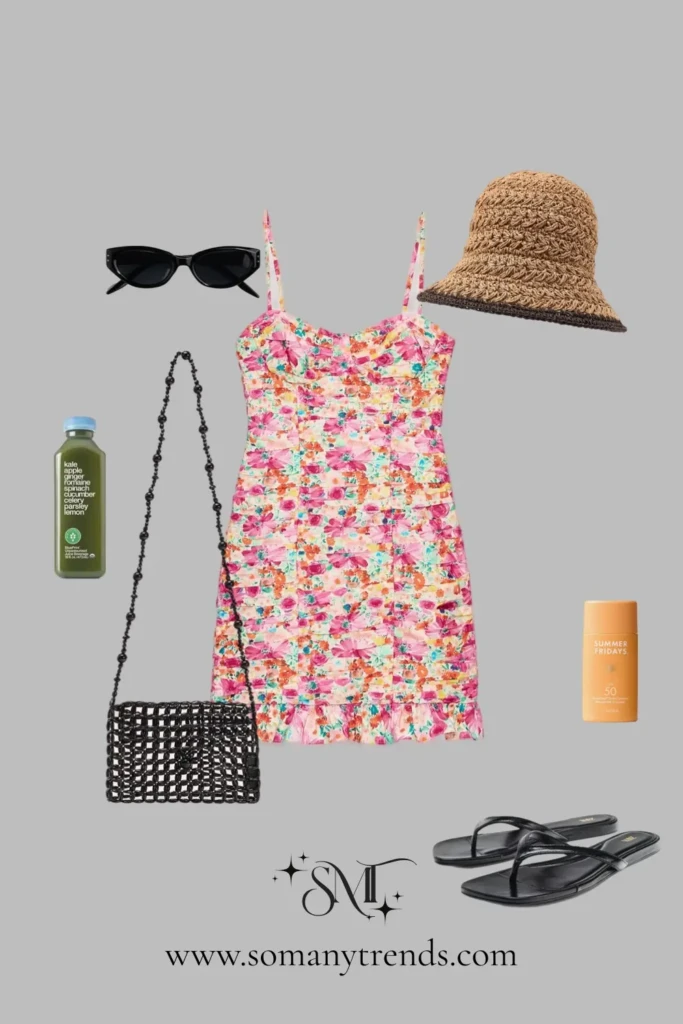
Proportion is specific here: this silhouette works best as a true mini, with the hemline 6–8 inches above the knee. Longer and the print overwhelms the figure; shorter and the fitted bodice reads as too much all at once. The mini length also creates a clean vertical line that lets the print exist as a defined rectangle rather than cascading in a direction you can’t control. It sounds technical, but the difference in the actual image is immediate.
The black accessories are doing the structural work that a belt would do in a more solid outfit — they introduce a hard edge against the softness of the print and the floaty hem. If you’re pulling this look together and the floral you have has a navy or a dark olive in the print rather than black, use that color in the accessories instead. The principle is the same: pull the darkest outline, not the loudest shade, and the result stays intentional rather than matchy.
Small-Check Cream Gingham Cami and White Shorts With Leather Lattice Bag
Gingham reads as either French or American depending on scale and cut — I always assumed it was too far from the Italian aesthetic to fit here. This small-check cream-and-black version in a fitted cami reads European because the color stays in the neutral range rather than committing to a strong primary. White shorts at a 4-inch inseam keep the leg line clean without veering into a beach vibe. The leather lattice bag is the standout: structured, artisanal, clearly not a beach bag — and that specificity is what places the whole outfit.
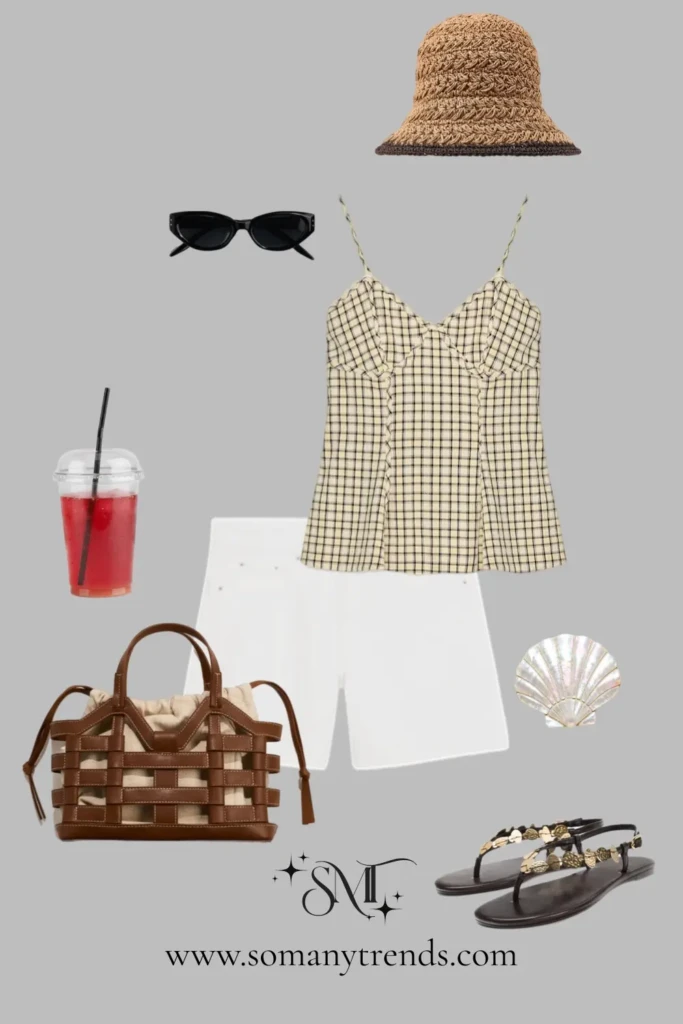
The gold coin sandal repeats the craft-market energy of the bag without duplicating the same material, which is the right move. Both pieces have a handmade-adjacent quality — the lattice weave on the bag, the coin detail on the sandal — that communicates the same aesthetic language while staying in different material registers. It’s an outfit built around two accessories rather than two clothing pieces, which turns out to be a very Italian way of approaching dressing.
The fitted cami silhouette is key to this working. A looser or oversized top with the gingham print would read casual-American immediately; the fitted cut keeps it European and deliberate. If your cami has adjustable straps, set them so the neckline sits just below the collarbone — high enough to be sophisticated, low enough to avoid looking corseted. Small check gingham in cream-and-black is genuinely a one-season-window item right now, so this is the moment to wear it.
Black Satin Cowl Halter Mini With Raffia Hat for Day-to-Evening
A black satin halter mini with a cowl front works for evening the same way a red lip does: it’s a single strong statement that handles all the visual weight, and everything else stays quiet. Raffia tote, flat sandals, minimal jewelry — the contrast between the luxe fabric and the casual accessories is exactly the Italian tension that makes this interesting rather than predictable. The raffia hat tips the balance toward day-to-evening rather than full evening, which is often the smarter call when the day runs long and you don’t want to carry a second bag.
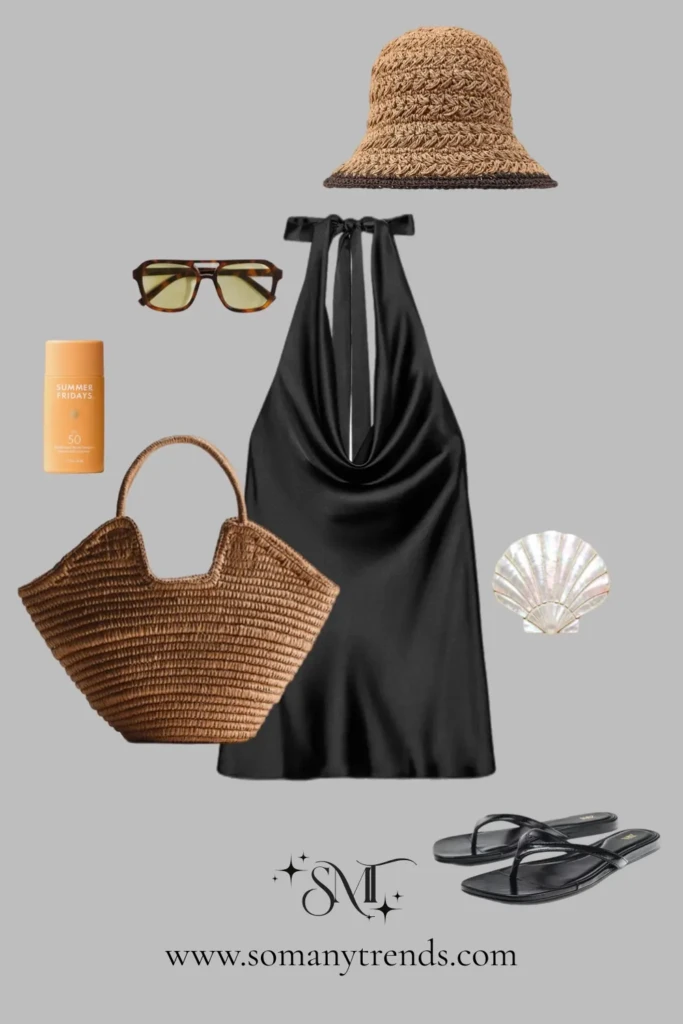
The cowl front is doing significant work here: it introduces drape and movement at the neckline that prevents the satin from reading as stiff or formal. A standard halter with the same satin fabric would sit closer to cocktail territory; the cowl creates softness that keeps this in the wearable evening-casual zone. Satin in a true mini length also stays cooler than it looks — the fabric doesn’t cling the way jersey does and there’s enough air movement under the hem to stay comfortable at 26°C.
Flat sandals are the correct call here rather than heels, because heels would push this into a formality that contradicts the raffia and the hat. The deliberate high-low tension between luxe fabric and casual accessories is the whole point of the outfit — a strappy heel would resolve that tension in the wrong direction, making it just a going-out dress rather than something more interesting. Keep the footwear flat and let the satin carry all the dressiness.
Black Halter Top, Cream Midi Skirt, and Thin Black Belt Against Old Stone Walls
The midi skirt is doing precise work here: at roughly 35–38 inches in length — mid-calf on someone around 5’5″ — it keeps the proportion sophisticated rather than casual, and that specific length is what makes this more than just a halter top and skirt. The thin black belt is not optional. Without it, the halter-top-into-midi reads unstructured and the waist disappears into the fabric; with it, there’s a defined waist and the whole silhouette organizes itself immediately.
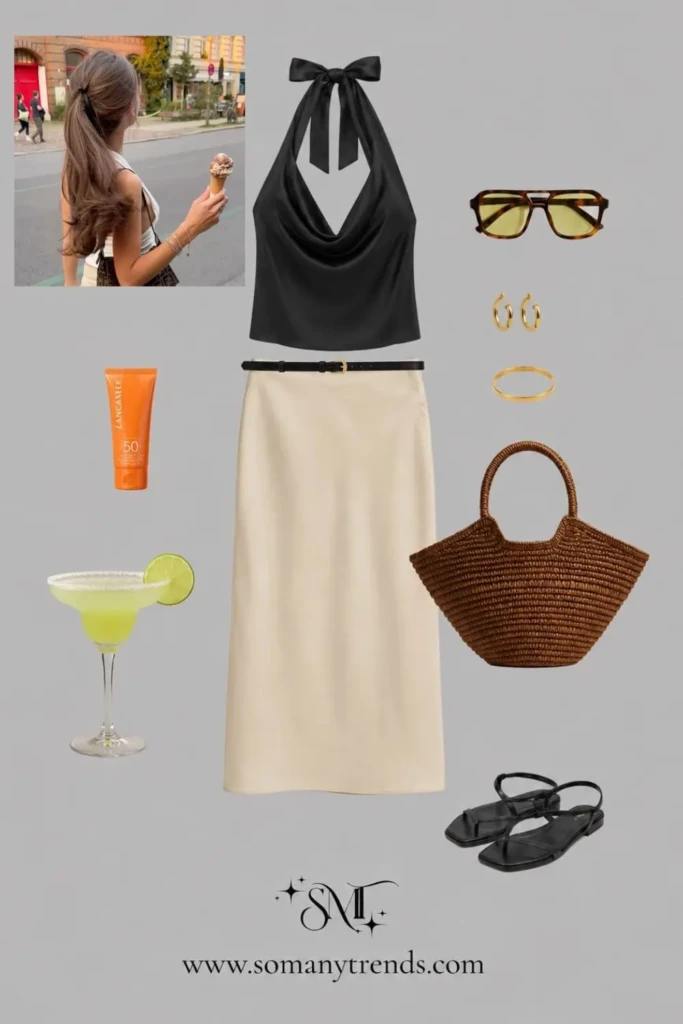
Flat strappy sandals keep the Italian ease in the footwear even while everything above reads polished. A heeled sandal here would formalize this outfit past the point of Italian summer ease — you’d be in dinner-party territory rather than afternoon-into-evening territory, which is the more useful zone when you’re traveling and your day rarely ends when you planned. The flat keeps your options open without compromising the look from the waist up.
This is the combination to photograph in front of a very old wall, and it knows exactly what it is. The cream skirt reflects warm light in a way that photographs beautifully against terracotta and stone, and the black halter creates a clean anchor at the top of the frame. If your midi skirt has any texture — a subtle texture weave, a linen slub — that’s even better, because it adds visual depth that solid cream in a smooth fabric can flatten slightly in direct sun.
Chocolate Brown Ruffle Bias Dress With Coin Sandals and Crystal Earrings
Ruffle dresses that work have two things in common: the ruffles are cut on the bias so they spiral rather than sit flat, and the hemline lands at a single length rather than cascading unevenly. This chocolate brown version hits both, which is why it moves correctly in real life rather than just photographing well. The coin-charm sandals add a detail that feels deliberately artisanal — the kind of thing you’d buy at an actual market stall rather than a high-street chain, which is exactly the energy this outfit is building toward.
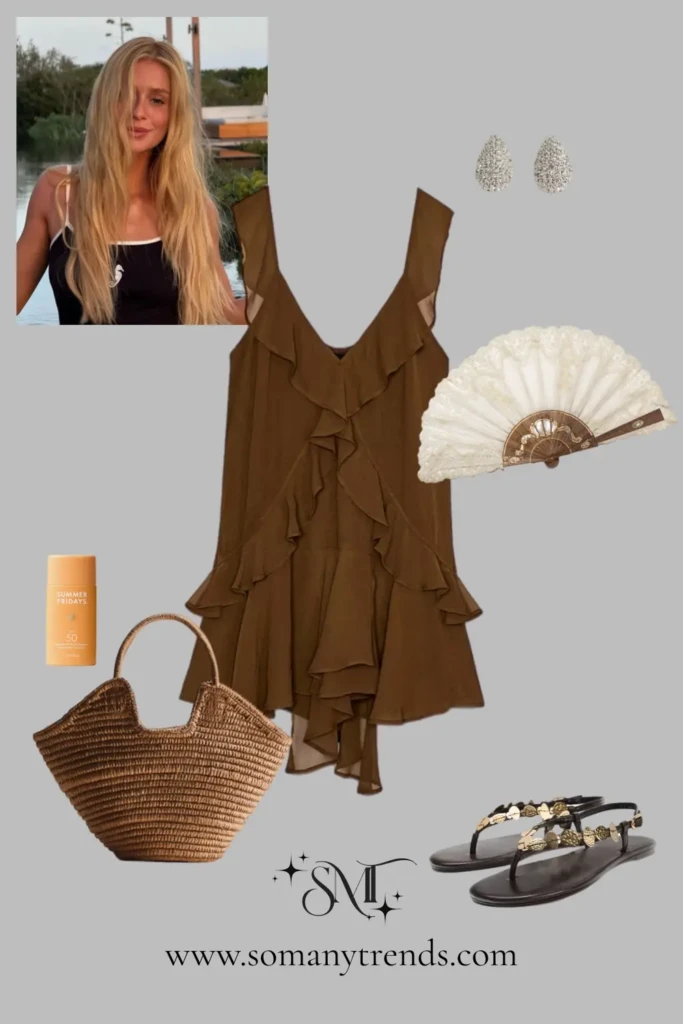
Crystal drop earrings add one moment of sparkle without competing with the ruffles, and that balance is the whole edit in miniature: one fabric-based statement, one accessories-based moment of light, nothing else. The bias-cut ruffles already introduce movement and dimension, so restraint in the jewelry is necessary rather than optional. A chunky necklace or stacked bracelets would fight the dress for attention and lose, making both look smaller in the process.
Chocolate brown is one of the stronger choices for a single-piece vacation dress because it doesn’t show dust or light marks from cobblestone splashes the way white or cream does, while still being warm and Mediterranean in tone. In a bias-cut ruffle construction, the brown also has a depth that shifts slightly in different lights — almost burnished in direct sun, richer and cooler in shade. A dress that changes in different lights is a dress worth packing.
Black Bandeau Top and Sand Pintuck Wide-Legs: Maximum Airflow, Reads as Dressed
The visual logic here is inverted from most summer outfits: the top is minimal — a 4-inch bandeau — and the trousers carry the silhouette. High-waisted sand-colored wide-legs with a pintuck front seam do the structural work that a more complex top would normally handle, creating a clean vertical line that reads as polished despite the simplicity at the neckline. This is one of the stronger combinations for anyone who runs warm: maximum airflow, and it reads as a dressed outfit rather than a casual one.
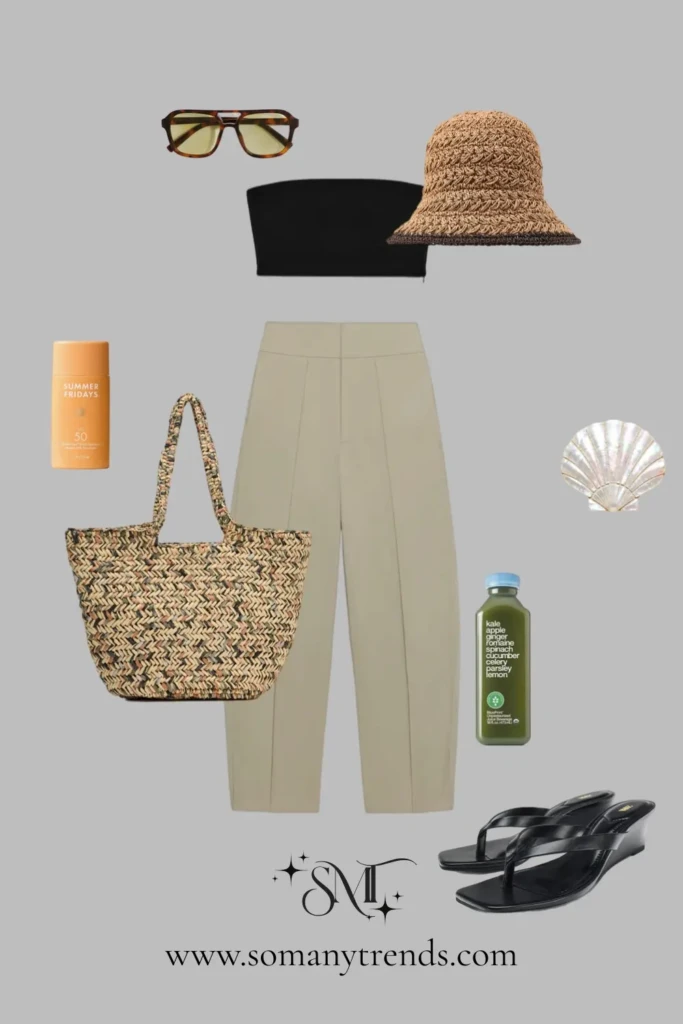
The wedge sandal at around 2 inches adds height without committing to heels, keeping the proportion manageable when you’re working with that much trouser volume. Flat sandals can disappear under a wide, full trouser leg; the wedge gives you just enough elevation to keep the silhouette reading clearly from the ankle up. A tan or warm-beige wedge stays within the sand color family and extends the leg line cleanly.
The pintuck front seam is a detail worth specifically seeking out in wide-leg trousers: it adds structure and a subtle pleat that prevents the fabric from looking formless at the waist. Without some kind of structural detail at the front, wide sand-colored trousers can read as loose and unintentional rather than considered. The pintuck creates a line that the eye follows from waist to hem, which is exactly the column effect you’re working toward with this silhouette.
Muted Mauve Linen Midi Dress With Dark Beaded Minaudière
The muted mauve-brown linen midi is the dress you pack because it requires nothing else — no accessories debate, no special shoes needed, no second-guessing on the way out the door. The dark beaded bag is the single decision that elevates this from simple to intentional: structured minaudières in dark tones work against muted linen because they introduce a material contrast — shiny and dimensional against matte and flat — that reads as considered without being obvious. The coin sandal appears across several outfits in this roundup, which tells you something about its actual range.
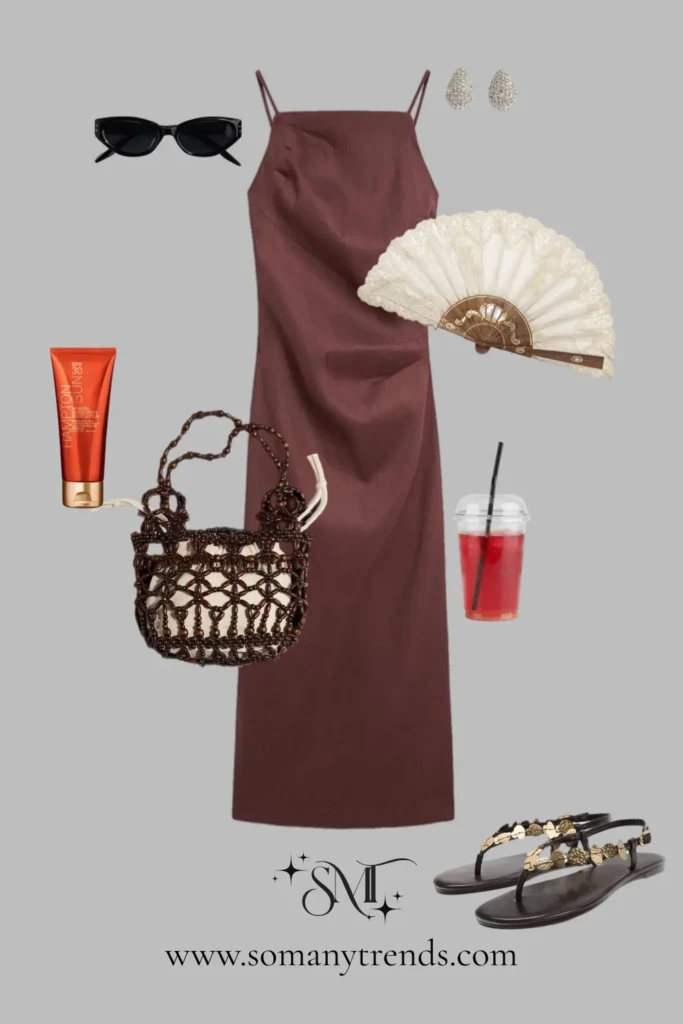
This is a strong candidate for an evening dinner dress, specifically because the muted linen midi reads quiet enough to work in a candlelit setting rather than only in bright daylight. The color has warmth without being saturated, which means it flatters across skin tones and doesn’t compete with the ambiance the way a bright print or a stark white would. Take it from afternoon sightseeing to dinner without any changes, just swap the crossbody for the beaded bag.
The coin sandal’s appearance across multiple outfits in this roundup isn’t repetition for repetition’s sake — it’s because that specific shoe type occupies exactly the right register for Italian summer dressing. It’s flat enough to be walkable, artisanal enough to read as chosen rather than default, and neutral enough in tone to work against warm earth shades and near-neutrals without ever clashing. One good pair genuinely does carry a two-week wardrobe.
Oversized Lace Blouse and Denim Bermuda Shorts With a Hand Fan
Lace-panel blouses have a short window where they look current rather than dated, and that window is open right now — partly because the silhouette has shifted toward oversized and slightly deconstructed rather than fitted. The key is pairing the delicate top with something sturdy: denim bermuda shorts at a 5–6 inch inseam rather than a floaty skirt, which would tip this into a different aesthetic entirely. The result is a tension between the romantic blouse and the casual denim that reads as very current Italian summer.
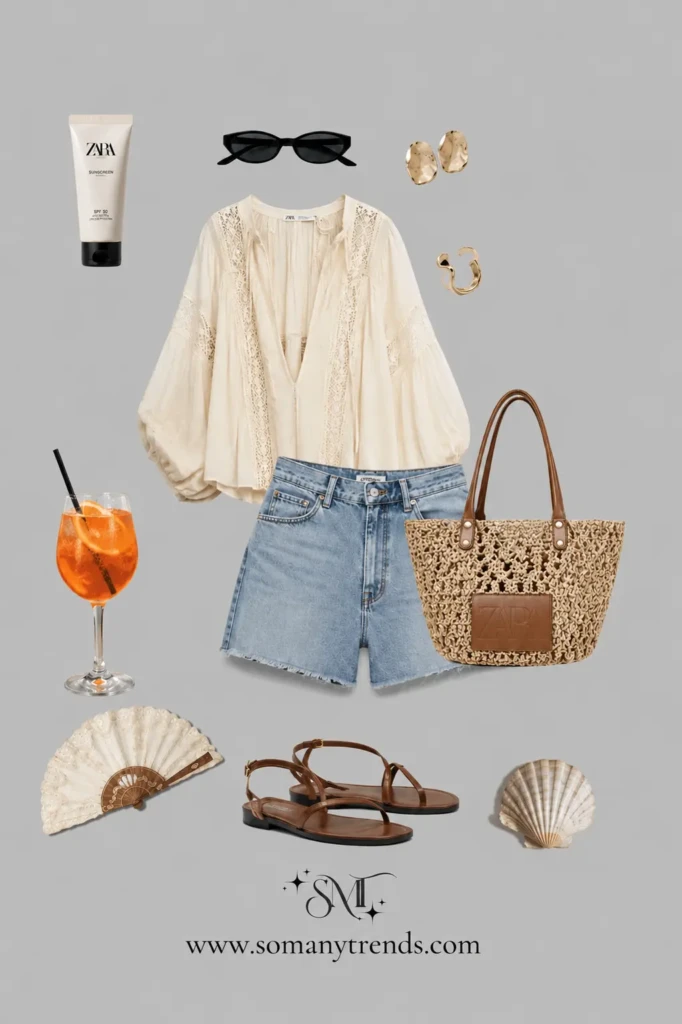
The lace hand fan is genuinely functional in 35°C heat, not just decorative, and in a photograph it adds a vintage-adjacent quality that no accessory at the same price point achieves. Carrying it while walking creates a continuous, low-effort breeze at face level that makes a real difference to how comfortable you are during peak afternoon hours. It’s also a compact pack — it folds flat and adds no meaningful weight to any bag.
The denim bermuda at 5–6 inches of inseam is specific: shorter and the lace blouse starts to read as a cover-up over swimwear; longer and you’re in workwear territory. That particular inseam length creates a proportional balance with an oversized blouse where neither piece overwhelms the other. Look for a mid-rise waist that sits just above the natural waist — it gives you a waistline reference point even without a belt, which you don’t need here since the belt would compete with the lace’s delicacy.
White Racerback Maxi Dress and Leather Basket Bag for Market to Restaurant
The white maxi is the cleanest possible canvas for demonstrating how accessories do all the work — and this one has a racerback cut that adds a sporty edge without breaking the maxi-dress formality. The leather basket bag — structured, geometric, clearly handmade in feel — is the piece that signals knowing what you’re doing, because it’s specific in a way that a standard tote isn’t. Savoring Italy’s summer 2026 packing guide describes this as exactly the formula for Amalfi Coast dressing: a day that starts at a morning market and ends at a seafront restaurant, and the wardrobe should handle both without a change.
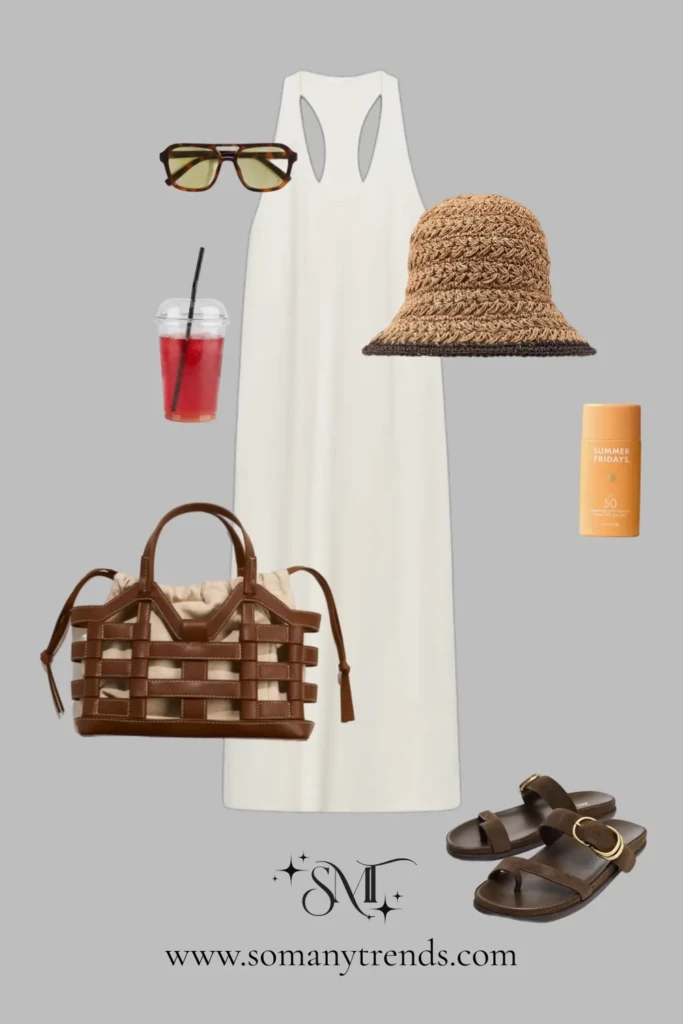
Double-strap sandals with a buckle detail add one more moment of deliberate choice without competing with the bag for attention. The buckle introduces metal hardware that echoes any gold in the leather basket without mattering — it’s a small sensory moment rather than a styling statement, which is exactly the level of detail Italian summer dressing operates at. Too much and it reads as assembled; just enough and it reads as natural.
A white maxi is the piece most likely to make you anxious in a foreign city — one spill at a rooftop aperitivo and it’s a problem. The practical answer is a white that leans slightly toward warm ivory rather than clinical white, which hides minor marks better in natural light and doesn’t show yellowing from sunscreen. The racerback cut also means you can wear a strapless bra without any architectural compromise, which solves the practical undergarment question before it arises.
How to Pack These Outfits Without Overpacking
The most useful thing I’ve worked out about packing for Italy is that you need fewer pieces than you think, and the key is staying inside a two-color palette. A base of brown, cream, and black — which is where most of the outfits in this roundup live — means that almost everything mixes with almost everything else. Four or five bottoms, five or six tops, two dresses, two bags, and two or three sandal options covers two full weeks without a repeat that anyone else would notice, and it fits in a carry-on if the fabrics are right.
Linen is the dominant fabric for a reason, but it does need a little management. Roll rather than fold to minimize heavy creases, and pack rolled pieces inside each other rather than stacking flat. When you unpack, hang everything immediately — even a couple of hours on a hanger in a ventilated room removes most of the roll-creases from linen and cotton. For satin and silk-feel pieces, turn them inside out and fold in a small square with the lining facing out; they shake out almost entirely wrinkle-free after travel.
The accessories are where Italian summer packing either saves you or costs you. Two bags — one structured wicker or leather basket for daytime, one small leather or beaded shoulder bag for evenings — cover every scenario in this roundup. Two sandal options — a flat thong or strappy flat for day, a low kitten heel or wedge for evening — handle the footwear. Beyond that, a single gold earring style that works with everything, one raffia hat, and a thin leather belt in either brown or black. That’s the entire accessories section of your bag, and it creates the Italian restraint that makes these outfits read the way they do.
One item worth specifically packing that doesn’t appear in every packing list: a very lightweight linen or cotton overshirt in a neutral. It functions as a layer for cool evenings, a cover-up at an outdoor lunch table with overhead sun, and a standalone top. The dark linen shirt in the chocolate-over-cream outfit in this roundup is exactly that piece — it works in three contexts that would otherwise require three different solutions. One piece with range is always better than three pieces with one use each.
The Outfit Formula That Packs in Eight Pieces
Most of these 17 looks are built on the same architecture: a warm neutral palette, one fabric-based statement, restrained accessories in no more than two materials. The specifics shift — maxi or mini, linen or satin, floral or solid — but the underlying logic doesn’t. Once you see the formula you can apply it to pieces already in your wardrobe, which is ultimately the most useful thing a roundup like this can do: give you a framework rather than just a shopping list.
The outfits that work hardest are the ones that carry through a full Italian day without requiring a change — something comfortable enough for 10,000 steps on stone, elevated enough for an aperitivo at golden hour, and interesting enough that you actually want to wear it. That’s the actual target. The red slip maxi, the halter-and-midi combination, the white racerback with the leather basket bag — they all pass that test, and that’s what earns them a spot in the suitcase.
FAQ
What fabrics work best for Italian summer outfits?
Linen, cotton, and viscose handle the heat best — all breathe well and don’t hold body heat the way synthetics do. For evening pieces, lightweight satin and silk-feel fabrics are genuinely functional because they sit away from the body rather than clinging. A 100% linen trouser weighs roughly 150–180g per meter; anything over 200g becomes uncomfortable in full sun, and heavy cotton twill or thick denim is best avoided for July temperatures above 30°C.
What shoes are most practical for Italian cobblestones?
Flat or low-heeled sandals with a secure strap around the ankle or between the toes — flip flops, gladiators, and thong sandals with a grip sole all work well. Block-heel sandals up to about 2 inches are manageable on flat surfaces, and kitten heels at 1.5–2 inches handle cobblestones better than stilettos because the contact point is wider. Any heel with a small, narrow tip catches in the gaps between stones, so save those for smooth restaurant floors rather than street walking.
Can you wear all-black outfits in Italian summer heat?
Yes, with fabric selection doing the work. Lightweight satin, sheer cotton, and viscose-blend fabrics in black absorb heat but release it quickly with any movement or breeze, and the black satin halter mini in this roundup is genuinely comfortable for evening temperatures around 24–28°C. The one exception is black linen in full midday sun — it absorbs and holds more than its breathability reputation suggests, so save black linen for shade or evening.
How many pieces do you actually need for two weeks in Italy?
Fewer than you think. A capsule built around four or five bottoms, five or six tops, two additional dresses, two bags, and two or three sandal options covers almost every scenario across two weeks. The key is staying inside a two-color palette — brown, cream, and black, for example — so everything mixes. Most of the outfits in this roundup work within exactly that palette and create well over 17 combinations from eight or nine pieces.
Are wicker and straw bags practical for actual travel?
For day-to-day use, yes — structured varieties hold shape well and fit more than they look like they should. The main limitation is that most don’t close fully and aren’t rain-proof, so for evenings or any scenario requiring a closed bag, a small leather or beaded shoulder bag works better. The basket bags in this roundup are styled for daytime; the halter-and-midi combinations shift to smaller, more structured bags precisely because the occasion calls for it.
What’s the difference between Italian summer style and French Riviera style?
Both share the natural-fiber, restrained-accessories logic, but Italian summer styling leans warmer in tone — more brown, terracotta, and mauve — and is more willing to include artisanal details like coin sandals, beaded bags, and lace fans. French Riviera style tends to stay cooler in palette — more white, navy, and breton stripe — and cleaner in silhouette. The tonal brown combinations in this roundup are distinctly Italian; the same outfits in navy and white would read more French.
How do you style Italian summer outfits for a cooler evening?
The temperature drop between Italian afternoon and evening is usually 8–12 degrees — enough to need a layer, not enough for a coat. A light linen jacket or structured overshirt adds warmth without changing the aesthetic; for more formal evenings, a lightweight knit cardigan in a tonal color works over any of the satin halter looks. The key is keeping the layer in the same color family — a contrasting layer breaks the tonal logic that makes these combinations work.
How do I stop a linen outfit from looking wrinkled and unkempt?
The mental shift that helps most is accepting that linen wrinkles are texture rather than a problem — the lived-in drape is intentional, not a failure state. Roll pieces rather than folding flat when packing, and hang everything immediately on arrival; even two hours on a hanger in a ventilated room removes most travel creases. If you want a crisper look, a handheld steamer is more effective on linen than an iron and takes two minutes per piece.
Can you mix prints in the Italian summer aesthetic?
Technically yes, but the aesthetic strongly favors restraint — most of the best Italian summer looks in this roundup are either one print against a solid, or all solids with interesting fabric texture doing the work. If you do mix prints, keep them in the same color family and vary the scale significantly: a large floral against a small stripe in the same neutral palette works. More than two prints at once starts to read as pattern mixing rather than Italian minimalism.
Have any thoughts?
Share your reaction or leave a quick response — we’d love to hear what you think!
-
 0
0 -
 0
0 -
 0
0 -
 0
0 -
 0
0 -
 0
0