

 Lena
Lena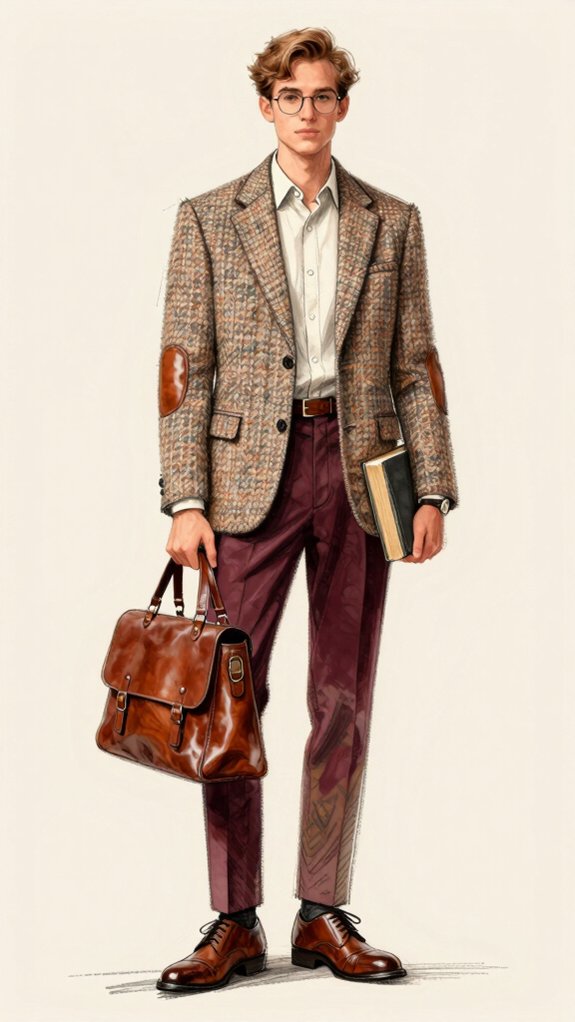
You’re browsing a Cambridge faculty directory from 1928, and every third professor looks like they raided the same country estate wardrobe: herringbone tweed, leather patches, oxford brogues worn to a dignified sheen. This wasn’t accident or budget constraint—it was calculated self-presentation, a visual argument that serious thinking required serious clothing. The question isn’t whether this uniform still works today, but why we can’t seem to abandon it, even as academia crumbles around us.
Academic Style Heritage
While fashion trends cycle through with the attention span of a TikTok algorithm, the professor aesthetic has maintained its grip on intellectual culture since the 1920s, when Oxford and Cambridge dons first codified tweed jackets and leather elbow patches as the unofficial uniform of serious thinking. You’re tapping into something deeper than mere scholarly attire when you button that herringbone blazer—you’re claiming membership in a visual language that spans generations, from dust-covered archives to modern lecture halls.
The collegiate aesthetics weren’t born from fashion houses but from practicality: tweed’s durability withstood endless library hours, leather reinforcements protected against worn desk edges. This same principle of function-turned-fashion applies to the barn jacket, originally designed for 19th-century French laborers before becoming a staple of elevated casual style. Yet somewhere between function and form, these pieces became armor, signaling intellectual credibility before you’d even opened your mouth. That transformation? Pure cultural alchemy.
Intellectual Fashion
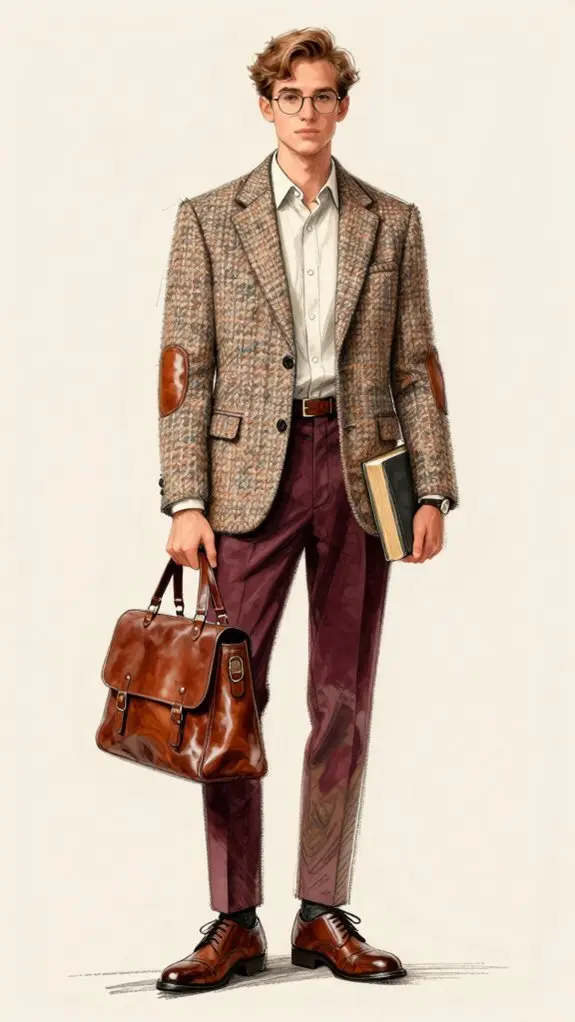
The clothing choices that signal “I’ve read Foucault” have become their own dialect in contemporary fashion, where horn-rimmed glasses, worn leather satchels, and strategically rumpled cardigans communicate intellectual seriousness more effectively than any LinkedIn headline ever could.
Your turtleneck isn’t just wool—it’s a thesis statement about refusing mainstream aesthetics while maintaining plausible deniability about caring at all.
You’re wearing your philosophical underpinnings, literally, when you button that tweed blazer with elbow patches—it’s costume, yes, but it’s also armor against accusations of superficiality.
The sociocultural implications run deeper than vintage stores and Instagram aesthetics suggest. This isn’t just playing dress-up; it’s signaling membership in a tribe that values critical thinking, literary references, and heated debates about postmodernism over brunch.
Your wardrobe becomes shorthand for “I’m complicated, I question systems, and yes, I own multiple editions of Being and Nothingness.”
The professor aesthetic embodies that effortless sophistication at the heart of Chanel’s DNA, proving that intellectual fashion and timeless elegance have always shared the same wardrobe.
Key Pieces
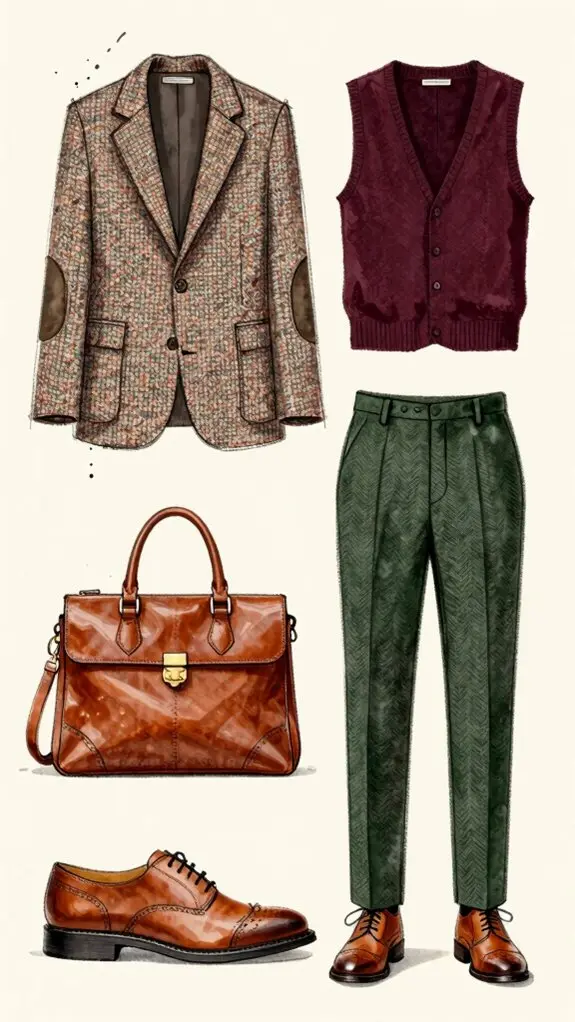
Building your professor wardrobe starts with three non-negotiables: a well-fitted tweed jacket (preferably with those iconic suede or leather elbow patches that say “I’ve actually leaned against something while contemplating Foucault”), a rotation of vintage accessories like leather satchels and tortoiseshell reading glasses, and the understanding that you’re not cosplaying—you’re curating a look that’s existed since academics first realized corduroy wasn’t cutting it anymore.
The tweed jacket alone does about 60% of the heavy lifting here, transforming even a basic white tee and jeans into something that could plausibly attend a visiting lecturer’s cocktail hour. You’ll want to hunt vintage stores and estate sales for authentic pieces from the ’60s through ’80s, when quality construction actually meant something, before fast fashion convinced everyone that polyester blends were acceptable. For a more relaxed take on academic dressing, consider layering a caramel suede shacket over your basics to achieve that effortlessly intellectual off-duty look.
Tweed jackets
Tweed jackets anchor the professor aesthetic with a kind of intellectual gravitas that’s impossible to fake with a hoodie and glasses. You’re investing in fabric textures that speak to centuries of academic tradition—herringbone, windowpane, donegal—each weave telling its own story about where knowledge happens. The magic lives in tailored silhouettes that actually fit your shoulders, not those boxy vintage finds that make you look like you’re drowning in your grandfather’s closet.
Consider these non-negotiables:
- Elbow patches aren’t ironic anymore—they’re practical reinforcement for desk-dwellers who actually lean on their forearms while grading papers
- Earth tones trump everything—browns, olives, charcoals that photograph well in badly-lit seminar rooms
- Two-button configurations maintain formality without the stuffiness of three-button dinosaurs from 1987
Choose quality over quantity, always.
Leather patches
Authenticity separates actual professor aesthetic from costume-party academia, and nothing telegraphs that distinction quite like leather patches positioned with purpose. You’ll want distressed leather on your elbows, worn naturally through years of contemplative desk-leaning, not artificially aged by some factory in Bangladesh. The suede patches speak to function—reinforcing friction points where tweed inevitably thins—while simultaneously broadcasting intellectual credibility.
| Patch Location | Material Choice | Cultural Signaling |
|---|---|---|
| Elbow | Distressed suede | Seasoned academic |
| Shoulder | Luxurious leathers | Pretentious newcomer |
| Cuff | Smooth calfskin | Fashion victim |
| Collar | Any leather | Absolute madness |
Choose chocolate brown or tobacco tan, never black. Those luxurious leathers you’re eyeing? They’re trying too hard. Authenticity requires restraint, subtle wear patterns, and patches that’ve earned their place.
Vintage accessories
Consider these foundational pieces:
- Leather briefcases with actual wear patterns, scratches earned from cramming dissertation drafts, not artificially distressed by manufacturers
- Pocket watches or vintage fountain pens that suggest you value permanence over disposability
- Houndstooth patterns on scarves, ties, or caps that reference menswear’s intellectual heritage without announcing “I’m trying too hard”
The difference between authentic and affected? Your grandfather could’ve worn these items. They whisper cultivation rather than shouting costume.
Styling Approach
Styling Approach
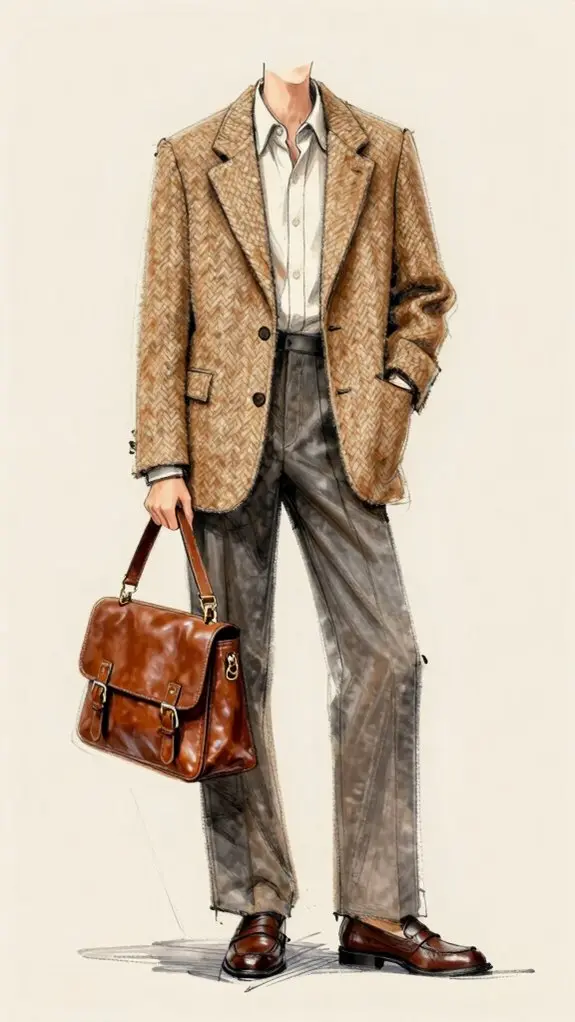
While most people treat academic style as some sort of costume to be assembled piece by piece—matching this blazer with those loafers, consulting Pinterest boards like they’re biblical texts—the professor aesthetic actually works best when you stop overthinking it. You’re aiming for understated elegance, not cosplay. The key is building outfits around one statement piece, letting everything else recede into minimalist chic.
| Focal Point | Supporting Elements | What to Avoid |
|---|---|---|
| Tweed blazer | Simple turtleneck, dark denim | Matching tweed trousers |
| Leather satchel | Neutral sweater, chinos | Designer logos everywhere |
| Vintage boots | Clean shirt, straight pants | Multiple bold accessories |
Think capsule wardrobe, not maximalist excess. You’re curating, not hoarding—each piece should justify its existence. The color palettes in professional settings are predominantly academic, featuring navy, khaki, brown, and gray—so building your foundation in these tones ensures everything works together effortlessly.
Modern Academic
The professor aesthetic doesn’t exist in amber, frozen somewhere around 1952 when Harris Tweed ruled the faculty lounge and everyone smoked pipes without irony. Your scholarly persona needs updating for 2024, and that means embracing bookish chic without looking like you’re cosplaying *Dead Poets Society*. You’re cultivating an intellectual identity that acknowledges Zoom meetings, third-wave coffee shops, and the reality that tenure-track positions are rarer than first-edition Faulkners.
Modern academic style requires strategic adaptation:
- Tech integration: Your leather messenger bag accommodates a laptop, not just Moleskines
- Sustainable choices: Vintage tweed from Poshmark beats fast fashion every time
- Comfort metrics: You’re teaching three-hour seminars, not attending garden parties
This evolution respects tradition while refusing to perform outdated academic theater.
Frequently Asked Questions
Can Tweed and Leather Work for Warm Weather Climates?
You’ll absolutely survive warm weather in tweed and leather—just choose wisely. Look for breathable tweed blends with cotton or linen that won’t suffocate you, tropical-weight options exist for a reason.
Lightweight leather pieces, like unlined vests or perforated loafers, work brilliantly when temperatures climb. Skip heavy Harris tweeds and motorcycle jackets in July, obviously, but don’t abandon the aesthetic entirely. Consider colors too: lighter tans, beiges, and stone shades reflect heat better than dark browns and blacks.
What’s the Price Range for Quality Tweed Jackets?
You’re looking at $300-$800 for genuine quality tweed patterns from reputable makers like Harris Tweed or Magee. Below $300? You’ll get cheap imitations that’ll pill faster than your ex blocked you.
Durable tweed fabrics demand proper wool construction, authentic weaving techniques, and Scottish or Irish provenance—none of which come cheap. Vintage pieces offer better value, honestly, running $150-$400 depending on condition.
Think investment, not impulse buy; quality tweed outlasts fast fashion by decades.
How Do I Care for and Maintain Leather Elbow Patches?
Those patches aren’t just decoration—they’re armor for your intellectual identity, so treat them right.
You’ll want to gently wipe them with a barely damp cloth, condition them sparingly once or twice yearly (avoid over-oiling leather patches, which creates dark, greasy spots), and brush away dust regularly.
Store jackets properly on wooden hangers, never cramped or folded, giving the leather room to breathe.
Think of it as skincare for your academic uniform—minimal intervention, maximum longevity.
Are There Vegan Alternatives to Traditional Leather Accessories?
You’ve got options beyond animal hide, thankfully. Sustainable vegan fabrics like cork, pineapple leather (Piñatex), mushroom leather (mycelium), and recycled polyurethane create convincing non leather accessories that won’t make you look like you’re cosplaying as someone who cares.
Brands like Matt & Nat, Angela Roi, and Will’s Vegan Store offer surprisingly sophisticated pieces. The texture’s evolved beyond that plasticky 1990s pleather nightmare—some cork elbow patches actually develop character over time, mimicking leather’s patina without the, you know, dead cow.
Which Brands Offer Affordable Professor Aesthetic Pieces?
You don’t need to drain your bank account for tweed dreams. Sustainable fashion brands like PACT and Quince offer wool blazers under $100, while thrifting opportunities at your local Goodwill or Buffalo Exchange literally overflow with leather-elbow-patched cardigans nobody wanted in 2003.
Uniqlo’s affordable knitwear looks deceptively expensive, and Everlane’s transparent pricing won’t make you choose between eating and looking like you’ve got tenure.
Vintage shops? They’re basically professor costume warehouses waiting for you.
Conclusion
You’re not just wearing clothes—you’re donning armor for a quiet battlefield where ideas clash, tenure hangs in balance, and superficiality gets dismissed with a raised eyebrow. That tweed jacket, those elbow patches? They’re your flag, declaring you’ve chosen substance over flash, depth over scroll-speed content. It’s cosplay, sure, but cosplay with footnotes. You’re signaling allegiance to something older, slower, maybe even endangered: the examined life itself.
Have any thoughts?
Share your reaction or leave a quick response — we’d love to hear what you think!
-
 0
0 -
 0
0 -
 0
0 -
 0
0 -
 0
0 -
 0
0