

 Lena
Lena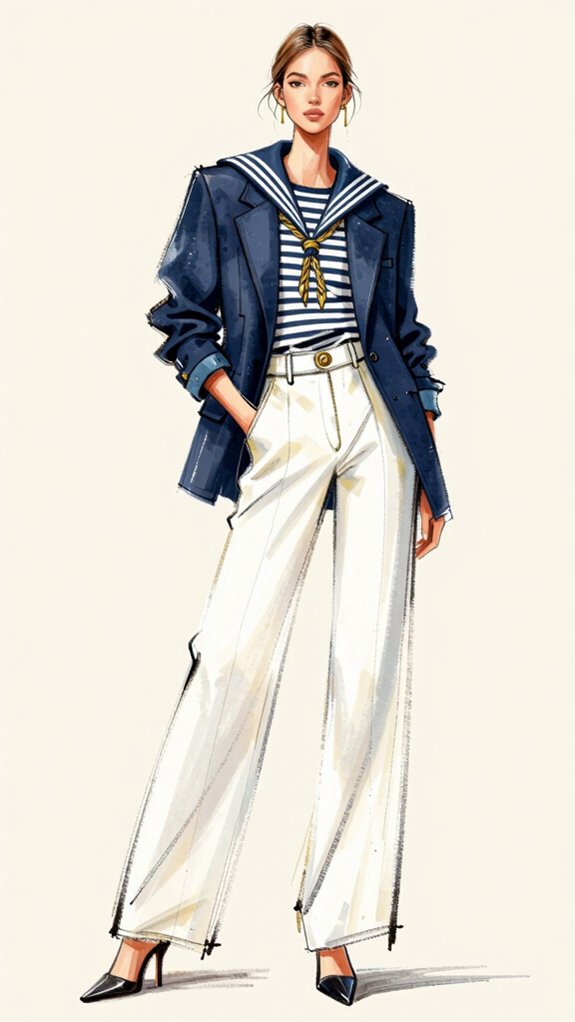
You’ve seen it everywhere—the striped shirt, the rope bracelet, the canvas shoes—but do you actually know why half the civilized world keeps dressing like they’re about to crew a yacht they’ll never own? Nautical style isn’t just some marketing ploy cooked up by J.Crew in 2009, though they’d certainly like you to think otherwise. It’s rooted in actual naval tradition, practical seafaring needs, and a complicated relationship with class aspiration that deserves unpacking, starting with those ubiquitous Breton stripes that weren’t always so innocent.
Historical Context
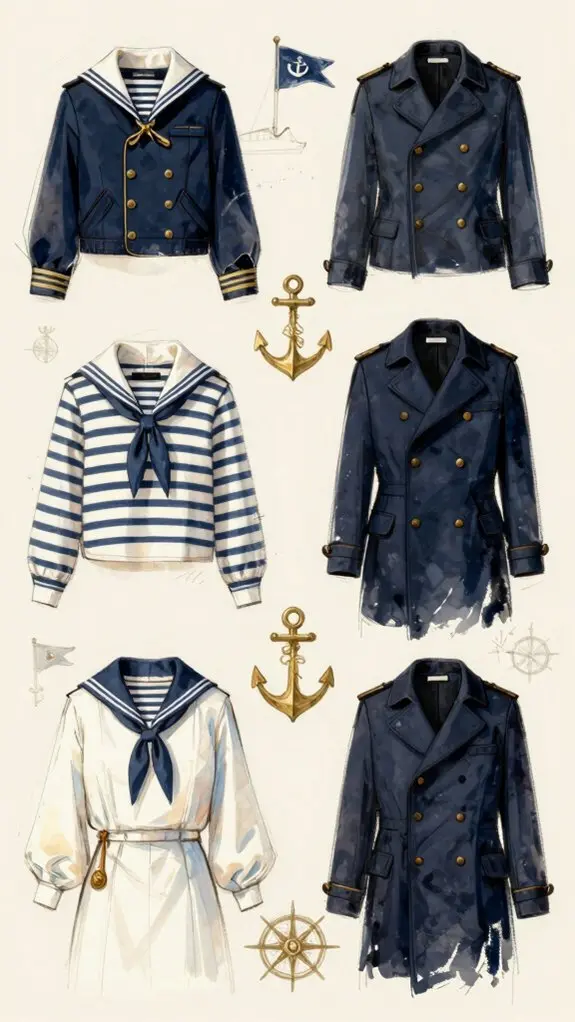
While most fashion trends emerge from runways or street culture, nautical style flowed directly out of functional necessity—specifically, the British Royal Navy‘s need to distinguish ranks and keep sailors from drowning.
Maritime history reveals that those iconic horizontal stripes weren’t aesthetic choices but practical solutions: the French Navy’s 1858 “marinière” featured exactly 21 stripes, making it easier to spot sailors overboard in choppy waters.
Twenty-one stripes weren’t fashion—they were survival, turning sailors into visible targets for rescue in unforgiving seas.
The peacoat’s double-breasted design protected against harsh winds from either direction, while bell-bottoms could be quickly rolled up for deck swabbing or, in emergencies, removed while treading water.
Today’s fisherman aesthetic draws inspiration from this traditional maritime workwear, combining functional elements with a modern twist that brings coastal nostalgia to contemporary street style.
You’re in effect wearing centuries of seafaring tradition every time you don that Breton stripe, whether you realize it or not—which is more than likely more interesting than whatever’s currently trending on Instagram.
Iconic Elements
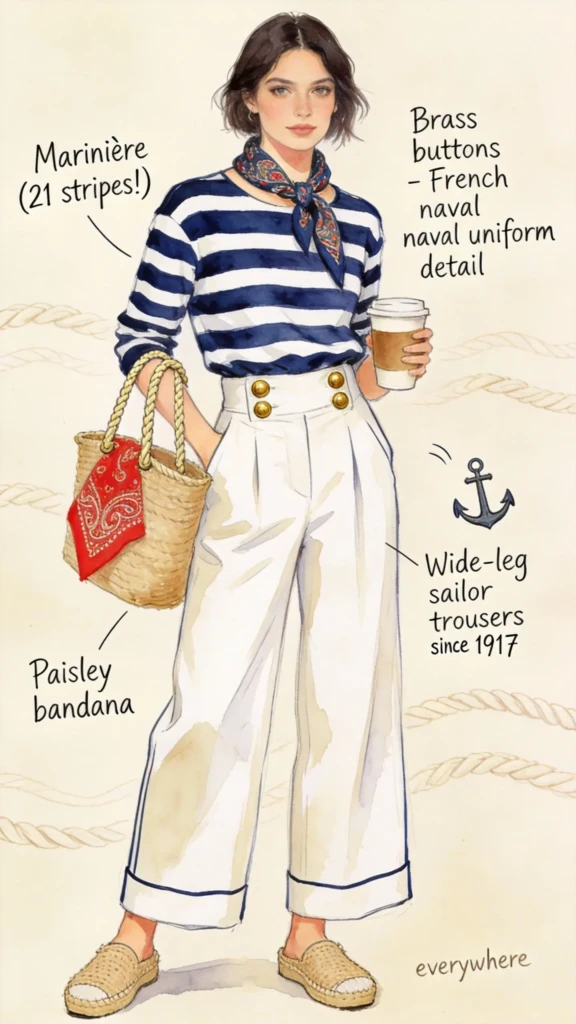
When you think nautical style, you’re really thinking about three specific visual markers that’ve been beaten into our collective fashion consciousness since Coco Chanel made Breton stripes acceptable off the boat in 1917: those iconic navy and white horizontal stripes (technically called marinière), anchor motifs that show up on everything from throw pillows to temporary tattoos, and sailor-inspired details like brass buttons, rope accents, and those oddly specific wide-leg trousers.
These aren’t just random design choices—they’re lifted straight from actual French naval uniforms, where the 21 stripes on a traditional sailor’s shirt supposedly represented Napoleon’s victories (though that’s probably apocryphal). You can’t escape them in summer collections, and honestly, why would you want to? For a finishing touch, tie a classic paisley bandana around your neck or wrist to channel that effortless seaside sophistication.
Navy and white stripes
The Breton stripe—that horizontal navy-and-white pattern you’ve seen on everyone from Parisian artists to suburban moms at Target—originated as official French naval uniform regulation in 1858. Each sailor’s shirt supposedly featured 21 stripes, representing Napoleon’s victories (though historians debate this romantic claim).
What’s undeniable is the design’s timeless appeal: Coco Chanel appropriated it for her 1917 collection, Jean-Paul Gaultier made it his signature, and now it’s shorthand for “I’m effortlessly chic without trying too hard.” The versatile design works because it’s both visually striking and neutral enough to anchor any outfit.
You can dress it up with tailored trousers or down with cutoffs, making it the rare pattern that genuinely transcends occasion, age, and trend cycles—assuming you haven’t completely oversaturated your wardrobe with maritime cosplay.
Anchor motifs
Anchors have sailed from functional maritime equipment to decorative shorthand for “I own a boat” or, more likely, “I wish I owned a boat”—cluttering everything from throw pillows to lower-back tattoos with their symmetrical, grounding shape.
You’ll find anchor design variations everywhere: rope-wrapped, distressed metal, embroidered in nautical inspired accessories like scarves, bracelets, and tote bags that’ve never seen saltwater. The symbol’s appeal lies in its contradictory nature—it simultaneously represents stability and adventure, staying put and sailing off.
Maritime museums showcase genuine nineteenth-century anchors weighing thousands of pounds, while H&M sells anchor-printed sundresses for $24.99. This democratization hasn’t diluted the motif’s power, though. When you spot those flukes and shanks, you’re connecting to centuries of seafaring tradition, even if your vessel’s a desk chair.
Sailor details
Stripes earned their nautical credentials through pure practicality—French maritime law in 1858 mandated that sailors’ shirts feature twenty-one horizontal bands (one for each of Napoleon’s victories, naturally) so you could spot a man overboard against the choppy water.
Today’s sailor collars, brass buttons, and those obsessive rope knots on everything from pillows to picture frames echo genuine maritime function. Real sailors tied bowlines and clove hitches with calloused hands, not for Instagram aesthetics.
The peacoat’s double-breasted design wasn’t a fashion statement—it protected against brutal Atlantic winds from either direction. Even those sea shanty lyrics everybody suddenly knows (thanks, TikTok) originally synchronized grueling labor aboard merchant vessels.
You’re wearing centuries of working-class naval history, whether you realize it or not.
Modern Interpretation
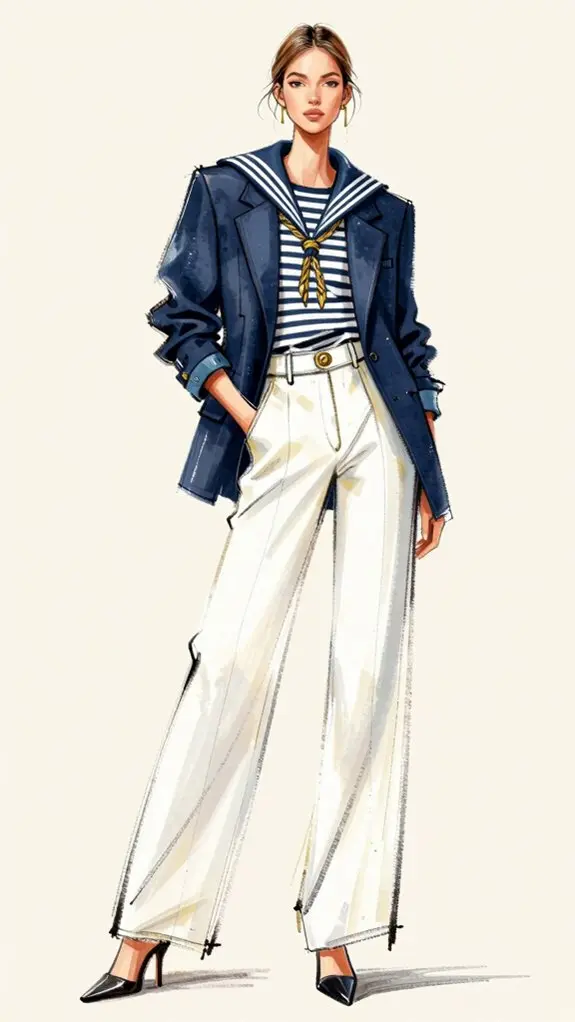
How did a look born in naval uniforms and yacht clubs become the go-to aesthetic for landlocked suburbanites shopping at J.Crew? You’ve watched nautical style shed its country club pretensions, morphing into something accessible, democratic even. Designers stripped away the brass buttons, the cloying anchor motifs, the overeager rope details that screamed “I vacation in Martha’s Vineyard.”
What emerged were sleek silhouettes that borrowed maritime proportions without the costume-party earnestness. You’ll find minimalist accents now—a single navy stripe instead of five, clean white sneakers replacing boat shoes. Brands like Uniqlo and Everlane democratized the aesthetic, offering Breton tops for $20 instead of $200. The same principle applies to styling lace pieces, where unexpected footwear choices like chunky boots or sneakers transform delicate fabrics from precious to everyday-wearable. It’s nautical without the yacht, coastal without the coast, a visual shorthand for “put-together” that requires zero sailing experience.
Wardrobe Building
You’re staring at your closet, paralyzed by the siren song of nautical style, but the path from inspiration to execution isn’t as simple as bulk-ordering striped shirts. Building a proper maritime-inspired capsule wardrobe requires strategic editing, not shopping sprees that’ll leave you looking like you’re cosplaying a yacht club member.
Start with foundational pieces: a Breton stripe tee (not five), dark denim, white chinos, and a navy blazer that actually fits your shoulders. When styling your white chinos, remember that matching proportions of an oversized blazer with wide-leg pants creates a balanced, polished silhouette that elevates the entire nautical aesthetic. Layer in seasonal updates thoughtfully—canvas espadrilles for summer, a fisherman’s sweater for fall—rather than chasing every maritime trend that surfaces during resort collection season. The goal isn’t to become a walking nautical cliché; it’s to incorporate maritime elements that complement, not commandeer, your existing aesthetic.
Styling Guidelines
Because nautical style telegraphs its influences so loudly—anchors, rope motifs, captain’s insignia—the difference between sophisticated maritime inspiration and Spirit Halloween’s “Sexy Sailor” costume lies entirely in restraint and proportion.
You’ll want to lean heavily into textured materials: heavyweight cotton canvas, chunky cable knits, weathered leather that actually looks like it’s survived salt spray rather than a distressing machine at J.Crew. Limit obvious maritime symbols to one piece per outfit, maybe two if you’re feeling rebellious.
A neutral color palette becomes your anchor here (pun absolutely intended), grounding those navy stripes and brass buttons with stone, sand, and charcoal tones. Think less “ahoy, matey” and more “I own a weathered sailboat I actually know how to operate.” Complete the look with classic loafers, which balance casual and polished elements while providing the understated sophistication that maritime style demands.
Frequently Asked Questions
What Fabrics Work Best for Nautical Style in Different Seasons?
You’ll want breathable lightweight fabrics like cotton, linen, and chambray when summer hits—they’re perfect for maintaining that crisp seafarer look without turning into a sweaty mess.
Come fall and winter, though, heavier durable fabrics become your best friends: think wool peacoats, canvas jackets, and thick cotton knits that actually withstand wind and salt spray.
It’s not rocket science, really—sailors didn’t wear synthetic nonsense, and neither should you if you’re serious about authentic maritime style.
Can Nautical Style Work for Formal Occasions or Business Settings?
You’ll definitely pull off formal nautical attire in professional settings—think tailored navy blazers with brass buttons, crisp white oxford shirts, and structured pieces that channel yacht club sophistication without looking costume-y.
Business appropriate nautical accessories like anchor cufflinks, striped silk ties, or navy leather briefcases add maritime polish without screaming “I’m dressed like a sailor!” The key’s restraint: choose one or two nautical elements, keep everything tailored, and you’ll look executive-ready, not themed-party-ready.
How Do I Incorporate Nautical Style Without Looking Costumey?
You’ll want to balance nautical accents with unexpected elements—think one striped piece, not head-to-toe sailor. Incorporate natural textures like linen, cotton, and leather to ground the maritime references in wearable reality.
Stick to navy, white, and khaki rather than screaming anchor prints. A Breton stripe under a blazer reads sophisticated; paired with a captain’s hat, you’re auditioning for a dinner theater production. The key’s restraint—let nautical elements whisper their coastal origins, not shout them through a foghorn.
What Colors Beyond Navy and White Count as Nautical?
You’ve got a whole palette beyond the obvious duo. Think seaside shades like sand beige, weathered gray, driftwood tan, and warm khaki—basically what you’d see on a New England dock.
Ocean hues matter too: deep teal, seafoam green, coral (yes, really), and faded red from vintage nautical flags. Even butter yellow works, channeling those classic rain slickers and lighthouse trim. The key? Keep things sun-bleached and natural, not bright and cartoonish.
Are There Budget-Friendly Nautical Brands or Shopping Alternatives?
You don’t need to sink your savings for maritime style. Target, HomeGoods, and TJ Maxx offer surprisingly solid discount nautical stores sections with rope mirrors, anchor pillows, and striped throws at fraction prices.
For nautical home decor alternatives, scour thrift shops for vintage brass compasses, actual ship lanterns, or weathered wooden oars—the real McCoy beats mass-produced fakery. Etsy sellers craft handmade pieces that channel authentic seafaring heritage without the Pottery Barn markup, and honestly, a few well-chosen rope accents trump overpriced catalog sameness.
Conclusion
Think of your wardrobe as a ship: you’re the captain, and these nautical pieces are your crew. You don’t need every sailor on deck—just the right ones, working together, steering you through whatever waters you’ll face. The Breton stripe’s your first mate, reliable and versatile. Brass buttons? Your compass. You’re not dressing for a costume party; you’re building something seaworthy, timeless, ready for wherever the current takes you.
Have any thoughts?
Share your reaction or leave a quick response — we’d love to hear what you think!
-
 0
0 -
 0
0 -
 0
0 -
 0
0 -
 0
0 -
 0
0