

 Lena
Lena
The problem with Italian fall style is that it looks effortless in photos and completely unhinged when you try to recreate it at home. You buy the trench coat, the wide-leg trousers, the silk scarf — and you look like you raided a prop closet for a period drama. The pieces are right. The feeling is wrong.
That gap exists because Italian fall dressing is not actually about items — it is about a set of rules that most people never articulate. Rules around proportion, texture mixing, color logic, and the specific kind of carelessness that only works when everything underneath it is considered. Once you understand those rules, the aesthetic stops being a costume and starts being a language you can speak with your own wardrobe.
These 24 italian fall trend outfits are organized around exactly those rules. Not what to wear — but why it works and how to replicate the logic, not the reference board.
This post contains affiliate links. If you buy through these links I may earn a small commission at no extra cost to you.
In this article
- Rule 1: One Luxury Piece Does All the Work — Beige Trench + Green Scarf + Wide-Leg Jeans
- Rule 2: Mix Eras, Not Just Textures — Cable-Knit Vest + Puff-Sleeve Blouse + Dark Jeans
- Rule 3: Monochrome Depth Over Surface Contrast — Dark Brown Plaid Jacket + Wide Trousers
- Rule 4: The Deliberate Clash — Oversized Olive Cardigan + Striped Tee + Dark Jeans + Mary Janes
- Rule 5: The Masculine Piece That Feminizes Everything It Touches — Suede Moto Jacket + White Midi Skirt
- Rule 6: Proportion Inversion — Structured Tweed Jacket + Mini Skirt + Knee Boots
- Rule 7: The Unexpected Pairing — Brown Knit Cardigan + Polka Dot Satin Midi Skirt
- Rule 8: Pattern as Neutral — Rust Cardigan + Navy Plaid Wool Maxi Skirt
- Rule 9: The Utility Piece Worn Like Armor — Olive Waxed Jacket + White Shirt + Silk Scarf
- Rule 10: The Vintage Coat as Statement — Beige Mac Coat + Silk Head Scarf + Cap-Toe Ballet Flats
- Rule 11: Hard Meets Soft — Black Leather Jacket + Plaid Bias Midi Skirt + Knee Boots
- Rule 12: The Scarf Does the Talking — Brown Leather Jacket + Wide-Leg Jeans + Printed Silk Scarf
- Rule 13: Layered Collars as Architecture — Cream Sweater + Striped Shirt + Wide-Leg Jeans
- Rule 14: Color as Punctuation — Navy Coat + Camel Turtleneck + Wide Jeans + Burgundy Boots
- Rule 15: The Coat as Protagonist — Deep Red Wool Coat + Flare Jeans + Red Heels
- Rule 16: Denim Reframed — Oversized Denim Jacket + Printed Scarf + Black Trousers + Loafers
- Rule 17: All-Black with One Texture Break — Leather Jacket + Black Trousers + Printed Scarf
- Rule 18: The Scarf as Only Ornament — Black Tee + Wide Trousers + Gold-Toned Scarf
- Rule 19: The Tonal Coat Moment — Deep Brown Trench + Wide Jeans + Ballet Flats
- Rule 20: Brown as a Base, Not a Default — Brown Corduroy Blazer + Silk Scarf + Black Jeans
- Rule 21: Contrast at the Neck — Black Blazer + White Wide Trousers + Sneakers
- Rule 22: The Long Coat as Identity — Dark Brown Duster + Grey Sweater + Blue Jeans + Loafers
- Rule 23: Check as a Neutral — Gingham Blazer + Grey Tee + Brown Trousers + Yellow Flats
- Rule 24: The Everyday Masterclass — Brown Cardigan + White Tee + Wide Jeans + Adidas
Rule 1: One Luxury Piece Does All the Work — Beige Trench + Green Scarf + Wide-Leg Jeans
The rule here is hierarchy. One item — in this case a floor-grazing longline beige trench coat — takes structural command of the whole outfit, and everything else defers to it. The sage green oversized scarf, the wide jeans, the dark croc-embossed bag: none of them compete. They support.
This is the first thing people get wrong when they try Italian fall dressing — they buy five interesting pieces and wear them all at once. The result is noise. The correct move is to let one architectural piece anchor the look while the rest stay quiet and functional.
The square-toed brown boots at the hem are exactly the right footwear choice here: they add weight without decoration. If you want to understand how to style trench coats across different aesthetics, the hierarchy principle applies to all of them.
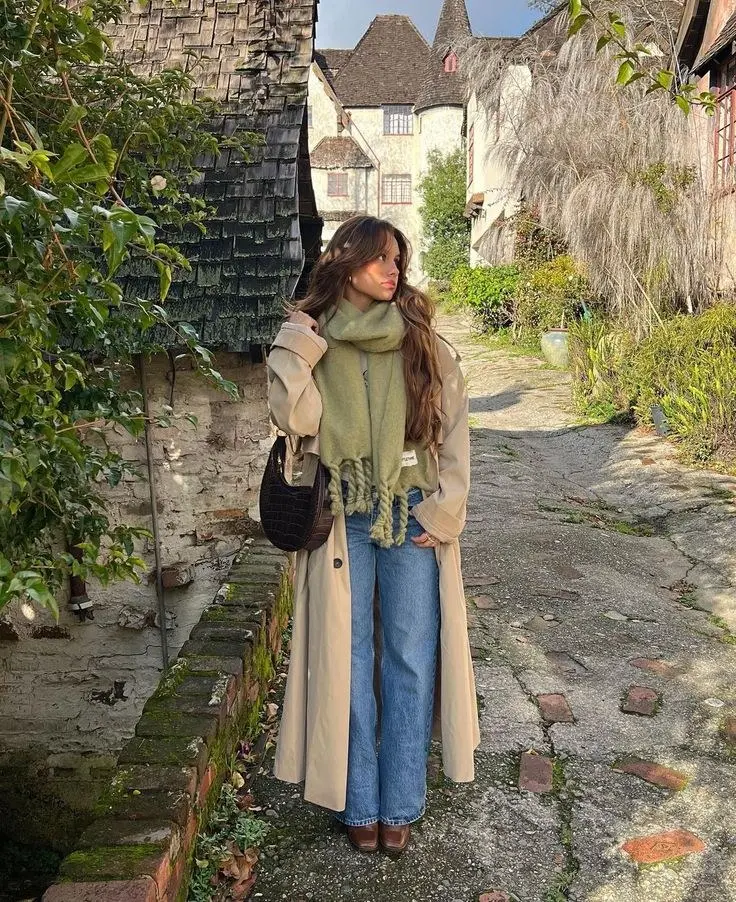
This combination works on almost every body type precisely because the trench creates one continuous vertical line. Width of jeans is balanced by the coat’s length. The scarf adds color at the collar without shortening the neck — it just drapes, it does not wrap tightly.
The croc-textured bag in dark chocolate is doing subtle texture work: it echoes the brown boots while the smooth leather of the coat creates contrast. That material conversation is very Italian — nothing is random, even when it looks thrown together.
A trench in gabardine or a cotton-poly blend holds its shape through the season without looking stiff. Avoid anything with obvious padding or structured shoulders here — the drape needs to look like gravity, not engineering.
The green scarf is made of what appears to be a heavy wool-blend — that chunky tassel fringe is the deliberate textural moment that stops the outfit from reading as too polished. That friction between formal (trench) and relaxed (fringed scarf, jeans) is the whole point of italian fall trend outfits done right.
Rule 2: Mix Eras, Not Just Textures — Cable-Knit Vest + Puff-Sleeve Blouse + Dark Jeans
This outfit is built on one specific Italian styling instinct: the idea that an outfit becomes more interesting when it contains things from different historical moments. A cable-knit sweater vest reads countryside-traditional, a white blouse with voluminous puff sleeves reads almost Victorian, and faded dark jeans read contemporary. Together they create something that has no single decade — which is exactly what makes it feel personal rather than trend-chasing.
The large wooden bead necklace is the punctuation mark that confirms the mix is intentional. Without it, someone might assume the blouse-and-vest combination is an accident. With it, you understand this person knows exactly what they are doing.
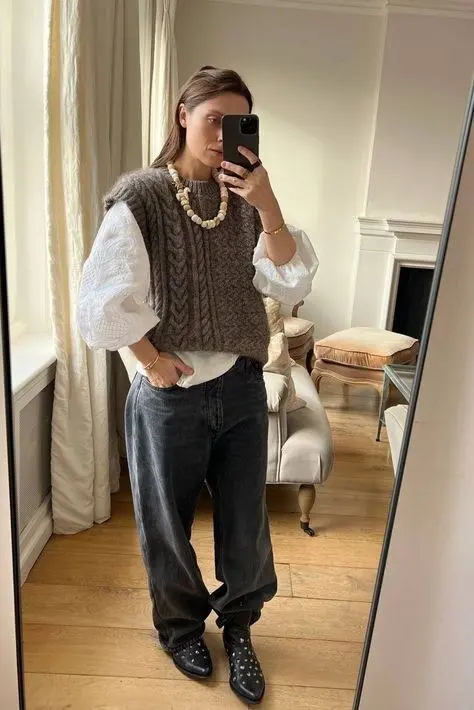
The cable-knit sweater vest in warm brown is the key piece — it bridges the blouse and the jeans structurally, adding mid-layer bulk that balances the volume of the sleeves below. The studded black ankle boots ground the whole thing and add a modern edge that stops it from reading as costume.
This look suits anyone comfortable with layering and not afraid of upper-body volume. The jeans are relaxed through the thigh without being baggy, which keeps the silhouette from becoming too amorphous.
The white blouse here needs to be something with genuine fabric interest — eyelet embroidery, broderie anglaise, or textured cotton. A plain oxford shirt would collapse this entire look. The Victorian quality of the sleeves is doing real aesthetic work.
For a deeper dive into how layering knitwear over shirts works across seasons, the same logic applies: the shirt’s collar and cuffs need to be visible to read as layering rather than just a warm-weather outfit with a vest thrown on top.
Rule 3: Monochrome Depth Over Surface Contrast — Dark Brown Plaid Jacket + Wide Trousers
When someone who has truly absorbed the Italian fall aesthetic gets dressed, they rarely reach for high contrast. Instead they work within a narrow tonal family and find depth through texture and pattern rather than color opposition. This look is entirely brown — a rich chocolate plaid cropped jacket over matching wide-leg dark trousers — yet it is visually complex because the plaid introduces pattern, the trouser weight introduces sheen, and the fringed scarf at the collar introduces softness.
The tan suede lace-up shoes at the hem are the one point of tonal relief — slightly lighter, same warm family. That is the move: break the monochrome with something from the same palette, not a contrasting one.
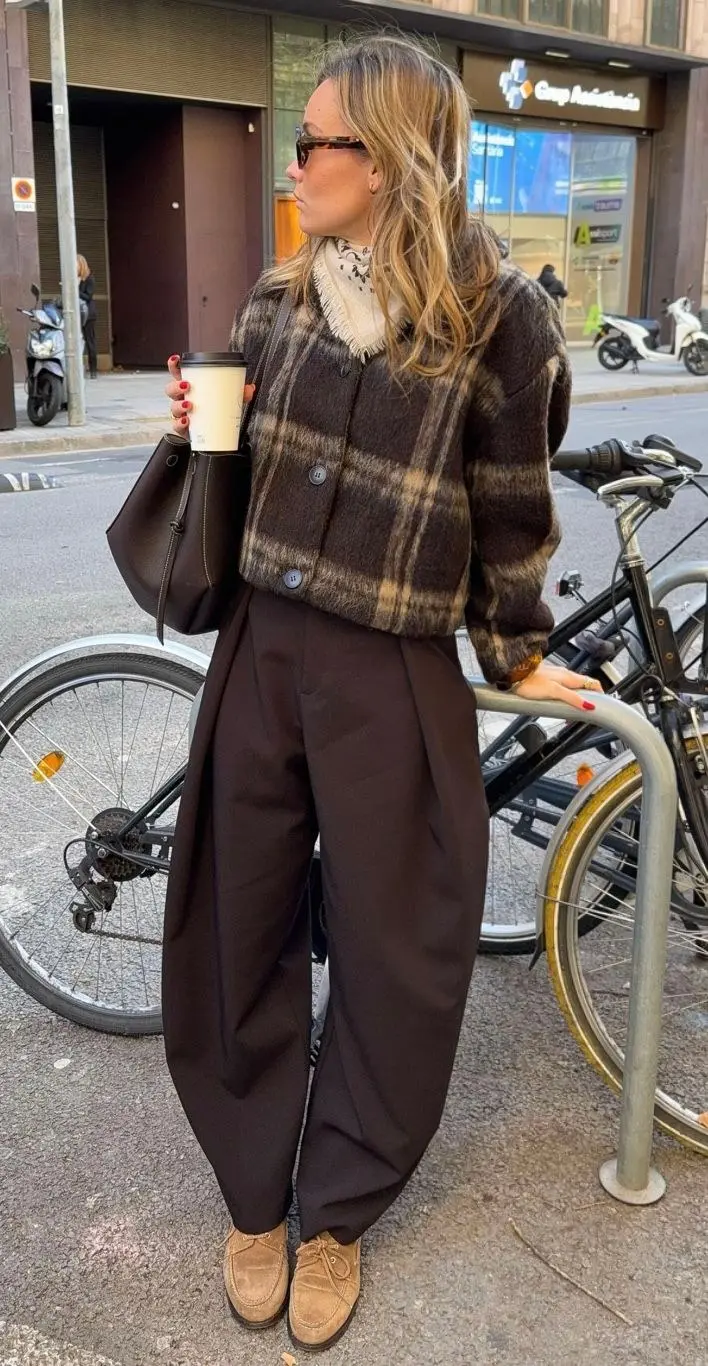
The cropped plaid jacket is doing the heavy lifting here. Its boxy silhouette paired with the enormous volume of the pleated trousers creates a deliberately exaggerated proportion — but because both pieces are in the same dark tonal family, it reads as intentional drama rather than a sizing mistake.
The dark chocolate structured tote bag disappears almost completely into the outfit, which is again intentional — it carries without competing. This is a look that rewards attention but does not demand it from across the room.
These wide-leg pleated trousers need weight to fall correctly — a heavy wool or thick cotton blend will hold the sculptural shape. Anything in a lighter fabric will collapse and look sloppy rather than architectural. For more ways to work oversized proportions, these wide-leg trouser outfit ideas show the same principle applied across different aesthetics.
Rule 4: The Deliberate Clash — Oversized Olive Cardigan + Striped Tee + Dark Jeans + Mary Janes
Here is where Italian fall dressing diverges sharply from old money or classic European style: it actively mixes registers. An oversized olive-green cardigan coat — the kind that looks half-sweater, half-jacket — worn over a navy striped Breton tee, tucked into dark raw-hem jeans, finished with buckled Mary Janes and sheer socks. The elements span sportswear, prep, utility, and girlhood simultaneously.
The reason this does not look chaotic is color control. Every piece stays within a muted, saturated palette — nothing bright, nothing pastel, nothing neon. The cardigan’s olive anchors the whole outfit and the navy stripe echoes it without matching.
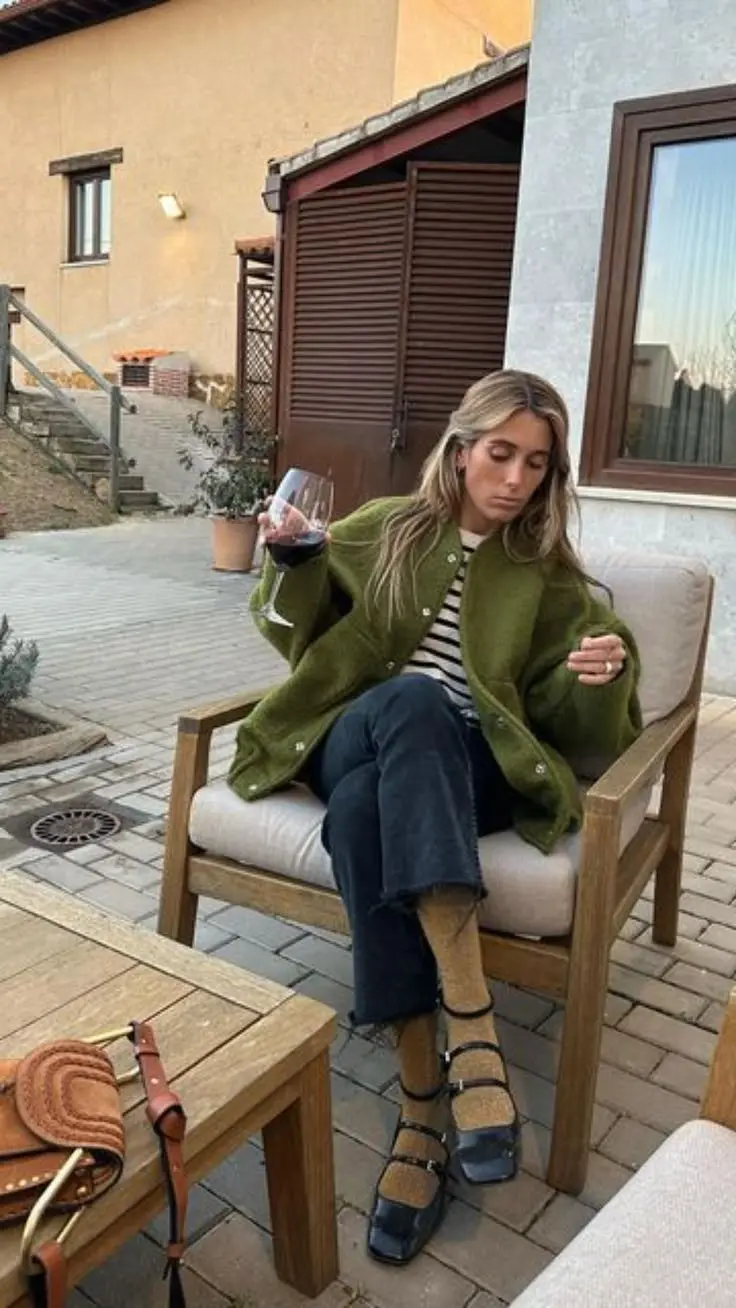
The oversized cardigan in olive green is the key investment piece here. It needs to be large enough to function like a coat — hitting at mid-thigh at minimum. A cardigan that is merely slightly oversized loses the whole point.
The Mary Jane shoes with sheer socks is the detail that separates this from a standard cardigan-and-jeans outfit. That one unexpected footwear choice signals that this person plays with fashion rather than just getting dressed. It is a small move with a disproportionate effect on the overall read.
Raw-hem jeans in a dark wash are doing important work at the bottom — the frayed edge against the sheer sock creates a deliberate unfinished quality that balances the deliberateness of everything above. If you swapped these for a clean-hem trouser, the outfit would immediately feel too intentional, too styled. The rawness is essential.
Rule 5: The Masculine Piece That Feminizes Everything It Touches — Suede Moto Jacket + White Midi Skirt
The suede or leather moto jacket over a flowing white midi skirt is one of the most reliable formulas in Italian fall dressing — and the reason it works is opposition. The jacket is structured, short, utilitarian, and rugged. The skirt is weightless, long, romantic, and soft. Neither piece would generate much interest alone. Together they create productive tension that makes both items look better than they are.
This outfit carries a Chanel quilted camel bag as the editorial piece and wears ivory ballet flats at the hem, both of which soften the jacket’s edge. The white graphic tee at the center is deliberately neutral — it refuses to take sides in the jacket-versus-skirt argument and lets the proportions do the talking.
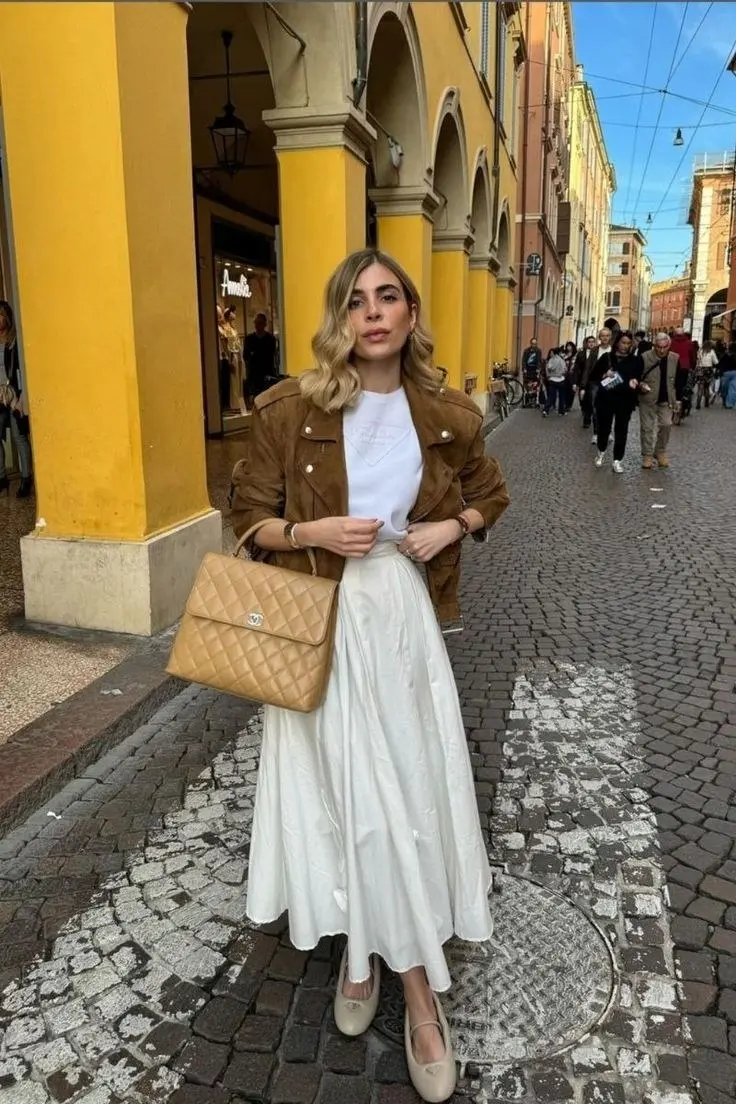
The tan suede moto jacket here is cut short enough to hit at the waist, which matters enormously. A longer leather jacket over a full skirt creates a different silhouette entirely — it compresses the waist and reads more 70s than Italian-editorial. The cropped length reveals the waist and lets the skirt’s volume breathe.
The bag in this image is a Chanel classic flap in camel — an unmistakably editorial piece that brings the look into luxury territory. For something that achieves the same visual weight without the investment, a quilted chain shoulder bag in camel leather reads almost identically from a distance.
The white midi skirt needs to have movement — a pleated cotton or a fluid crepe will catch light and contrast the jacket’s matte suede surface. A stiff structured skirt kills the romance of the pairing. For more ways this skirt silhouette works across seasons, the maxi and midi skirt outfit ideas here show exactly how much styling range the length has.
Rule 6: Proportion Inversion — Structured Tweed Jacket + Mini Skirt + Knee Boots
Italian fall dressing sometimes goes deliberately short rather than relying on midi or maxi length — but when it does, the proportion logic inverts. A long, oversized top layer (here a boxy brown and black plaid tweed jacket with gold buttons) worn over a very short leather mini skirt shifts the visual weight entirely to the top half. The knee-high dark brown boots fill the gap between hem and knee with a long unbroken vertical line.
This is one of the more structured looks in the Italian fall repertoire — the jacket’s gold button detail and Peter Pan collar read almost Parisian in their formality. Paired with the small Celine-style crossbody bag in deep burgundy, the overall effect is pulled-together without being corporate.
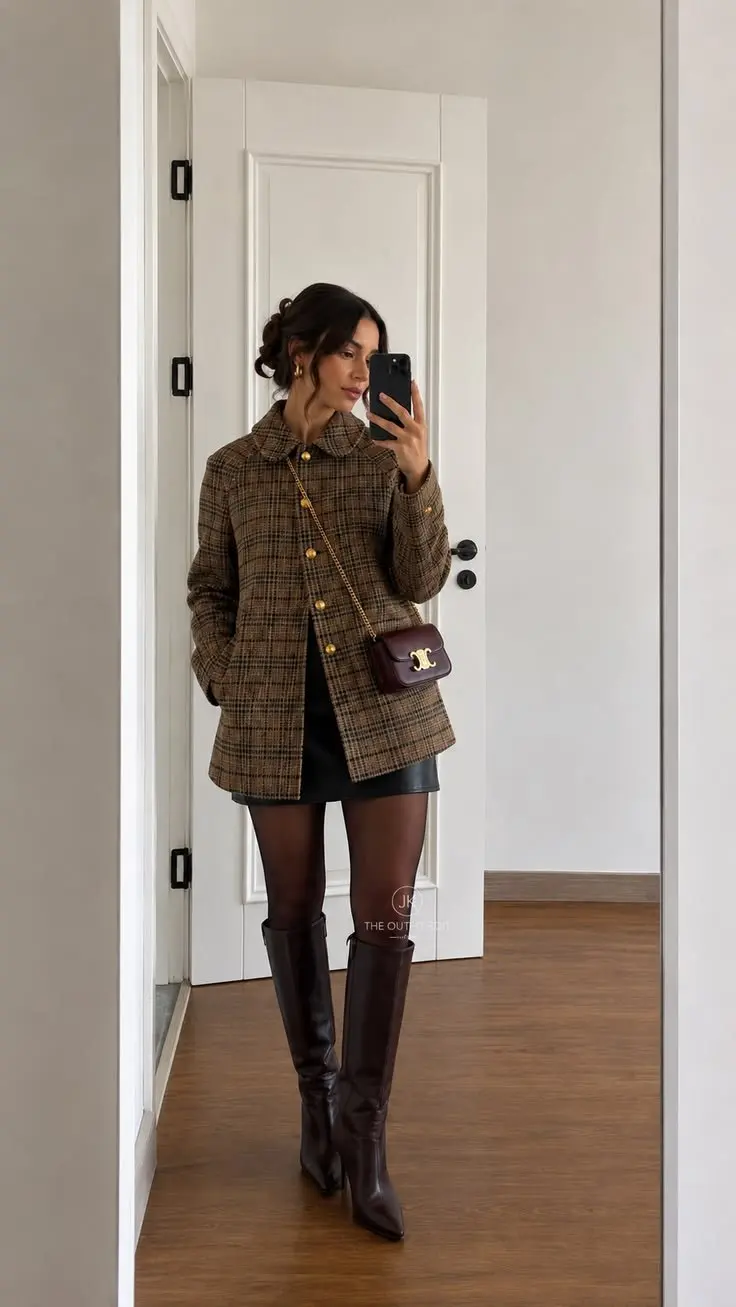
The plaid tweed jacket with gold buttons is the piece that makes or breaks this look. It has to be boxy enough to read as intentionally oversized over the mini — if it fits close to the body the whole proportion logic collapses. The structure of a tweed also matters: it should hold its shape at the shoulders without padding.
The dark chocolate knee-high boots are essential rather than optional here. Without them, the exposed leg between mini hem and ankle creates an awkward gap. The boots solve that problem by completing the long line from thigh to floor. Look for knee-high leather boots in dark brown with a modest heel — enough to elongate, not enough to change your gait.
The sheer tights connecting the mini and the boots are a crucial detail — bare legs would read as summer, opaque thick tights would read as strictly European winter. The sheer gives it a transitional quality that is right for the season. The burgundy crossbody bag is from Celine — but a small structured bag in wine leather achieves the same editorial effect at a fraction of the price.
Rule 7: The Unexpected Pairing — Brown Knit Cardigan + Polka Dot Satin Midi Skirt
One of the clearest signs that someone actually understands the Italian fall aesthetic rather than simply executing it from a mood board: they pair pieces that have no logical business being together and make it feel completely natural. A rich chocolate brown button-front knit cardigan — the kind with a turtleneck — over a cream and brown polka dot satin midi skirt is precisely that kind of pairing.
The knit is cozy and autumnal. The satin skirt is slippery and feminine. They are different temperatures, different moods, different histories. And yet the warm brown palette threading through both pieces makes the combination feel deliberate and considered. The dark brown suede ballet flats and a moon-shaped brown shoulder bag complete the tonal story without interrupting it.
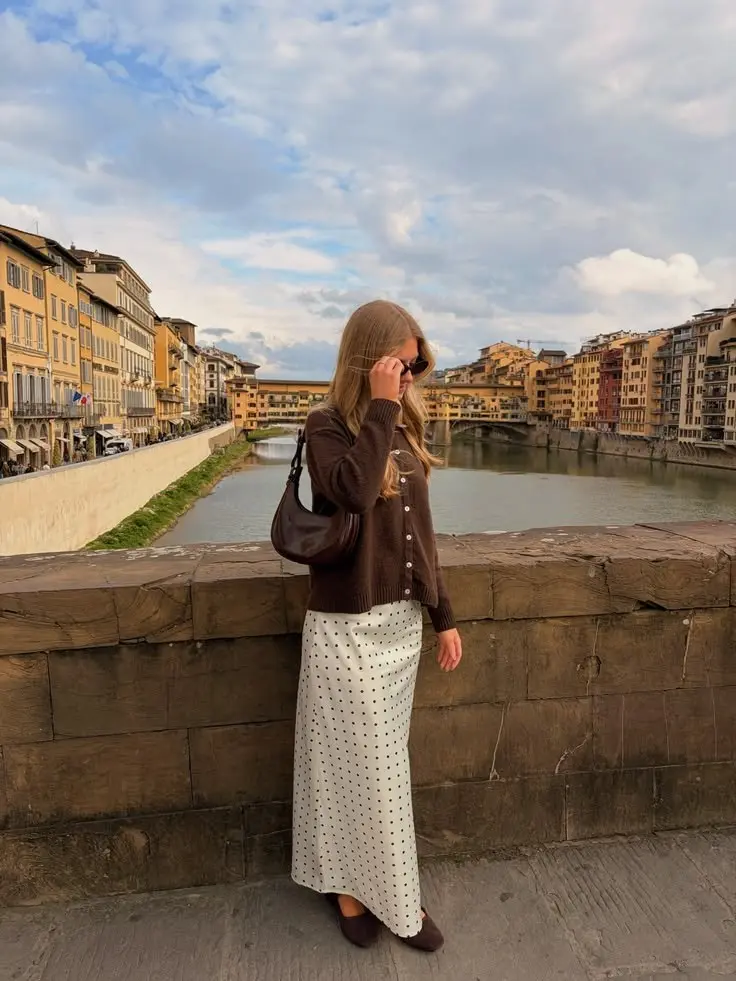
The polka dot satin midi skirt is doing something specific here: it introduces pattern and sheen into what would otherwise be a very matte, textural outfit. That shimmer against the matte knit creates exactly the kind of surface tension that Italian dressing loves. If you swapped the satin for a plain cotton skirt, you would lose the whole reason the pairing is interesting.
This look suits those who are comfortable with feminine silhouettes but want an edge of literary-intellectual via the heavy knit. It photographs beautifully because the two textures catch light differently — which is partly why this type of combination circulates so widely as an italian fall trend outfit reference.
The cardigan here needs to be long enough to tuck loosely into the skirt waistband, creating a slight blousing at the front. A short cardigan that sits above the waistband breaks the silhouette’s flow. Button it all the way up if you want a cleaner line, or leave the top two open if you want the turtleneck beneath to show — either works, but choose deliberately.
Rule 8: Pattern as Neutral — Rust Cardigan + Navy Plaid Wool Maxi Skirt
The instinct when wearing a plaid skirt is to pair it with something plain so the pattern can breathe. Italian fall dressing often rejects this instinct entirely — here a rust-brown fine-knit cardigan (with visible buttons and a slightly open neckline) sits over a voluminous navy-and-brown plaid maxi skirt without any apparent tension. Both pieces have pattern or texture; neither fights the other.
The reason it works is that the plaid is treated as a neutral — its navy and brown tones are darker and more complex than the cardigan’s rust, so the cardigan reads as the solid piece even though it has subtle knit texture. The brown suede loafers and the dark leather bucket bag on the ground stay so close to the plaid’s color story that they disappear into the outfit as supporting players.
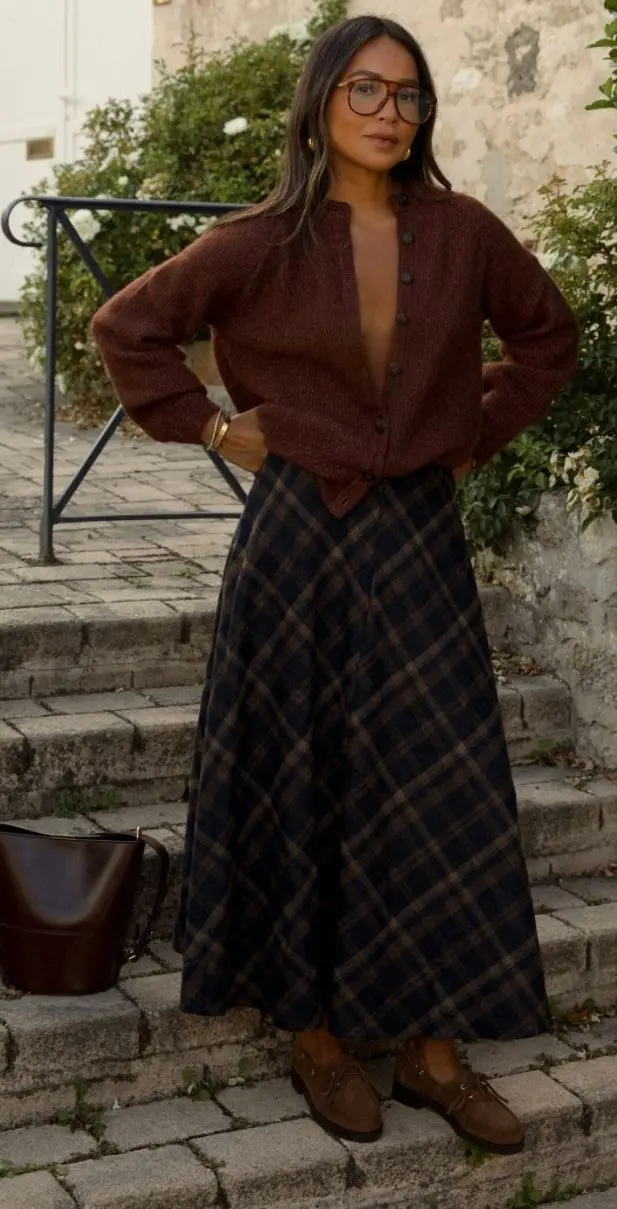
A plaid wool maxi skirt in a dark, complex tartan is the kind of piece that anchors an entire seasonal wardrobe — it works with almost any warm-toned top and reads as inherently European and considered. The A-line volume here is generous enough to create movement when walking, which gives the outfit life that a fitted skirt would not.
The oversized tortoiseshell aviator glasses are carrying style information without adding color — they are the accessory equivalent of a period detail, something that suggests this person has a point of view that goes beyond what they happened to find on sale this season.
The cardigan’s neckline is opened low enough to show collarbone and a hint of whatever is underneath — this slight revelation is important in Italian styling, which uses deliberate undressing to counter any reading of the outfit as too buttoned-up or conservative. It is a small move but it changes the entire temperature of the look. For more cardigan styling ideas that work across seasons, this cardigan guide covers the range.
Rule 9: The Utility Piece Worn Like Armor — Olive Waxed Jacket + White Shirt + Silk Scarf
There is a specific category of Italian fall dressing built around workwear and utility pieces — the Barbour-style waxed jacket, the field coat, the overshirt — worn in a context that is unmistakably not utilitarian. Here a dark olive waxed jacket sits over a crisp white shirt, paired with matching olive wide-leg trousers, a printed silk scarf at the neck, mini oval sunglasses, and a structured taupe tote bag. Nothing about this reads as functional. Everything about it reads as intentional.
The Hermès Birkin-style bag in taupe is the luxury anchor — in a look this dark and military-adjacent, it provides the visual counterweight that says this is fashion rather than uniform. For a bag that achieves the same structural impact, a large structured leather tote in taupe or greige reads similarly from a photo distance.
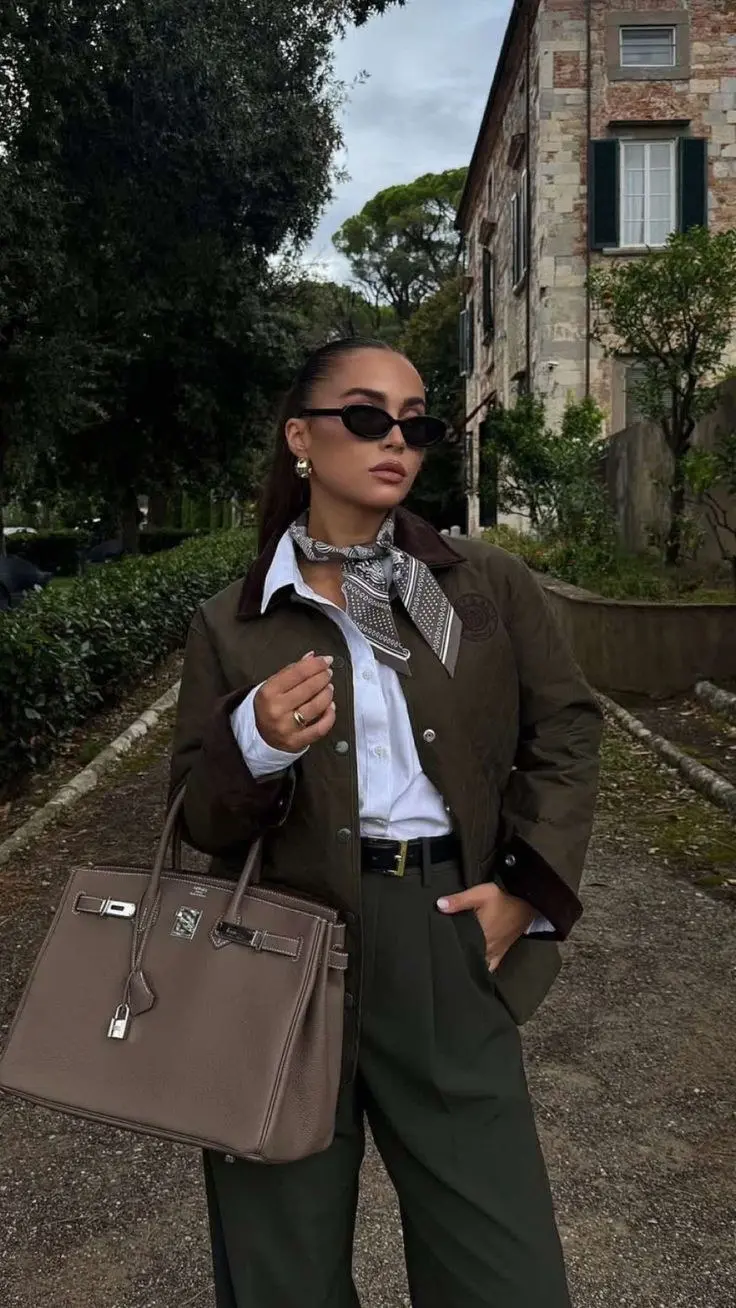
The white shirt underneath is not fully tucked — it creates a slightly layered effect where the collar extends beyond the jacket’s lapel, and the cuffs would presumably show if arms were down. That layering signal is essential: it tells you this person is wearing multiple considered pieces, not just a jacket.
The printed silk scarf tied loosely at the neck is doing something specific: it introduces a soft, feminine, printed element into an otherwise structured and utilitarian palette. Without it, this outfit would veer toward menswear. With it, it stays distinctly female and fashion-forward.
The head-to-toe olive with the taupe bag is a color story that requires confidence — it is not a combination most people reach for instinctively. But the restraint of staying within that earthy family while using the scarf to add pattern is precisely the kind of thinking that characterizes someone who has internalized italian fall trend outfits rather than just assembling them from references.
Rule 10: The Vintage Coat as Statement — Beige Mac Coat + Silk Head Scarf + Cap-Toe Ballet Flats
The single-breasted mac coat worn open over a layered collared shirt, with a large printed silk scarf tied over the head and a fuzzy circular bag held at the wrist — this is a look that could only exist if its wearer has a very specific and well-developed sense of personal style. Not because the pieces are rare, but because the combination requires the confidence to look slightly eccentric and completely unbothered about it.
The long beige mac coat is cut in a clean A-line that gives it a certain 1960s quality — its lack of a belt or any cinching means it falls as a single volume from shoulder to hem. The light blue collared shirt provides the crisp underlayer that keeps the whole thing from looking shapeless.
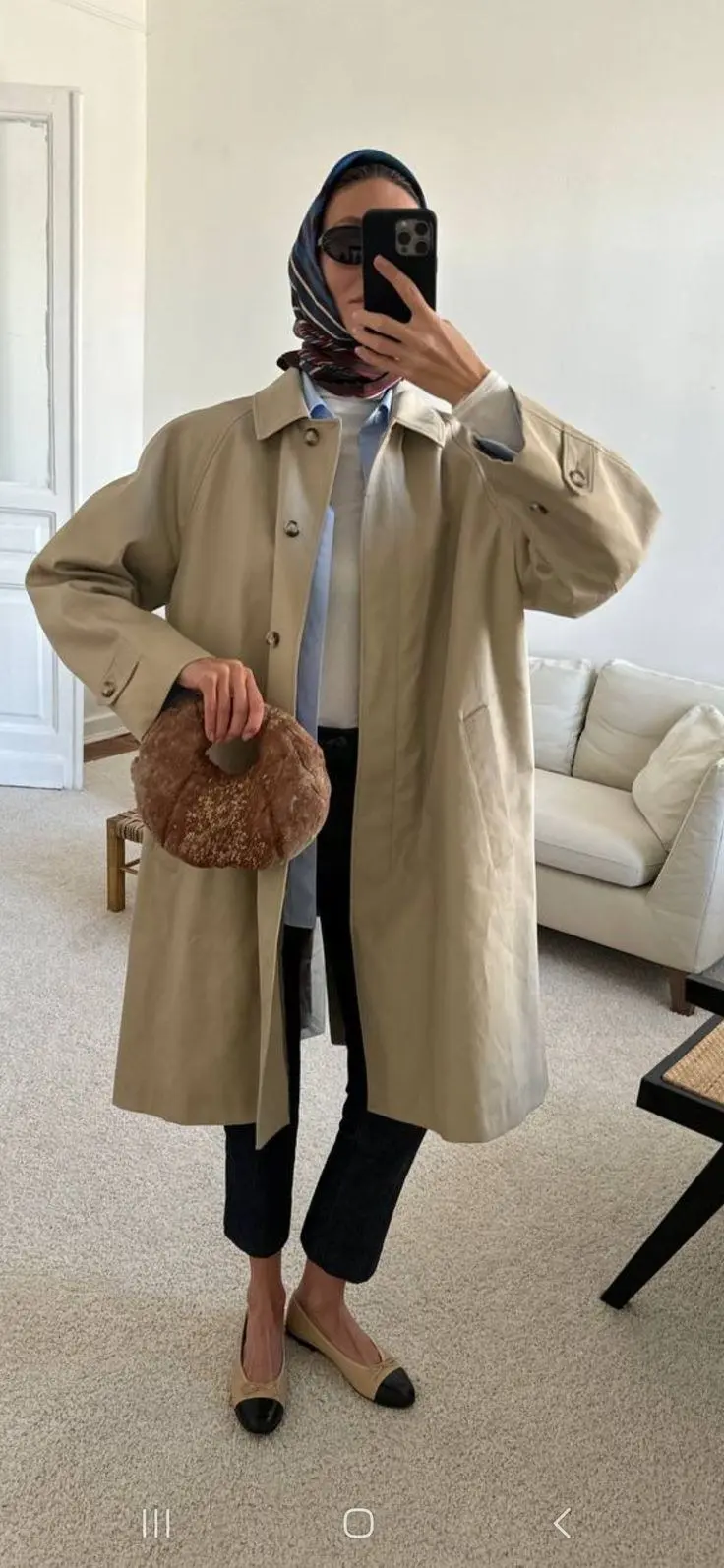
The head scarf in printed silk is the move that separates this from a simply nice coat outfit. Worn tied under the chin or loosely at the crown, it shifts the entire register of the look toward something more personal and deliberate — less ‘I put on a nice coat’ and more ‘I have a genuine aesthetic that I have been developing for a decade.’ The fuzzy circular bag adds textural surprise at the hand level.
The two-tone cap-toe ballet flats at the hem ground the look in something clean and slightly Parisian — they prevent the headscarf-mac combination from tipping into fancy dress. If you want more ways to wear ballet flats with fall-weight layers, these ballet flat outfit ideas cover the range.
Dark slim jeans at the center of this look are intentionally understated — they are the canvas, not a participant. Any slim dark trouser works here. The goal is vertical simplicity at the legs so the coat’s volume and the scarf’s pattern can carry all the visual interest from the waist up. This is the quiet authority that comes from knowing exactly what you are doing.
Rule 11: Hard Meets Soft — Black Leather Jacket + Plaid Bias Midi Skirt + Knee Boots
This is another application of the masculine-feminine opposition principle — but where outfit 5 used suede to soften the edge, here a proper black leather bomber jacket (oversized, boxy, with visible zip and hardware) is deliberately kept hard and urban. The contrast piece is a cream and caramel plaid bias-cut midi skirt that flows and moves with every step.
The oversized black leather jacket sits completely outside the color story of the skirt — and that contrast is exactly the point. There is no attempt to harmonize. The leather is hard and the skirt is soft and the tension between them is the outfit.
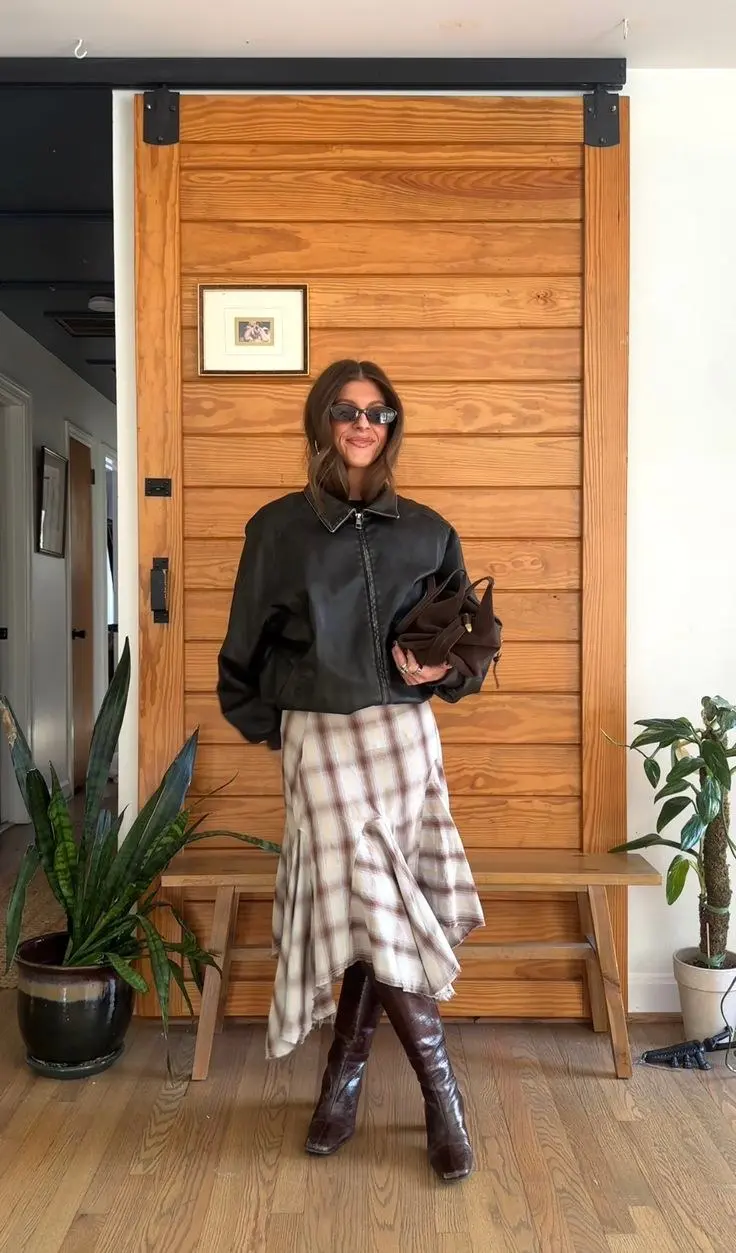
The knee-high dark brown boots underneath the skirt hem add warmth and a slight equestrian note — they bridge the black jacket and the caramel plaid without matching either exactly. The dark chocolate hobo bag at the wrist continues the brown family without completing a matchy-matchy set.
The small oval sunglasses with grey lenses and a half-up hairstyle keep the head area minimal — important when the rest of the outfit is generating a lot of visual complexity through the jacket-skirt contrast. This is a look that photographed well because the plaid’s diagonal cut creates movement even in a still image.
A bias-cut plaid skirt needs to be in a fabric with enough weight to hold its diagonal cut — lightweight cotton will puddle. Wool blend or heavy viscose challis will create the elegant swing that makes this silhouette so appealing in fall. The plaid bias-cut midi skirt is currently one of the most referenced pieces in the Italian fall aesthetic — and for good reason, it photographs beautifully and works with almost any jacket you already own.
Rule 12: The Scarf Does the Talking — Brown Leather Jacket + Wide-Leg Jeans + Printed Silk Scarf
Every Italian fall dresser I research seems to understand something about silk scarves that most American dressers miss: the scarf is not an add-on. It is often the single most important piece in the outfit, the one that shifts a fairly normal combination into something that reads as distinctly European and deeply considered.
Here a warm cognac-brown leather overshirt-jacket (button-front, boxy, slightly longer than a trucker) is worn over a white crewneck, with wide-leg light-wash jeans and a cream shoulder bag. A relatively standard combination on its own. Then a large printed multicolor silk scarf is looped loosely around the neck — and the entire outfit moves up several registers.
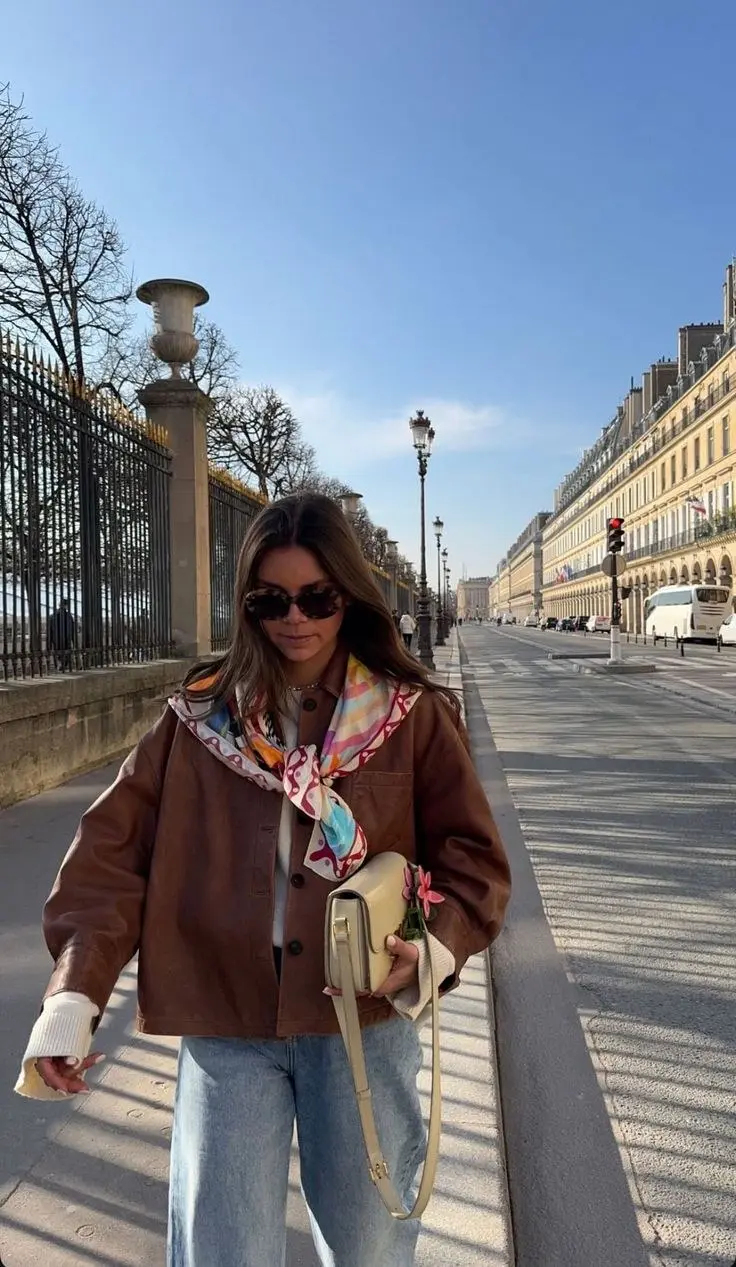
The scarf here is printed with saturated colors — pinks, blues, yellows — that would dominate any other piece in the outfit. But because the rest of the look is restrained warm neutrals, the scarf reads as the controlled release of personality. It tells you who this person is without requiring any other piece to do the work.
The cognac brown leather overshirt jacket is an extremely versatile piece for fall — it sits between a jacket and a shirt in formality, which means it works over almost any layer and under almost any coat. The visible ribbed cuff of a white layer underneath is an intentional detail, showing the layering rather than hiding it.
The cream mini shoulder bag with a small flower detail is exactly the right scale here — small enough not to compete with the scarf, present enough to add a feminine note. A large tote would overwhelm; a belt bag would be too casual. Size calibration in accessories is something Italian fall dressing takes seriously. For more on earthy toned bags that complement warm-palette outfits, the suede bag edit is worth bookmarking.
Rule 13: Layered Collars as Architecture — Cream Sweater + Striped Shirt + Wide-Leg Jeans
The layered collar look — a sweater over a shirt so that the shirt’s collar and cuffs extend beyond the knitwear — is one of the foundational techniques in Italian fall dressing. It communicates that you are wearing multiple pieces with intention, that you understand proportion and detail, and that you are paying attention to the inches of fabric visible at the neck and wrist.
Here a cream ribbed crewneck sweater sits over a navy-striped Breton-style shirt. The stripe peeking above the neckline and below the cuffs does the architectural work — it adds pattern without requiring any other patterned piece in the outfit. The wide-leg medium-wash jeans and dark brown knee-high leather boots create a clean base.
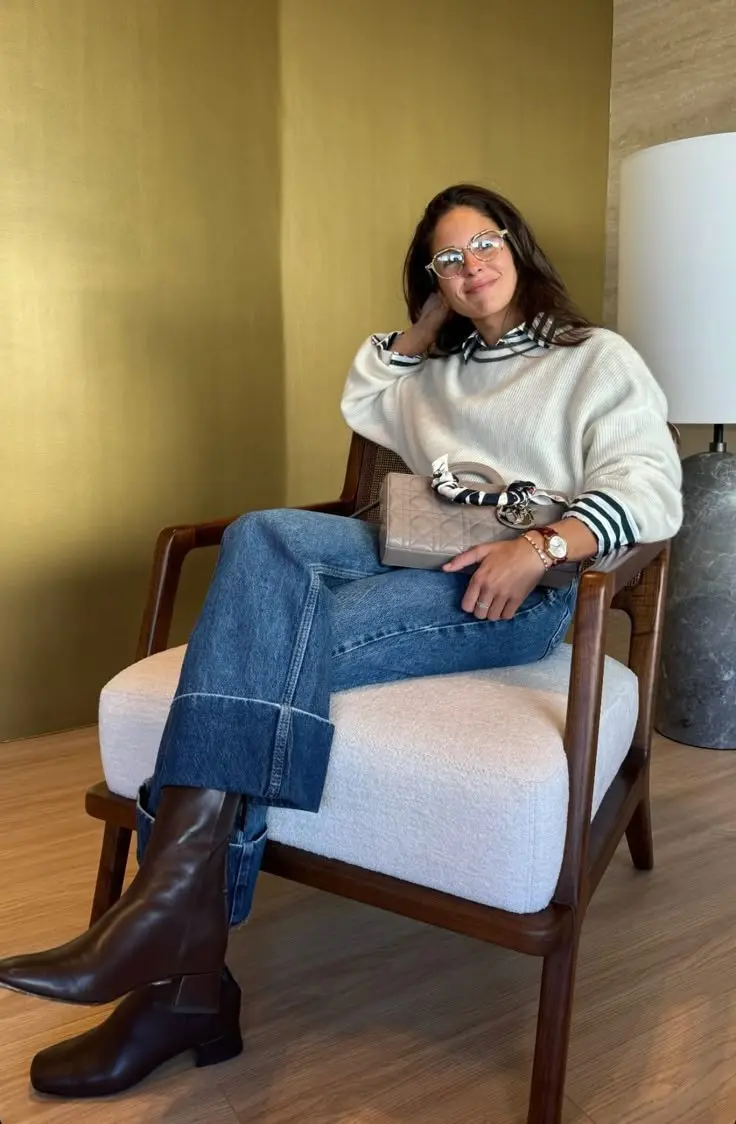
The Dior-style quilted bag resting in the lap is clearly a luxury editorial piece — its presence here anchors the look in a specific register. But the actual styling principle does not require it: a small structured crossbody or a rectangular frame bag in caramel or cream achieves the same visual result. Look for a structured rectangular bag in warm ivory or caramel for the same proportion effect.
The round clear-frame glasses and a silk scarf tied to the wrist (not shown clearly but implied by the bracelet detail) are the finishing elements that confirm this person is thinking about every inch of the look.
The dark brown knee-high boots are doing exactly what they did in outfit 6 — filling the gap between jeans hem and floor with a long unbroken line. The jeans are wide enough that the boots are partially hidden, which is the correct proportion for this leg opening. A skinny jean over a knee boot looks dated; a wide leg that grazes the boot shaft looks current and considered. For more ideas in this direction, wide-leg trouser outfit ideas show how the proportion works across multiple styling directions.
Rule 14: Color as Punctuation — Navy Coat + Camel Turtleneck + Wide Jeans + Burgundy Boots
Here is a rule about color that Italian fall dressing applies consistently: use one unexpected color as punctuation — not as the main theme, just as a single note that makes everything around it more interesting. In this look, nearly everything is neutral: a long structured navy coat, a camel turtleneck visible at the collar, wide-leg blue jeans, a chocolate suede crescent bag. And then: deep burgundy block-heeled square-toe boots that pull the eye immediately to the foot.
The boots are not matching anything else. They are not even in the same color family as most of the outfit. But they are so perfectly placed — that deep wine against the light denim — that they make the whole look feel finished in a way that brown or black boots never would.
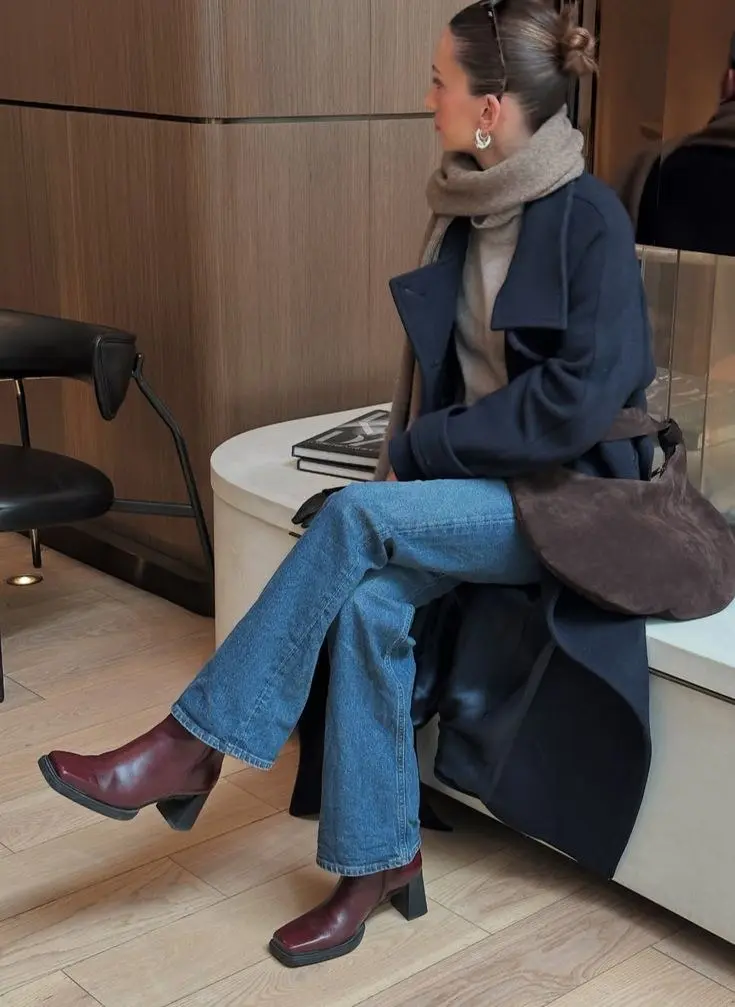
The burgundy block-heeled square-toe boots are the most important piece in this outfit. The coat is beautiful, the scarf is good, but the boots are what make this image save-worthy. They are making an argument: that neutral dressing is not the same as boring dressing, and that one punctuation piece in an unexpected color does more than a whole color-coordinated outfit.
The navy long coat itself needs to be in a heavy structured fabric — wool, cashmere blend, or thick cotton twill. Its belted tie hangs loose and open, which gives it a relaxed quality despite its formal cut. Gold hoop earrings at the face provide the only other color break, small enough to whisper rather than shout.
The camel turtleneck visible above the coat collar is doing quiet work — it warms the cold navy tonally, adds a layer visible at the neck, and connects to the suede bag’s warm brown. These details are not accidents in a well-assembled italian fall trend outfit. They are the thinking that separates someone who reads as stylish from someone who reads as simply well-dressed.
Rule 15: The Coat as Protagonist — Deep Red Wool Coat + Flare Jeans + Red Heels
Sometimes the Italian fall aesthetic goes maximalist in a very specific way: it commits to a single bold color so completely that the outfit becomes about the color itself. This deep red — almost wine, almost burgundy — is not a detail or a punctuation mark. It is the whole story. A long, sweeping red wool coat worn open, with matching deep red pointed-toe kitten heels, and a small brown-red box bag in hand.
The wide-leg jeans underneath are the deliberate neutralizer. They are clean medium-wash denim that simply get out of the way of the coat’s theater. This is the inverse of rule 14 — instead of using color as punctuation, color becomes the protagonist and everything else steps back.
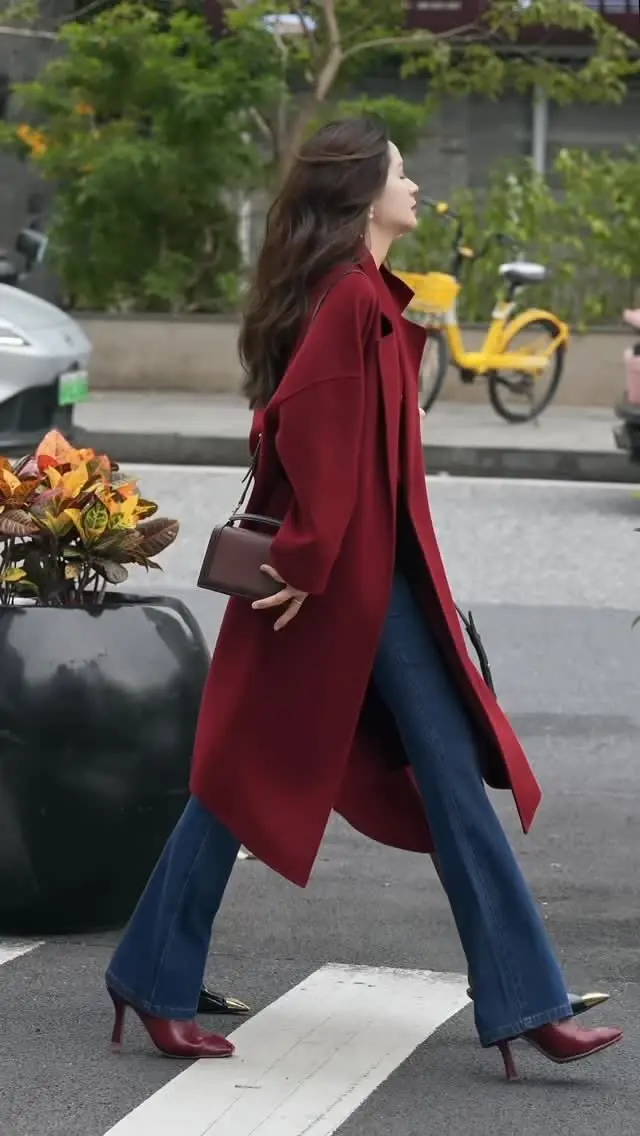
The long red wool coat here has a slightly wrapped silhouette with lapels — it is not a boxy overcoat but something more draped and soft, which gives it movement as she walks. That movement is essential to how this look reads. A stiff structured red coat would look costumed; a flowing one looks comme il faut.
The matching red pointed-toe heels are a harder choice to replicate without looking overly coordinated — but they work here because the coat is so dominant that the shoes read as an extension of it rather than a separate matching piece. For anyone who wants to approach this more cautiously, a nude or camel heel achieves a cleaner result while still letting the coat dominate.
Wide-leg jeans with a slight flare are the exact right trouser here — enough flare to create movement at the hem that echoes the coat’s sweep, but not enough to compete with the coat’s volume. The gold-tipped heel on the red shoe is a tiny detail that elevates the shoe from statement to considered statement. Small things like that are what distinguish Italian fall dressing from simply wearing a red coat.
Rule 16: Denim Reframed — Oversized Denim Jacket + Printed Scarf + Black Trousers + Loafers
Denim appears in Italian fall dressing not as casual default but as a deliberate textural counterpoint. Here an oversized vintage-wash denim jacket is worn over a black turtleneck, with tailored black wide-leg trousers, black loafers with bit detail, and a large printed silk scarf tied loosely at the neck. A structured black top-handle bag completes the look.
The denim jacket reads as slightly rough and utilitarian — which is exactly what makes the rest of the outfit’s sophistication (tailored trousers, loafers, printed scarf, top-handle bag) register. Without the denim, this would be a very polished look. With it, the polished elements become interesting because there is an anchor pulling against them.
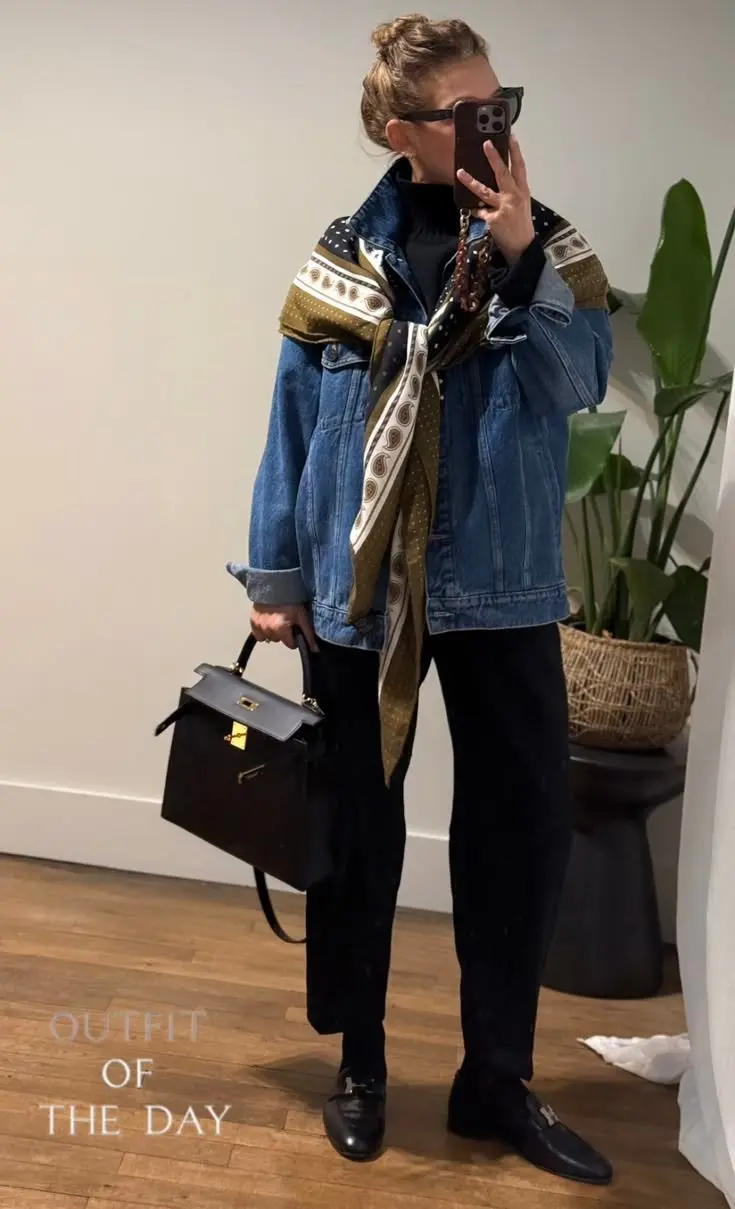
The oversized vintage-wash denim jacket needs to be genuinely large — not slightly relaxed, but properly boxy, with shoulder seams sitting away from the natural shoulder and sleeves that are slightly long. A close-fitting denim jacket loses this particular energy entirely.
The printed silk scarf tied in a loose knot at the front — with both ends hanging freely — is doing the same work it does in outfit 12: providing pattern, personality, and a European reference point all in one. The scarf here appears to mix khaki, cream, and black in its print, which connects it to both the denim and the black trousers simultaneously.
Black on black (turtleneck, trousers, loafers, bag) as the base layer of this outfit is a decision that simplifies everything below the jacket, creating a dark column that makes the denim read as clearly deliberate rather than lazy. The scarf is then the only disruption of that darkness — which amplifies its impact considerably. Styling loafers within this kind of layered, slightly austere look is one of the most consistently chic choices in the Italian fall aesthetic.
Rule 17: All-Black with One Texture Break — Leather Jacket + Black Trousers + Printed Scarf
All-black Italian fall dressing is its own discipline. The challenge is that without color contrast, the only tools available are texture, silhouette, and proportion — and all three need to be working simultaneously or the look reads as lazy rather than minimal. Here an oversized black leather utility jacket (with patch pockets and a boxy cut) sits over black wide-leg trousers, black loafers with socks, and a structured black top-handle bag. Then a large printed scarf — cream, khaki, and dark tones — is draped across the shoulders without being properly tied.
That casually draped scarf is the entire styling move. Everything else is in submission to the black palette. The scarf is the only permission given to pattern, the only visual relief, and it is worn so loosely that it reads as almost accidental — which is the highest compliment in Italian fall dressing.
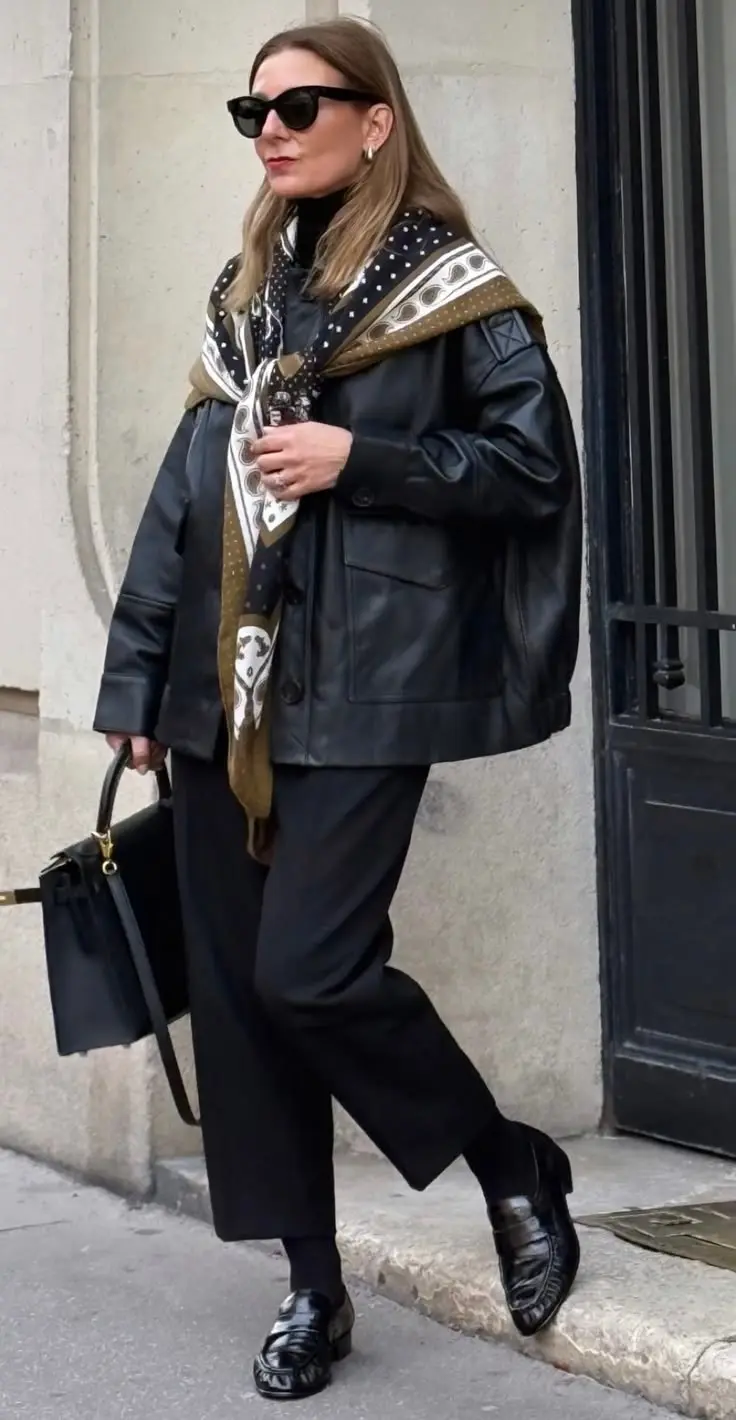
The oversized black leather utility jacket is the structural anchor here — its patch pockets and slightly military silhouette give the all-black palette enough shape variation that it does not collapse into a monolithic void. The wide trousers add volume at the leg that counters the jacket’s bulk at the shoulder.
The large cat-eye sunglasses in black acetate are a strong detail on the face — they reinforce the intentionality of the all-black commitment and add a slightly dramatic edge. Red lip is the one color note that exists entirely outside the palette, which in the logic of this outfit functions as punctuation in the same way the burgundy boots did in outfit 14.
This is one of the more advanced looks in the Italian fall repertoire because it relies entirely on understanding of proportion and texture — there is no color strategy to fall back on. The person who wears it confidently is the person who truly understands that italian fall trend outfits are not about what colors to use but about how to construct a look that communicates intention from across the street. The gap between inspired and pastiche shows up most clearly in all-black dressing: either you have the proportion exactly right, or it looks like you are simply wearing black clothes.
Rule 18: The Scarf as Only Ornament — Black Tee + Wide Trousers + Gold-Toned Scarf
Pared down to its minimum, Italian fall dressing can be a black crewneck tee tucked into high-waisted wide-leg black trousers, a structured black mini bag, black leather loafers — and a gold and brown printed satin scarf tied loosely at the neck. That is the entire outfit. No layering, no interesting textures competing, no proportion tricks. Just one silk rectangle doing all the personality work.
This is where the scarf’s role becomes most visible: it is not a supplement to the outfit. It is the outfit’s character. Remove it and you have corporate basics. Add it and you have something that reads as distinctly personal and European.
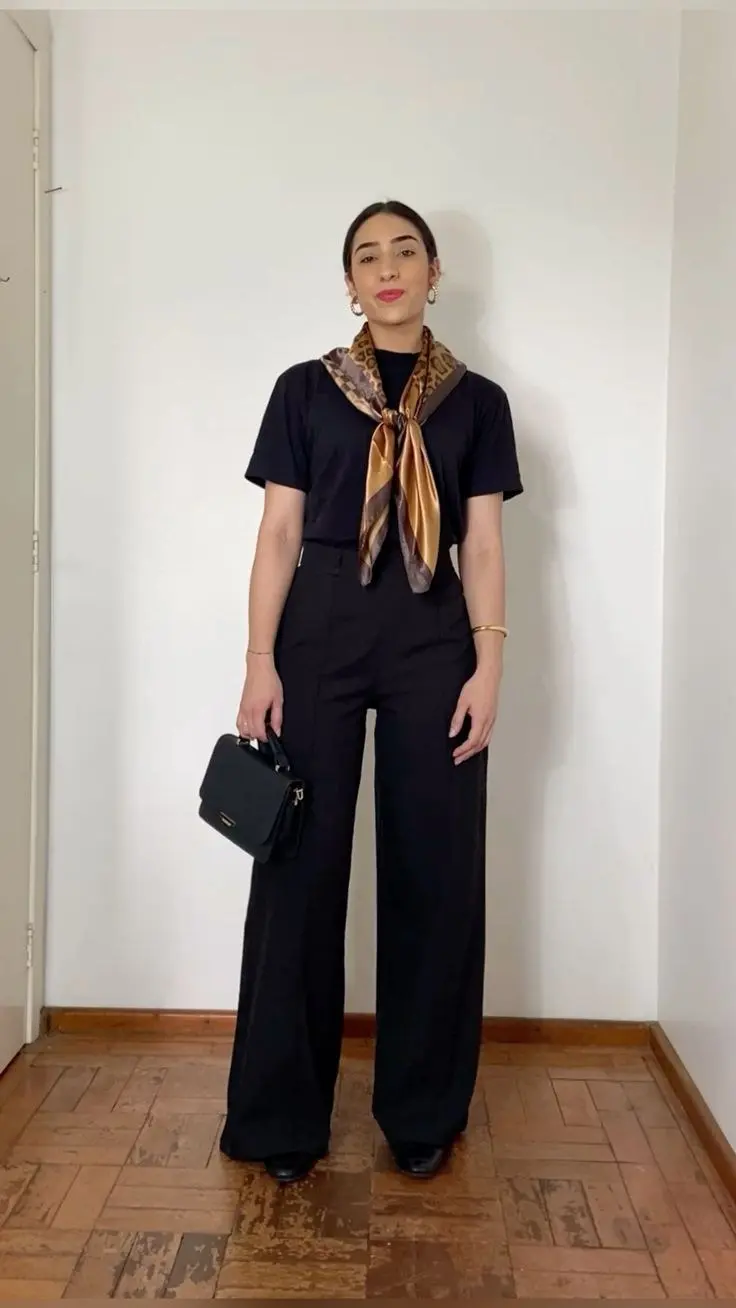
The gold and brown printed satin scarf is tied in a loose front knot — not tight, not a neat bow, just a loose loop that allows both ends to fall freely at different lengths. That asymmetry is important: a neat, symmetrical scarf knot reads as uniform or hostess; a loose casual knot reads as fashion.
The gold hoop earrings and the gold bangle repeat the scarf’s warm metallic tone, which creates a small internal color story that is more sophisticated than it first appears. The black trousers need a proper high waist and wide leg to create the proportions that make this otherwise minimal outfit feel considered rather than underdressed. Smart casual work outfit ideas often use this same formula: clean base, one personality piece.
The structured black mini top-handle bag is carrying enough visual weight to count as a second personality element — its gold hardware connects to the scarf’s tones. This is the attention to small connections that separates Italian fall dressing done thoughtfully from the same pieces assembled randomly. None of it is accidental, even when it looks effortless.
Rule 19: The Tonal Coat Moment — Deep Brown Trench + Wide Jeans + Ballet Flats
There is a specific look that circulates constantly in Italian fall dressing references: a long, structured coat in a deep single color — here chocolate brown, almost espresso — worn over wide-leg denim with ballet flats and a neck scarf. The Miu Miu-branded elongated leather bag in the image is an editorial piece, but the styling logic is entirely replicable.
The coat is worn open, belted loosely at the waist with a matching belt that disappears into the coat’s tonal story, and the jeans emerge below in a clean medium-wash that provides the only color contrast in the lower half. The ballet flats in dark brown-black keep the palette within the same family and avoid interrupting the long coat’s vertical line.
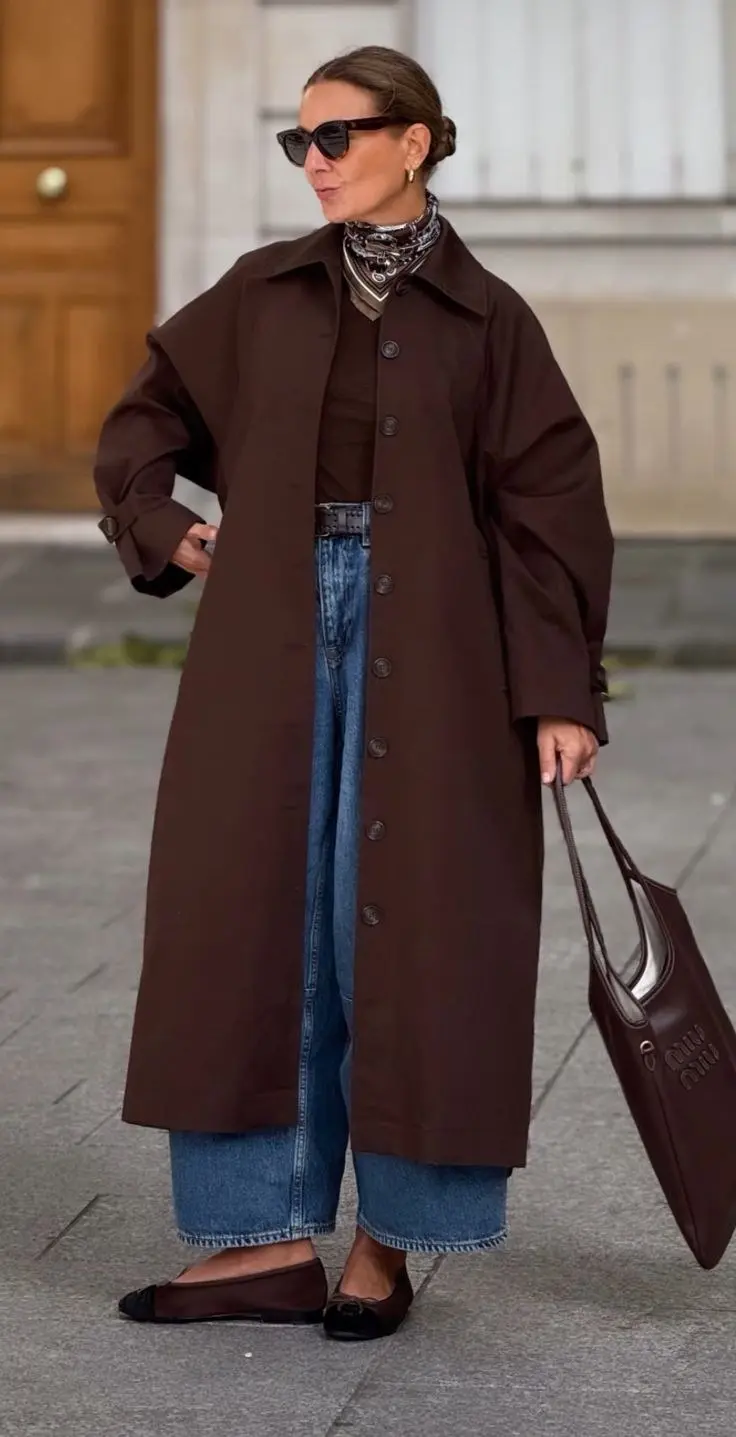
What makes this a strong Italian fall look rather than just a good coat outfit is the sum of small decisions: the scarf print at the neck adds pattern in a controlled way, the sunglasses are dark and oversized (reading as deliberately accessorized rather than practical), the hair is in a clean updo that exposes the scarf placement, and the bag’s unusual elongated shape adds interest without competing with the coat’s volume.
The long chocolate brown button-front trench coat is the investment piece that anchors a whole season’s worth of italian fall trend outfits. It works over everything from jeans to trousers to skirts, and in a deep enough brown it reads as richer and more personal than the standard camel.
The wide jeans here are cropped just enough at the hem to reveal the full ballet flat — this is a deliberate proportion choice that keeps the look from feeling heavy at the floor. The hem length of wide jeans matters enormously in fall dressing. Too long and they drag and read as sloppy; too short and the break disappears and the leg looks cut off. The right length grazes the top of the foot or lands just below the ankle bone. For more on how ballet flats work within this kind of layered fall wardrobe, the range is wider than most people assume.
Rule 20: Brown as a Base, Not a Default — Brown Corduroy Blazer + Silk Scarf + Black Jeans
Brown as a color in Italian fall dressing is not a safe choice or a default earthy tone — it is a genuine palette decision. Here a rich chocolate brown corduroy blazer with visible welt pockets sits over a deep burgundy-collar shirt with a printed scarf at the neck, over black wide-leg jeans, and dark brown knee-high pointed boots with a dark drawstring shoulder bag.
The corduroy texture of the blazer is doing significant work — its ribbed surface creates a matte, tactile quality that reads as vintage and considered rather than basic. Corduroy as a material signals a specific kind of taste: one that values texture and history over shine and newness.
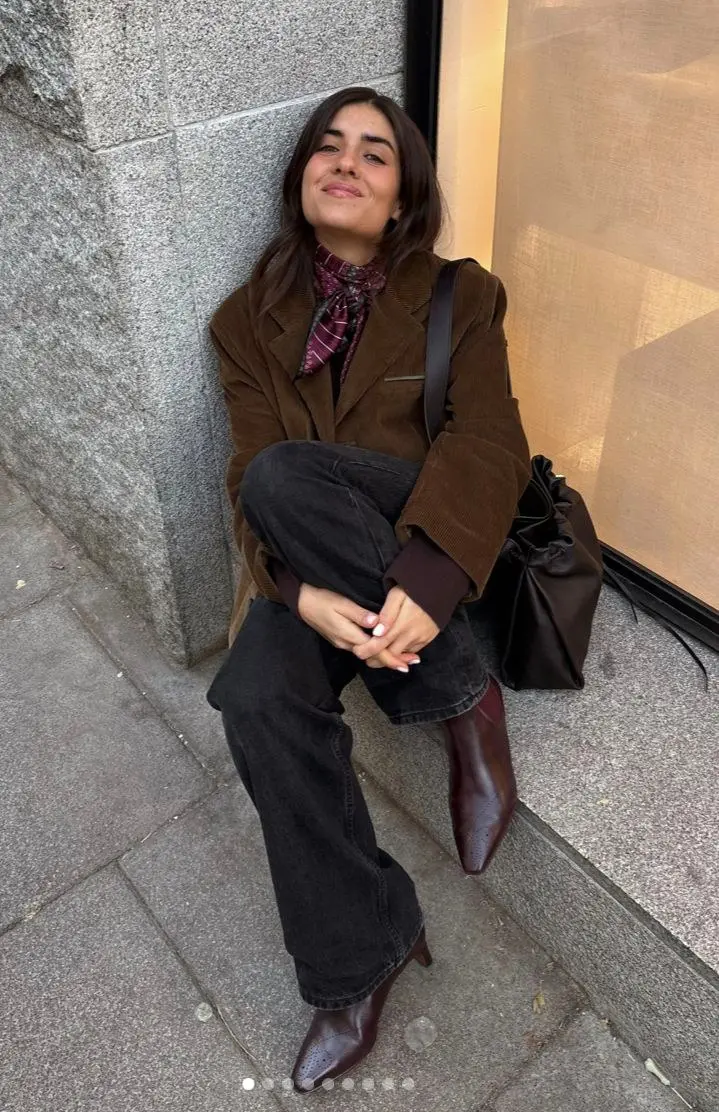
A chocolate brown corduroy blazer is one of the most useful pieces for building italian fall trend outfits — it adds instant warmth and texture to any base, works as a layer under a coat, and reads more interesting than a wool or jersey blazer in the same color. The visible welt pockets and lapel width matter: wider lapels read as more vintage and fashion-forward; narrower ones more corporate.
The printed scarf at the neck here is smaller and tied more tightly — a neckerchief effect rather than a loose drape — which changes its energy from free and Parisian to more precise and 1970s. The burgundy tones in the shirt collar and the boot’s dark wine connect across the look in a way that is not immediately obvious but rewards attention. For ideas on how brown jackets can anchor a full outfit palette, that guide covers the same logic applied to suede.
The dark drawstring shoulder bag at the back is intentionally casual — it introduces a relaxed note into what would otherwise be a fairly structured look (blazer, pointed boots, tailored jeans). That tension between the blazer’s structure and the bag’s casualness is again that productive friction that Italian fall dressing relies on. Nothing is allowed to be entirely one thing.
Rule 21: Contrast at the Neck — Black Blazer + White Wide Trousers + Sneakers
One of the more minimal looks in this collection, and possibly the most wearable: a black oversized blazer with a leather-look detail at the lapel, worn over a simple white tee, tucked into white wide-leg trousers with a narrow black belt, and finished with white leather sneakers. The belt is the only structural element; everything else is relaxed and slightly oversized.
The contrast here is entirely tonal — black above, white below — with the belt marking the territory between them. Small round sunglasses in dark frames and a low bun complete the head-to-toe deliberateness. This is the look where Italian fall dressing meets old money minimalism — clean, undecorated, entirely about proportion.
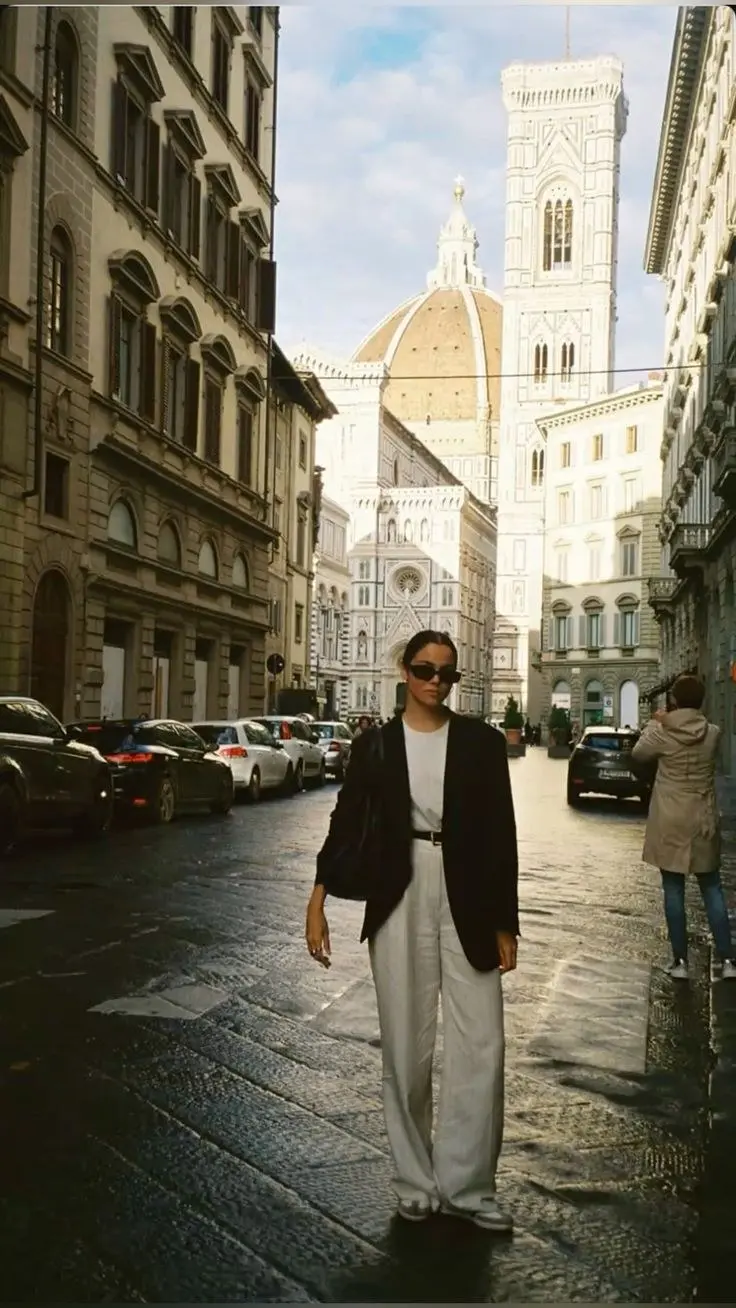
The black blazer with contrast lapel detail here has enough volume to count as a proper oversized piece — its shoulder seams sit dropped, giving it an easy, unstructured quality despite the formal structure of a blazer silhouette. The white wide trousers need to be in a fabric that drapes — linen, viscose blend, or heavy crepe — so they fall in clean vertical lines.
White leather sneakers instead of loafers or flats is a deliberate modernizing move — it keeps the look from reading as vintage or overly European and grounds it in something current and accessible. The whole point of this combination is its simplicity: it asks nothing of the wearer except confidence in proportion.
This is the look to start with if you are new to Italian fall dressing. It requires the fewest pieces, the least complex styling, and the most forgiving components. The skill required is entirely in fit — the blazer must be properly oversized (not just large), the trousers must have the right leg width and hem length, and the tuck of the tee into the waistband should be casual rather than precise. Wide-leg trouser outfits are the single fastest way to update a basic wardrobe toward this aesthetic.
Rule 22: The Long Coat as Identity — Dark Brown Duster + Grey Sweater + Blue Jeans + Loafers
There is a difference between wearing a coat and committing to it as your visual identity for the day. This look commits: a floor-length dark charcoal-brown duster coat worn fully open, over a taupe grey crewneck sweater, medium-wash straight jeans, and dark burgundy penny loafers, with a large cognac-brown leather tote bag slung over the shoulder.
The coat is the outfit. Everything inside it could be a student’s daily basics — and the person wearing this knows that. The coat elevates those basics into something that reads as considered because the coat itself is so commanding in its length and its color depth.
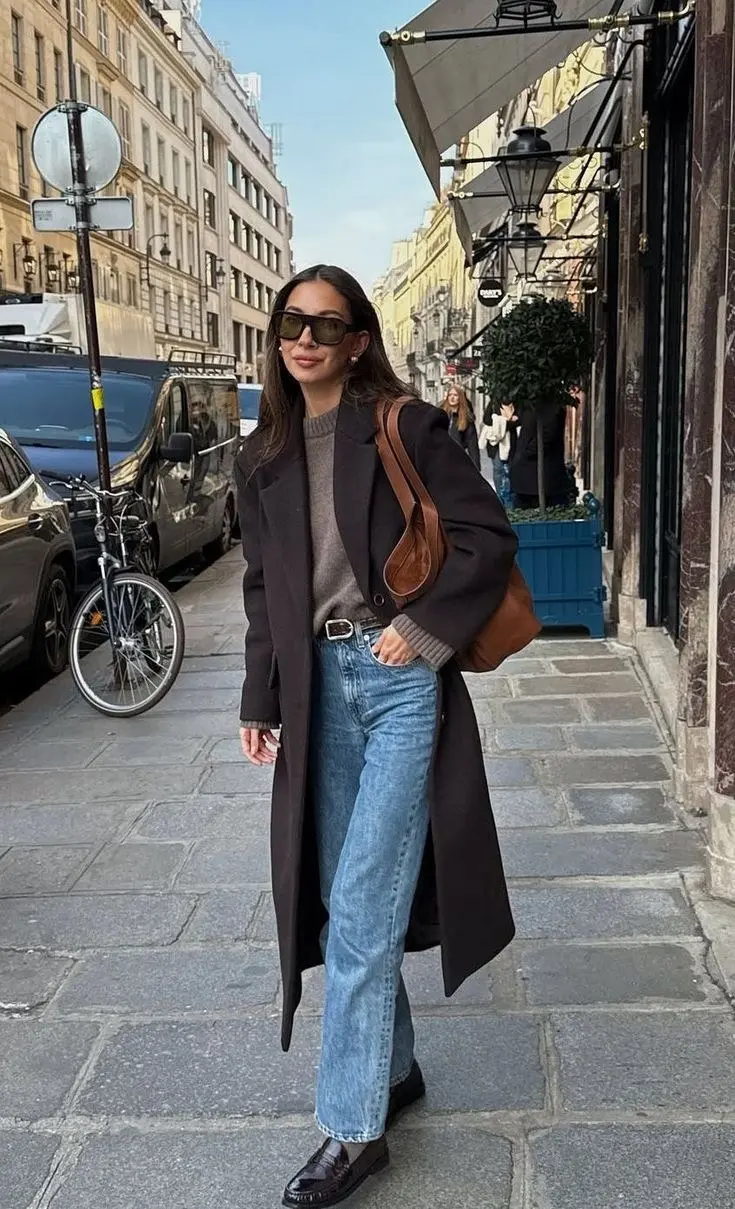
The long dark brown duster coat needs to be long enough to hit at or below mid-calf — anything shorter becomes a regular coat rather than a duster, and loses the drama. The shoulder width can be generous. The fabric should be heavy enough to hang without bunching at the sides when worn open.
The large cognac leather tote is doing important color work here — it is the one warm-toned element against the very cool dark coat, and it connects directly to the earthy bag palette that recurs throughout the Italian fall aesthetic. Pearl stud earrings at the face are the only jewelry visible — they are intentionally quiet against the coat’s volume.
Dark burgundy penny loafers are the perfect footwear choice here for the same reason burgundy boots worked in outfit 14: they provide color punctuation at the foot that the otherwise dark-neutral look needs. They also reinforce the European and slightly preppy quality of the loafer silhouette, which is entirely appropriate for the Italian fall register. For more on how loafers work within this wardrobe direction, the full loafer styling guide is a genuinely useful resource.
Rule 23: Check as a Neutral — Gingham Blazer + Grey Tee + Brown Trousers + Yellow Flats
What separates someone who owns this aesthetic from someone who is wearing a reference board is the presence of one unexpected element that no reference board would have predicted. In this outfit, that element is the bright yellow suede ballet flat against chocolate brown trousers and a black-and-cream gingham oversized blazer. Nothing on any Italian fall mood board would have generated that particular shoe choice — it came from someone who knows their own taste well enough to take a risk that no algorithm suggested.
The gingham blazer here is treated entirely as a neutral — its black and cream check is not the statement, it is the structural layer. The grey tee underneath and the warm brown wide-leg trousers are the base. The yellow shoe is the one move that makes the outfit personal rather than editorial.
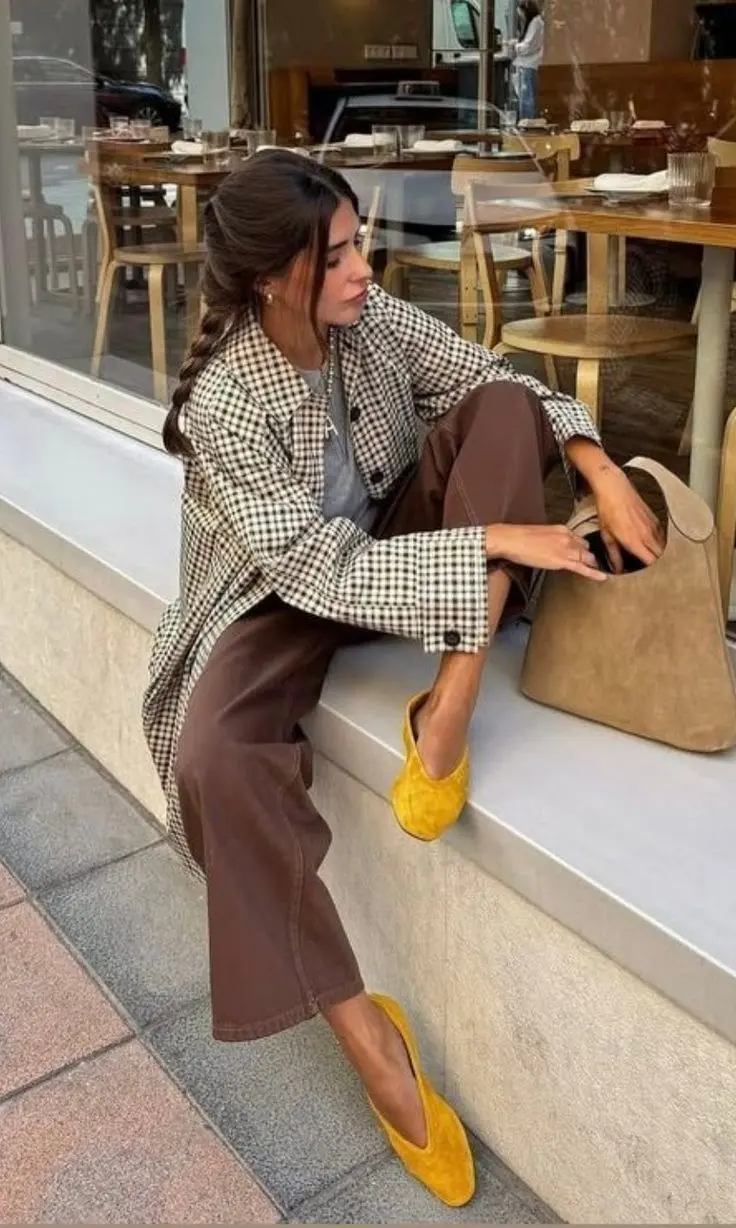
An oversized gingham blazer is one of the most versatile pieces in the Italian fall wardrobe — it works over everything from plain tees to knitwear, pairs with denim or tailored trousers, and reads as pattern without requiring any other loud element in the outfit. The key is wearing it genuinely oversized rather than fitted: the boxy version is the fashion-forward one.
The yellow suede ballet flats are the decision that would not appear on a reference board — and that is precisely the point. Italian fall dressing done at its best is not about assembling references correctly. It is about understanding the language well enough to add your own sentence to it. The suede texture of the flat connects to the brown trouser’s matte finish; the yellow breaks everything open.
A side-braided updo and delicate pearl drop earrings keep the head area intentional without competing with the blazer’s pattern. The small tote bag in natural sand suede disappears into the overall warm palette. This is a look that rewards close inspection — the more you look at it, the more decisions you find. That density of considered choices is what makes it feel like personal style rather than assembled fashion.
Rule 24: The Everyday Masterclass — Brown Cardigan + White Tee + Wide Jeans + Adidas
The final and most instructive look in this collection: a taupe-brown zip-up knit cardigan over a white tee, with medium-wash wide-leg jeans, brown and white Adidas Gazelle sneakers in tobacco suede, and round lavender-tinted glasses. A watch and a ring are the only jewelry. The setting is a garden café with a green juice on the table.
This is the look where Italian fall dressing meets real life — no drama, no architectural coat, no silk scarf required. And yet it is immediately recognizable as the same aesthetic as everything else in this collection because the color decisions are right (warm brown, white, warm denim), the proportions are right (wide leg balanced by a close-fitting but not tight cardigan), and the footwear is doing its job (the brown Adidas connects the cardigan’s color to the shoe without matching it).
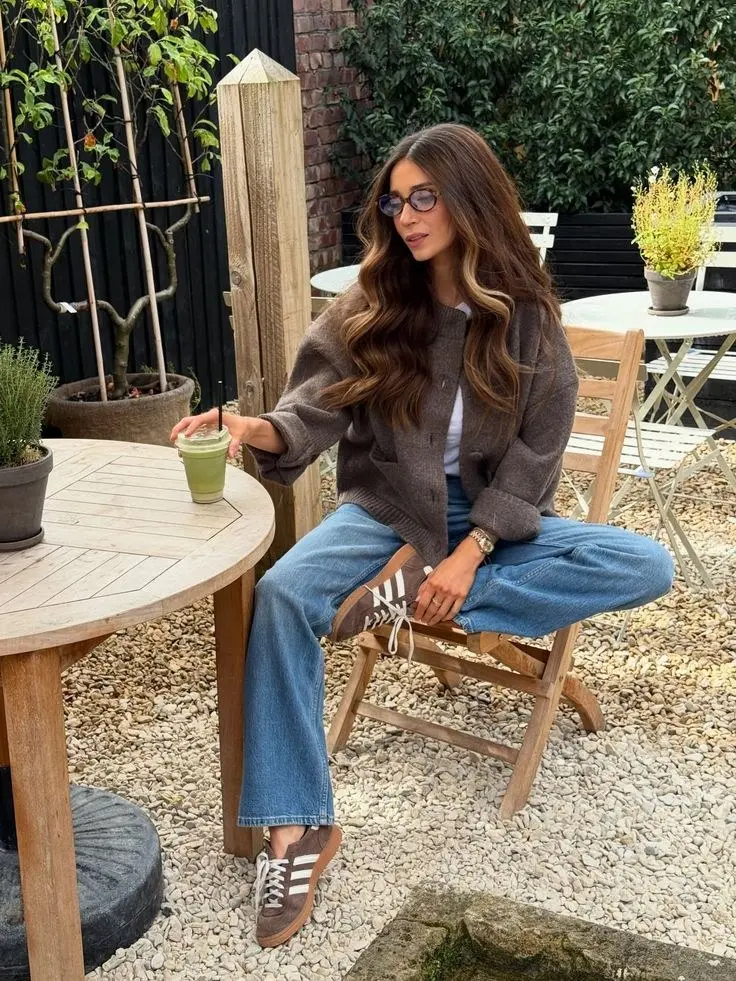
The brown zip-front knit cardigan is an extremely useful piece — it layers over tees, under coats, over shirts, and reads as casual or smart depending on what it is paired with. The zip allows proportion control: half-zip gives a different neckline than fully open. Here it sits open at the collar with the white tee visible below.
The Adidas Gazelle in a tobacco brown suede colorway is one of the most naturalistic sneaker choices for this aesthetic — its low profile and warm color tone work within the Italian fall palette in a way that bright white sneakers or chunky trainers do not. For more on how these sneakers work across different outfit directions, building a capsule around Adidas Gazelles is worth reading.
This is the look that proves the point: Italian fall dressing is not about expensive pieces or rare finds or a wardrobe transplant. It is about understanding the rules — hierarchy, proportion, tonal control, texture friction, the one unexpected element — well enough to apply them to jeans and a cardigan on a Tuesday. When the rules become instinct, you stop looking like you are wearing a reference board and start looking like yourself. That is when the aesthetic becomes a language rather than a costume.
The Actual Rules Behind Italian Fall Style
Italian fall dressing has a contradiction at its heart: it looks like nothing is being tried, but it requires more thinking than most overtly fashion-forward aesthetics. The looks that read most effortlessly are usually the ones where the most decisions were made — about proportion, about which texture goes next to which other texture, about where to introduce a single unexpected element and where to hold back. Understanding this is the difference between borrowing a look and actually wearing an aesthetic.
The color logic is the first thing to internalize. Italian fall dressing works in tight tonal families — deep brown, camel, olive, burgundy, navy, charcoal — and does not scatter across the color wheel. When a bright or unexpected color appears (yellow shoes, burgundy boots against a neutral coat), it functions as a single note, not a chord. One color decision per outfit. Everything else defers to the tonal family the coat or the main piece has established. This is why head-to-toe looks in this aesthetic work: they are not boring, they are committed.
The second rule is about texture friction. Italian fall dressing consistently pairs things that have different surface qualities — matte corduroy with shiny satin, rough waxed cotton with fine silk, heavy cable knit with flowing bias-cut fabric. That friction between surfaces is what makes an outfit feel three-dimensional rather than flat. If every piece in the outfit has the same texture finish, the look collapses into something forgettable regardless of how expensive or well-chosen the individual pieces are.
The third rule is about the one rule-breaking element. The person who has truly absorbed this aesthetic always has one thing in the outfit that nobody would have predicted: the yellow suede flat, the head scarf worn over a mac coat, the silk scarf draped on an all-black look, the wine-colored ankle boot against a navy coat. That one element is what makes the look personal rather than editorial — it signals that this person has enough confidence in the language to add their own sentence. Without it, even the most beautifully executed Italian fall outfit reads as good curation rather than genuine personal style. The line between inspired and pastiche is almost always located at that one element: either you found it yourself, or you found it on a reference board. The difference shows.
Start with the Rule, Not the Reference
If you take one thing from these 24 italian fall trend outfits, let it be this: the aesthetic is a logic system, not a shopping list. Buy the long brown coat and the silk scarf and the wide-leg jeans, by all means — but understand why those pieces work together before you put them on. The coat establishes hierarchy. The scarf introduces personality. The jeans stay out of the way. When you understand the role of each piece, you can substitute almost any piece that plays the same role from your existing wardrobe.
The easiest entry points are the pieces that do the most work without requiring the most commitment: a long coat in a deep neutral, a printed silk scarf, a pair of properly proportioned wide-leg trousers. From there, the friction elements — an unexpected shoe color, a texture contrast, a deliberate mix of eras — are things you can add one at a time as the logic becomes more intuitive. For more inspiration in adjacent aesthetic directions, French-inspired outfit ideas and the old money aesthetic guide both share the same underlying principle: intention dressed as effortlessness. And if the wide-leg trouser is new territory for you, this guide to wide-leg trouser outfits is the single most useful technical reference you will find.
FAQ
What is the Italian fall aesthetic exactly?
It is a style built on tight tonal palettes (browns, olives, navies, burgundies), deliberate texture mixing, and carefully considered proportions — usually with one unexpected element that makes the look personal. It reads as effortless but requires more intentional thinking than most obvious trend-based dressing.
What are the most essential pieces for Italian fall outfits?
A long coat in a deep neutral (brown, navy, or charcoal), wide-leg trousers, a printed silk scarf, quality loafers or leather boots, and at least one piece with interesting texture — corduroy, cable knit, or suede. Those five categories cover the vast majority of looks in this aesthetic.
How do you wear a silk scarf the Italian way?
Loosely. Not tightly knotted, not perfectly symmetrical. Loop it around the neck with both ends falling at different lengths, drape it over the shoulders without tying it, or tie it as a low loose front knot. The careless quality of the tie is the entire point — it should look like it settled there naturally.
Can I do Italian fall style without a big budget?
Absolutely. The aesthetic is built on color logic and proportion, neither of which requires expensive clothes. A thrifted long coat in the right color, wide-leg trousers from Zara, and a vintage silk scarf will read exactly as well as the same combination at a higher price point. The thinking matters more than the labels.
What shoes work best with Italian fall outfits?
Loafers (penny or bit), ballet flats, leather ankle boots, knee-high boots, and clean leather sneakers like Adidas Gazelles all work. The key is that the shoe color should either extend the outfit’s tonal family or provide a deliberate single-note color contrast. Mid-tone brown, deep burgundy, and dark navy are the most versatile choices.
How do I avoid looking like I am wearing a costume?
Include at least one element that comes from your own taste rather than the reference board — an unexpected shoe color, a bag you already own, a scarf you bought for a different reason. The costume feeling comes from assembling a look exactly as it appears in inspiration images. Personal style comes from understanding the rules well enough to deviate from the references.
Is the wide-leg trouser essential to this aesthetic?
Not strictly essential, but it appears so consistently because wide-leg trousers create the proportional base that most Italian fall coats and jackets need. A slim or straight leg works in some combinations — especially under a very long coat — but the wide leg’s volume creates a silhouette that reads as more contemporary and fashion-forward within this particular aesthetic.
Can this aesthetic work for petite frames?
Yes, with some proportion adjustments. Petite wearers often find that midi-length rather than maxi coats work better to avoid being overwhelmed by fabric. Wide-leg trousers in a cropped length (hitting above the ankle) maintain the aesthetic’s proportion logic without adding extra length. Keeping the top-to-bottom ratio intentional — not everything oversized at once — matters more for petite frames.
What is the difference between Italian fall style and French girl style?
Both share a commitment to quality basics and an avoidance of obvious trend chasing, but Italian fall dressing tends toward richer, deeper colors (more brown, burgundy, and olive versus the French preference for navy, ecru, and red), more dramatic proportions (longer coats, wider trousers), and a slightly more editorial treatment of texture mixing. French style is often more contained; Italian style is more willing to be architecturally bold.
Have any thoughts?
Share your reaction or leave a quick response — we’d love to hear what you think!
-
 0
0 -
 0
0 -
 0
0 -
 0
0 -
 0
0 -
 0
0