

 Lena
Lena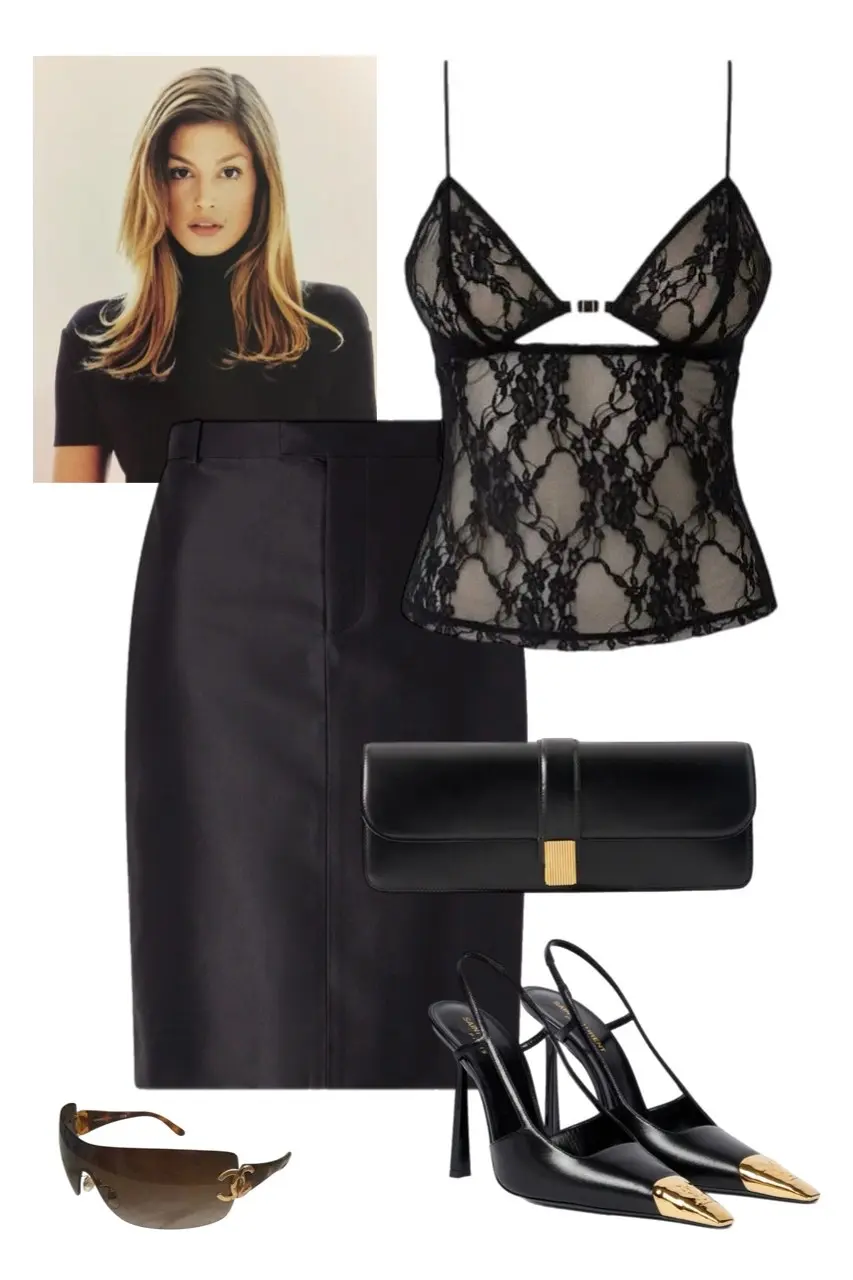
The Y2K aesthetic has a tension built into it that most people miss: it was never supposed to look polished. The original version was loud, confident, occasionally chaotic — and completely unbothered about whether you approved. The reason so many attempts to recreate it fall flat is that people approach it as a costume rather than a language. They collect the right props — the shield sunglasses, the rhinestone belt, the micro skirt — and assemble them in a way that reads as performance rather than personality.
What actually separates someone who wears Y2K from someone who’s dressed as Y2K is surprisingly simple: the originals mixed high and low without hierarchy, they treated sportswear and eveningwear as equals, and they never apologized for any of it. The 17 y2k outfits party looks I put together here each illustrate a different rule of the aesthetic — what makes something belong versus what makes it feel forced. By the end you won’t just have outfit ideas. You’ll understand why they work.
This post contains affiliate links. If you buy through these links I may earn a small commission at no extra cost to you.
Rule 1: The Friction Principle — Luxury Meets Street
This is the foundational Y2K move: pairing something with obvious designer pedigree against something deliberately rough. A Saint Laurent track jacket — cream with black racing stripes, logo across the chest — worn over a distressed brown leather micro skirt with zip hardware and raw edges. The contrast is the entire point. Neither piece is playing second fiddle.
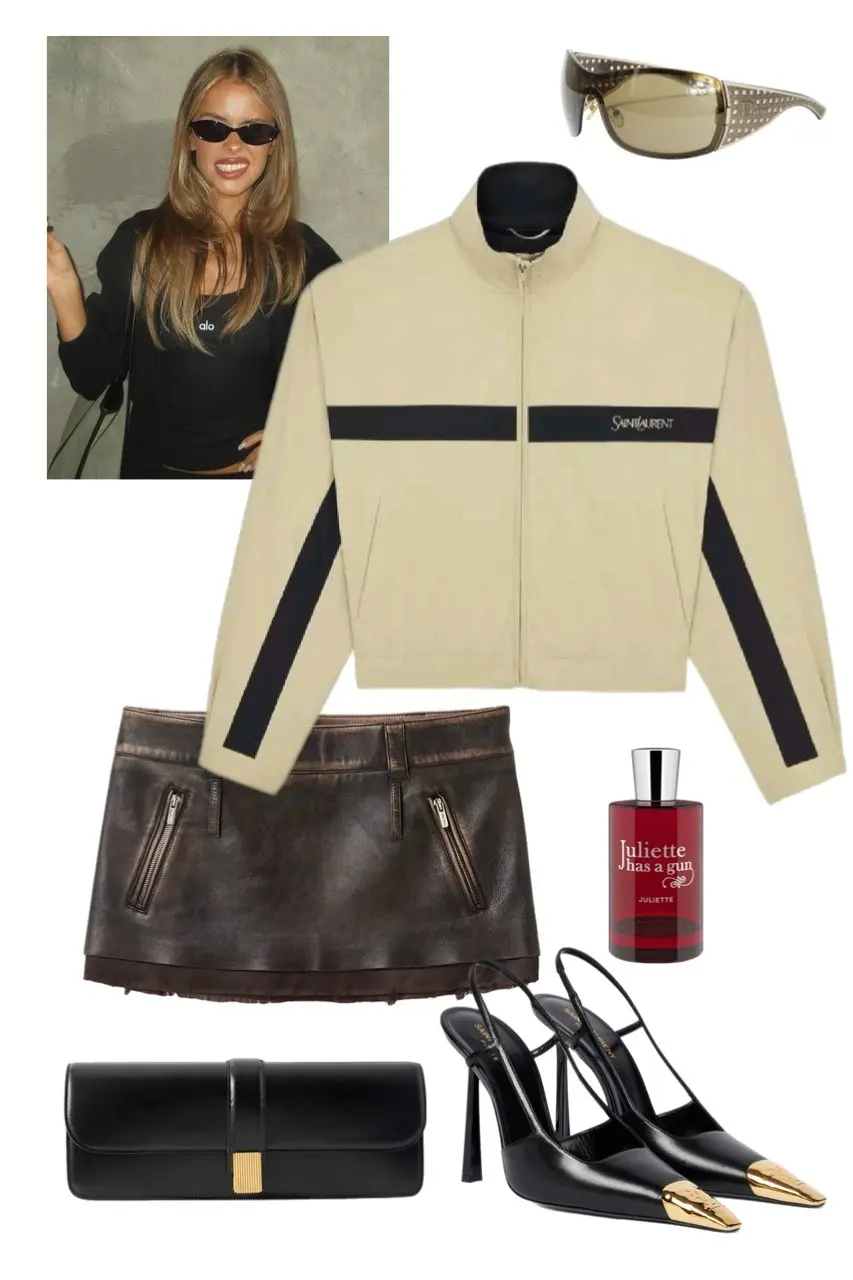
The accessories here follow the same logic. Gold-tipped black slingbacks and a sleek black clutch tip the whole thing toward evening, while the rhinestone-embellished shield sunglasses drag it right back into Y2K territory. This is the look for someone going somewhere that matters — a concert afterparty, a birthday dinner that starts late.
The distressed leather skirt is doing the heavy lifting in terms of era-authenticity. Look for distressed leather mini skirts with zip details — they read immediately as early 2000s without needing the actual vintage piece. The Juliette Has a Gun perfume in the mood board is a sharp choice; the Y2K girl had a signature scent and she wasn’t shy about it.
Rule 2: The Denim Micro + Elevated Top Equation
A bleached micro denim skirt with a fitted black sleeveless ribbed turtleneck — this combination was absolutely everywhere in 2002 and it still holds up because the proportions are inherently good. The turtleneck gives the ultra-short hem some intellectual weight; it says you thought about it rather than just grabbed the smallest skirt you own.
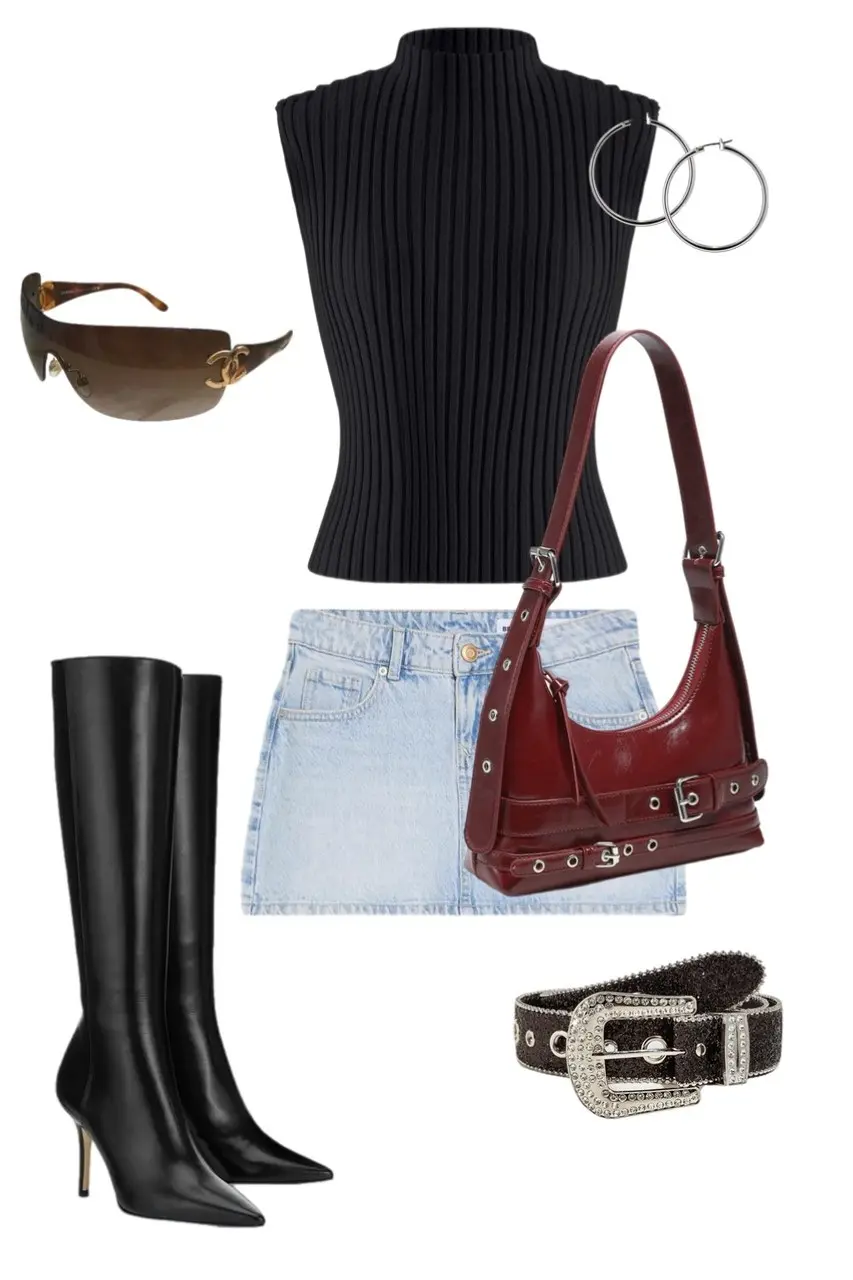
The accessories are doing the era work here: a burgundy grommet-detail shoulder bag, Chanel shield sunglasses in tortoiseshell, a rhinestone-studded western belt, silver hoop earrings, and sleek black knee-high stiletto boots. That belt is the most Y2K piece in the room — the rhinestone buckle was ubiquitous, and finding a rhinestone western belt now gives any look an instant timestamp.
The boots versus micro skirt ratio is important to get right. Knee-highs with a very short hem can look proportionally off if the top isn’t cropped or fitted — the ribbed turtleneck solves that by keeping the upper half clean and body-conscious. This is a strong choice for a birthday night out where you want to look intentional without going full cocktail dress.
Rule 3: Y2K’s Version of Maximalism — Everything Loud, Nothing Clashing
Silver sequin crop cami, light-wash denim cutoff shorts, grey distressed Diesel logo knee-high boots, a studded pink Guess bag with gold hardware, a pink rhinestone western belt, and rhinestone-encrusted shield sunglasses. On paper this sounds like too much. In practice it’s exactly right because the color story — silver, pink, denim, grey — is cohesive even when the textures are competing.
This is where most people go wrong with Y2K maximalism: they mix loud pieces that have nothing in common except loudness. The originals always had an internal logic, even when it looked anarchic. Here, the metallic sequins and the rhinestone details are in the same family. The Diesel boots with their logo hardware and the Guess bag with its gold G-clasp are both unabashedly branded — that brand visibility was a specific power statement of the era.
For anyone building this look today, the silver sequin crop top is the easiest piece to find and the one that does the most work. The Diesel velvet knee-high boots are a serious investment piece but they photograph like nothing else. This whole look is built for the kind of party where you want to be the one people ask about.
Rule 4: The Y2K Casual — When Everyday Pieces Borrowed Nighttime Logic
Not every Y2K party look was overtly dressy. This one is built around black wide-leg trousers and a white ruched strapless top — genuinely simple pieces — but the details shift it. An acid-wash cropped denim jacket with a slightly bleached-out quality, orange patent leather mule heels, a dark brown Chloe Paddington bag, and Chanel shield sunglasses in tortoise. The perfume on the mood board is Juliette Has a Gun again.
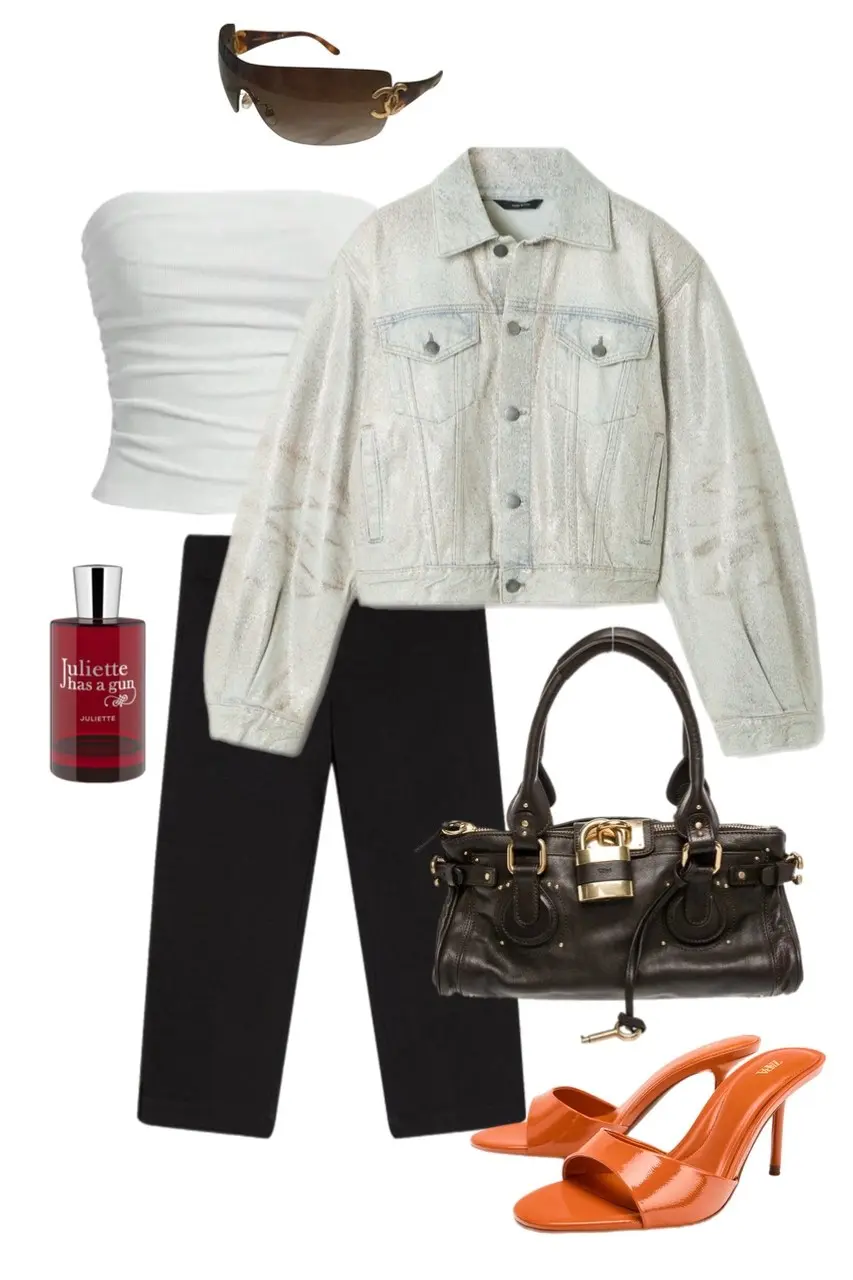
What makes this feel Y2K rather than just Y2K-adjacent is the color disruption: a single loud accent color — the orange heels — against an otherwise neutral base. The early 2000s loved exactly this move: a clean outfit interrupted by one piece that had no business being that bold. It looked like confidence. It still does.
The Paddington bag is the piece that carries the most cultural weight here. It was the it-bag of 2004-2006, and its chunky padlock hardware is one of the most recognizable signals of the era. If you can find a padlock hardware satchel bag in dark brown, you have the cornerstone of multiple Y2K looks. These wide leg trousers styled with a party top is a combination that keeps giving.
Rule 5: The Drama Layer — Glamour Worn Casually
A black bustier mini dress under a long bronze-brown sequin coat that falls to mid-calf — this is the Y2K rule of the drama layer. The party piece is underneath; the outerwear is louder than the occasion technically demands; and that gap between what you’re wearing and where you’re going is exactly where the attitude lives. Chanel tortoiseshell shield sunglasses, black stiletto knee-high boots, and a dark brown Chloe Paddington bag complete the look.
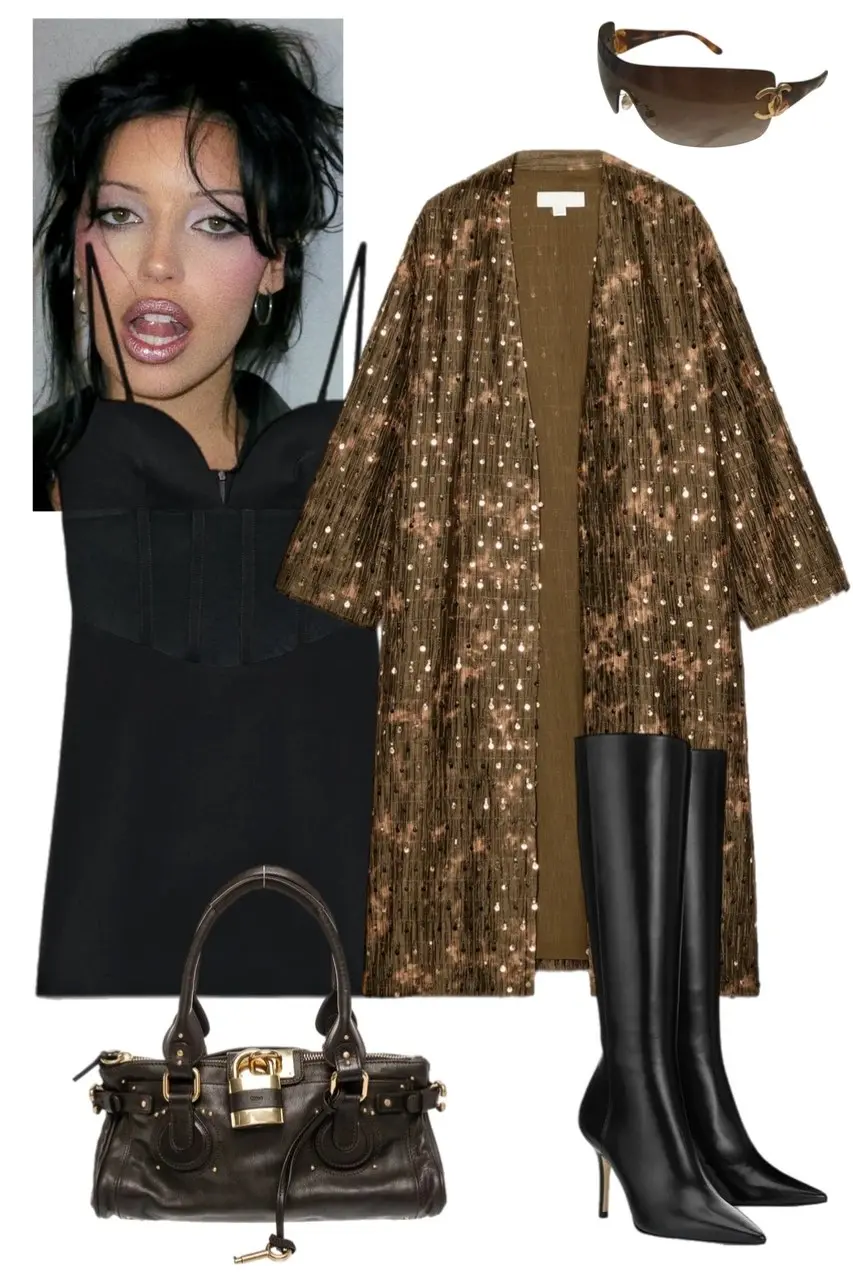
The person who owns this aesthetic understands that a sequin coat worn over a simple dress is not overdressing — it’s a point of view. The person dressed from a reference board would wear the sequin coat over a sequin dress and wonder why it reads as costume. Restraint underneath is what lets the statement piece breathe.
The brown and bronze palette here is very specific to the era — this wasn’t the all-black evening wear of the 90s, and it wasn’t the pastel sweetness that came later. It was chocolate, bronze, cognac, caramel, all worn together without apology. A bronze sequin duster coat is the statement investment here, and it works over almost anything.
Rule 6: Shine in the Daytime — Y2K Didn’t Wait for Dark
One of the clearest tells that separates actual Y2K dressing from nostalgic approximation: the originals wore shine and sparkle in the daytime without blinking. A silver-champagne satin top with scattered rhinestone detailing, light-wash flared jeans, a rhinestone-buckle western belt in black, a pink studded Guess bag, chocolate wedge flip-flops, and green shield sunglasses with an ombre tint. This is a daytime outfit that contains more glitter than most people’s party looks.
The green sunglasses are doing something specific here — they bring a pop of color that’s unexpected enough to read as confident rather than coordinated. Early 2000s dressing was comfortable with color clashing in a way that 90s minimalism was not. The pink bag against the silver top against the green glasses is not an accident; it’s the logic of the era.
Flared jeans are the easiest entry point into Y2K dressing for anyone who finds the aesthetic intimidating. A light-wash flare jean with a fitted sparkly top is immediately readable without requiring any of the more extreme pieces. For nail inspiration to finish a look like this, the aura nail trend from now maps perfectly onto Y2K’s love of iridescent finishes.
Rule 7: The Slip Dress Updated — Plaid and Cowl Neck
A cowl-neck slip dress in a plaid print — beige, red, blue, and brown tones — is doing something interesting: it takes the grunge plaid of the mid-90s and gives it the liquid silhouette of 2000s going-out dressing. The result is a dress that sits at the intersection of both eras, which is exactly where Y2K fashion actually lived. It wasn’t a clean break from the 90s; it was a transition.
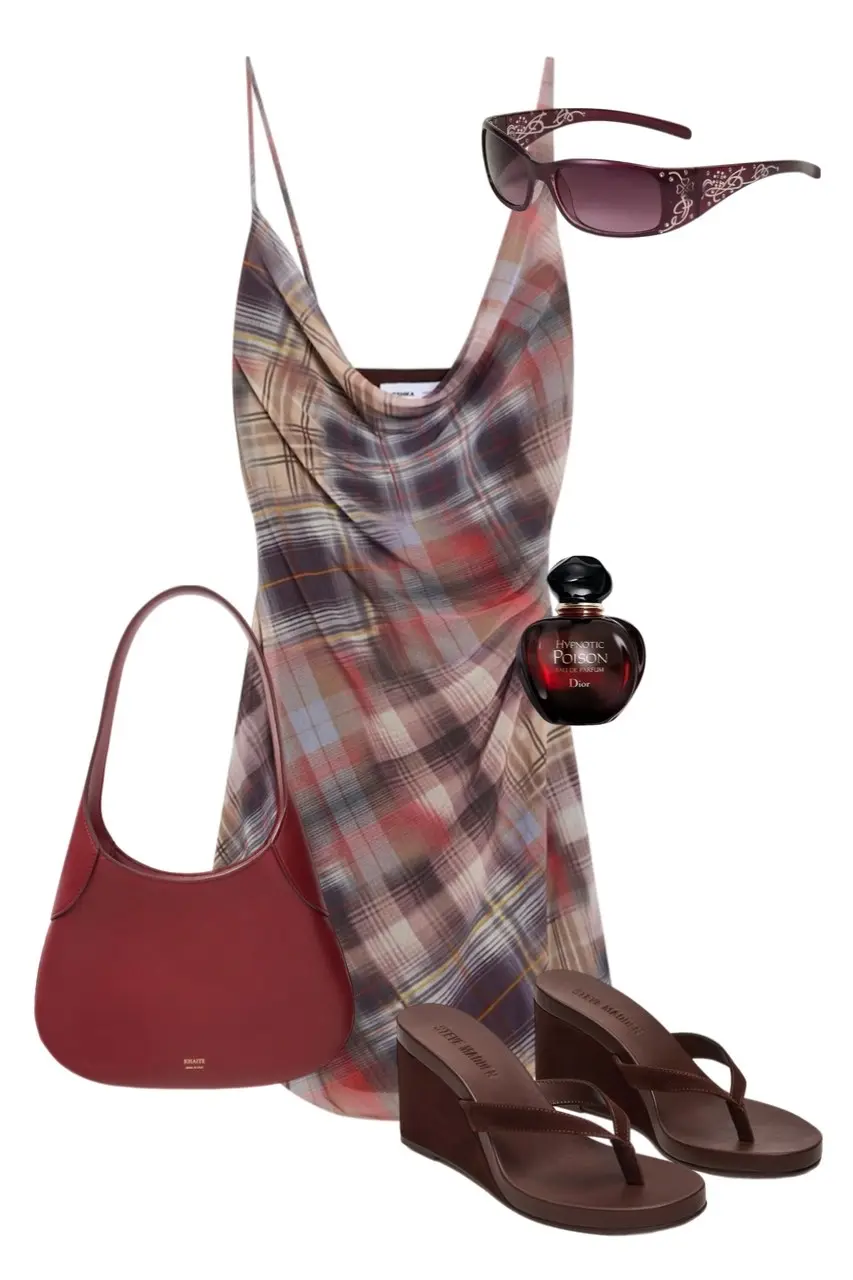
The accessories anchor it firmly in Y2K territory: a burgundy wrap sunglasses frame with floral engraving on the temples, brown wedge flip-flops, a red structured mini shoulder bag, and Dior Hypnotic Poison on the vanity. That perfume detail matters — there’s a very specific olfactory memory attached to this era, and Hypnotic Poison was a significant part of it.
The cowl neck is worth paying attention to as a construction detail. It has a natural sensuality that doesn’t require the dress to be tight — it gives shape through drape rather than structure, which is part of why it worked so well in the early 2000s when the preference shifted away from the rigid bodycon of the late 90s. Find a cowl neck slip dress and you have something that also works well beyond Y2K themed events.
Rule 8: The Velour Tracksuit — The One That Started Everything
The baby pink velour tracksuit with a contrast turquoise graphic slinky cami underneath is the most literal Y2K reference in this entire lineup — and it works because it’s specific. Not a generic tracksuit in any color, but specifically baby pink velour, specifically with a branded zipper, specifically worn with a Chloe Paddington bag in dark brown and Chanel shield sunglasses. The contrast between the softness of the velour and the seriousness of the Paddington is very much the point.
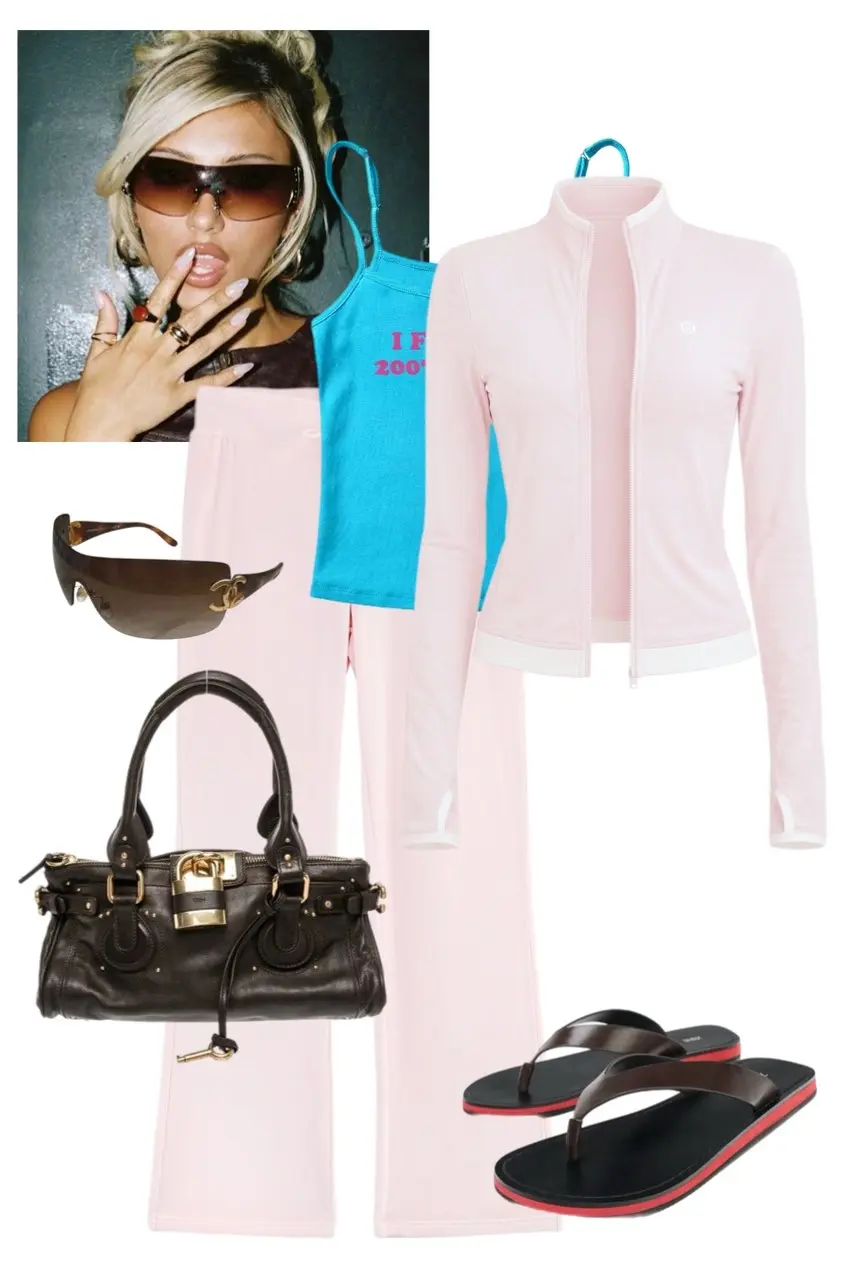
The tracksuit moment was genuinely revolutionary for its time — it took what had been gym clothing and reframed it as status dressing. The person who gets this look right today understands that the brand logo on the jacket matters, the color needs to be unapologetically sweet or pastel, and the accessories need to be legitimately expensive-looking. You cannot do this look with a drugstore bag.
Dark brown DKNY flip-flops with a red sole detail are an inspired choice here — they ground the pink without going matchy. For anyone building this look, athleisure styling principles apply directly: the key is always one piece that has no business being there. Here it’s the serious leather bag with the loungewear. That gap is where the style lives.
Rule 9: The Logo Halter — When Branding Was the Accessory
A Burberry check halter top — the classic nova check in beige, black, and red — worn with wide-leg brown trousers and brown flip-flops with a logo sole. A dark chocolate patent shoulder bag with grommet and buckle detail, burgundy engraved wrap sunglasses, and Dior Hypnotic Poison. This is Y2K logomania at its most specific: not head-to-toe branded, but one statement logo piece worn against clean neutrals so it can actually be seen.
The Burberry check had a particular cultural moment in the early 2000s — it was simultaneously the brand of British heritage and the brand of tabloid celebrity culture, which is exactly the kind of contradiction Y2K fashion thrived on. Wearing the check halter with slouchy brown trousers and flat sandals kept it feeling like a real outfit rather than a fashion exercise.
The brown palette here is cohesive enough that the check reads as a print choice rather than a logo flex — the beige and black of the Burberry print sit naturally within the warm brown tonal story. If you can find a check print halter top in this colorway, the rest of the look can be built entirely from accessible basics. The perfume choice is worth thinking about for the full era-accurate experience.
Rule 10: The Military Mini — Structure as Femme Statement
An olive khaki strapless mini dress with double-breasted silver button detailing and a pleated skirt hem — this is the Y2K take on military dressing, which was a recurring theme of the era. It takes a traditionally masculine structure (the double-breasted regimental front) and makes it overtly feminine through the strapless silhouette and the short hem. Green ombre shield sunglasses, orange patent mule heels, a dark brown grommet shoulder bag, silver hoop earrings, and Juliette Has a Gun perfume.
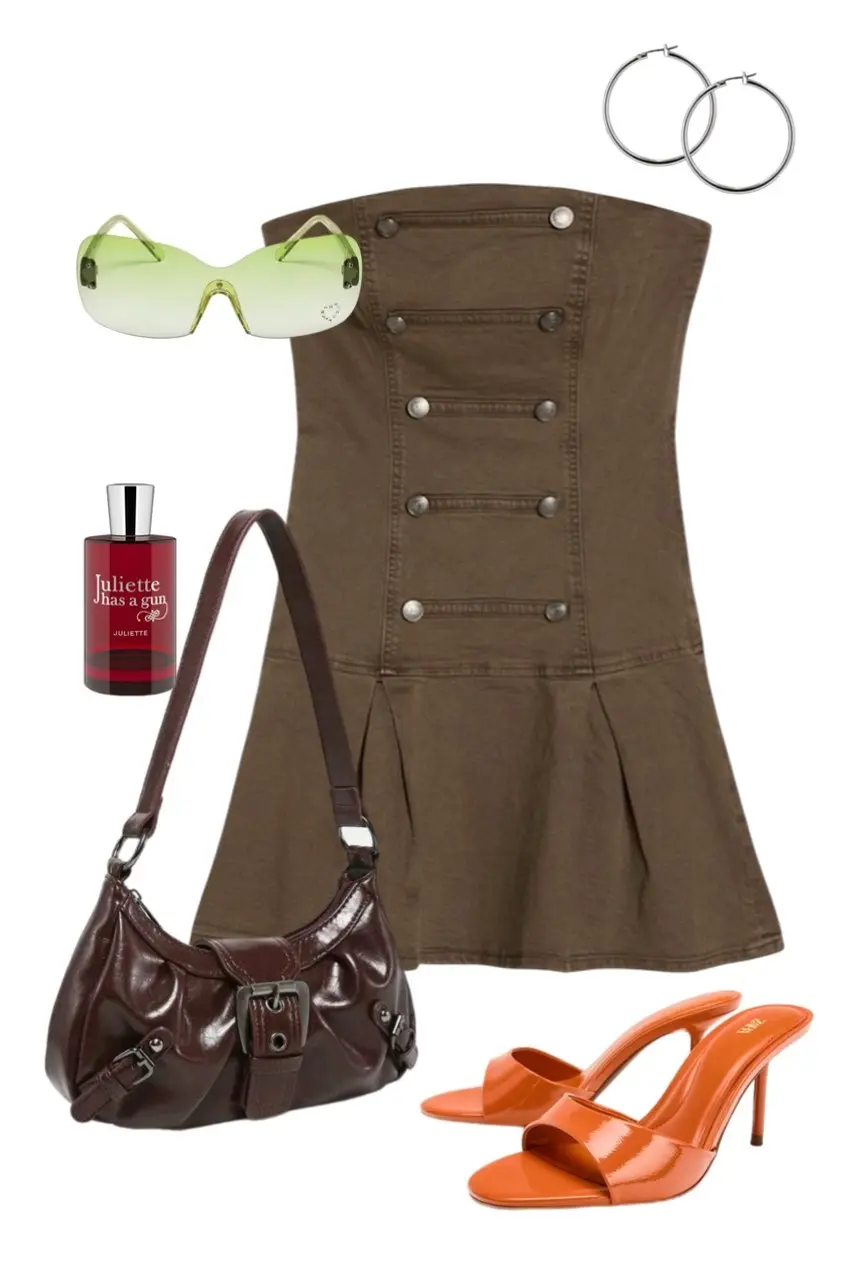
The orange heels against the olive dress is the kind of color pairing that would have made sense in 2003 and makes complete sense again now. The early 2000s had a specific relationship with earthy tones interrupted by a single citrus pop — olive, brown, and camel as the base, then tangerine or lime as the disruption. It looked alive in a way that safe color coordination never does.
This dress silhouette — strapless, structured bodice, short skirt — is one of the most flattering shapes to come out of the era and it works on a wide range of body types because the structured top provides support while the flared skirt hem moves well. Look for a strapless military button mini dress in olive or khaki to anchor this look.
Rule 11: The Lingerie-as-Outerwear Rule — Y2K’s Most Enduring Contribution
A black floral lace bustier top — sheer lace over a boned bodice, floral appliqué, thin straps — worn with a black satin midi pencil skirt, black gold-tipped slingback heels, a sleek black leather clutch with gold hardware, and Chanel shield sunglasses in tortoise. The reference image here is a 90s supermodel portrait: languid, precise, completely composed.
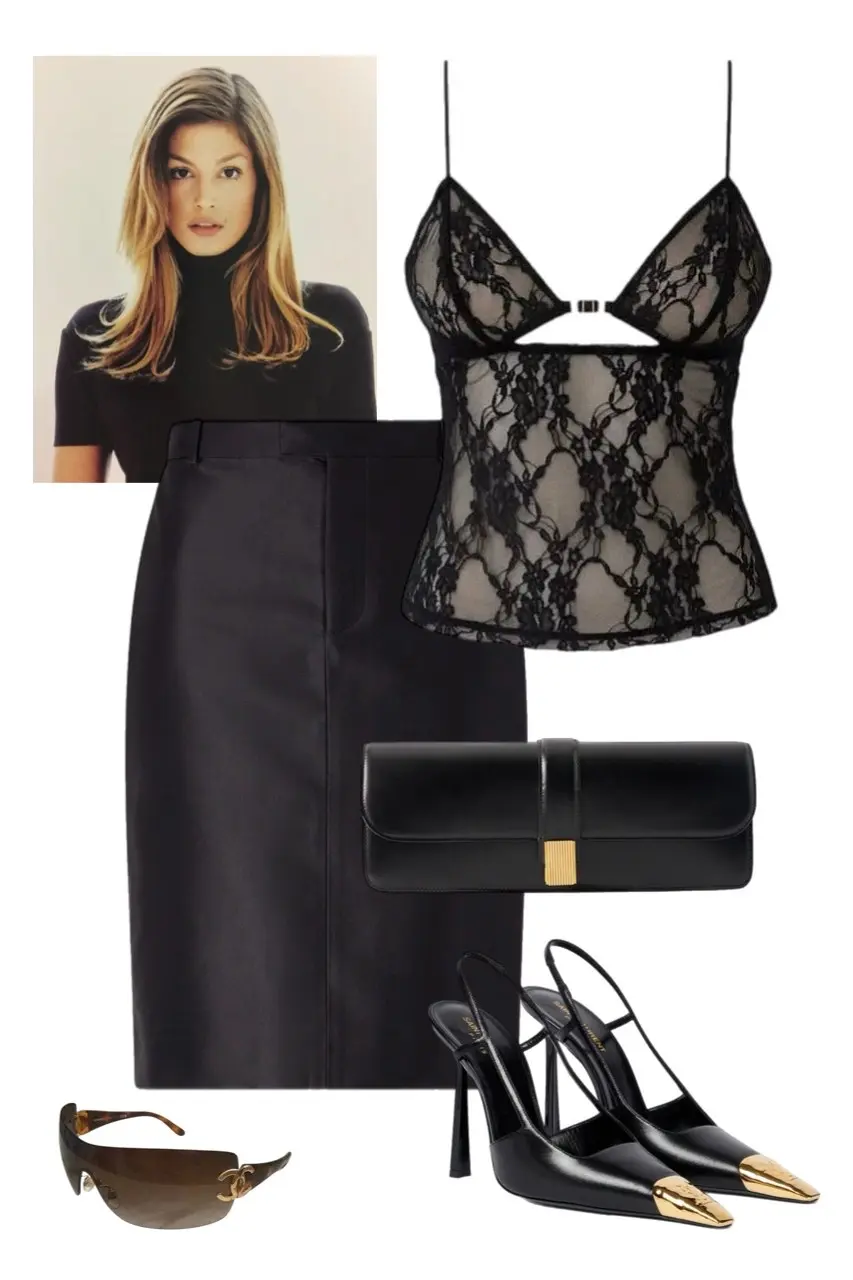
The lingerie-as-outerwear rule is the most misunderstood part of Y2K dressing. People see it as an excuse to wear underwear out, but the originals treated it as a construction choice — the lace bustier isn’t underwear, it’s a top with the aesthetic language of intimate wear. The crucial difference is how it’s styled. Against a tailored midi skirt and proper heels, it reads as deliberate glamour. Against sweatpants, it reads as unfinished.
This is the most versatile look in this entire guide — the black lace bustier + black midi skirt combination works for a cocktail occasion, a concert, or any event where you need to look pulled-together but not formal. Find a black lace bustier top with boning for the right silhouette — a soft lace bralette reads differently and doesn’t carry the same structure that makes this look work. This is also covered beautifully in how to style lace for chic looks.
Rule 12: Pink and Burgundy — The Y2K Sweet-Dark Pairing
A pink V-neck cami with a seamed bustier-style front, dark wash wide-leg jeans, brown wedge flip-flops, a burgundy grommet shoulder bag, burgundy floral-engraved wrap sunglasses, and Dior Hypnotic Poison on the table. This is Y2K dressing at its most wearable — nothing here is extreme, but the combination is specific enough to read as intentional.
The pink-burgundy pairing was a recurring color story in early 2000s fashion — baby pink against deep wine, sweet against sophisticated, feminine against slightly dangerous. It appeared in everything from Paris Hilton’s velour moments to more editorial takes. The combination has an internal logic: both colors sit in the same red family, which means they harmonize without matching.
The dark wash wide-leg jean with a fitted cami is actually a very current combination right now, which is what makes Y2K dressing feel less like costume and more like wardrobe when you approach it this way. The accessories do the era work while the clothing does the silhouette work. For anyone looking to build a wide-leg outfit that leans nostalgic, this pink-burgundy story is the most approachable starting point.
Rule 13: The Sequin Halter + Denim Jacket — Y2K’s Casual-Glam Formula
A black sequin halter top with tie-front detailing worn under a light-wash cropped denim jacket, white denim shorts with button-fly detail, chocolate wedge flip-flops, a sky-blue baguette shoulder bag, and Juliette Has a Gun perfume. No sunglasses. This is the look that goes from afternoon to evening without a costume change — the denim jacket covers the sequins at dinner; you lose it later and suddenly you’re dressed for the floor.
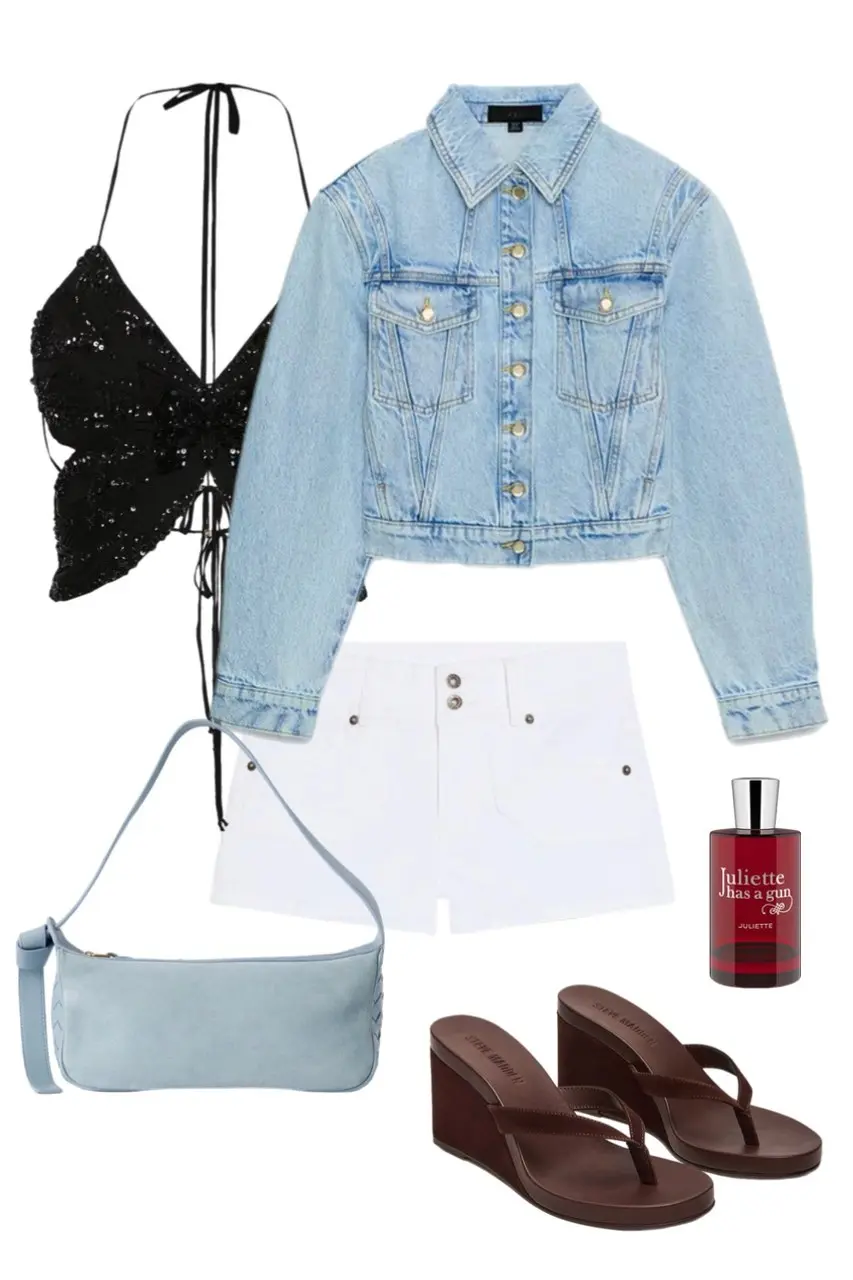
The all-denim-on-denim approach — light wash jacket, white shorts — with the sequin piece underneath is a very specific formula. It works because the denim reads as casual and the sequin reads as party, and wearing them simultaneously creates the slightly paradoxical energy that Y2K dressing did so well. Nothing was purely one thing.
The sky-blue bag against the light-wash denim is a tonal play that keeps the look from reading as too deliberate — both are in the same blue family but different enough to look curated rather than matched. Double denim styling principles apply here: vary the wash, vary the weight, and let a statement piece do the talking between the two denim items. The black sequin halter top is the piece that makes or breaks this look.
Rule 14: Full Sequin, Balanced by Hardware — The Night-Out Formula
Matching champagne-gold sequin crop top and mini skirt worn under a black leather belted jacket with large button hardware — Saint Laurent in silhouette if not in label — with black knee-high stiletto boots, a dark brown buckle shoulder bag, and no sunglasses. This is the most overtly party-ready look in this lineup, and it works because the black leather jacket contains the full sequin set rather than leaving it exposed and vulnerable to looking overdressed.
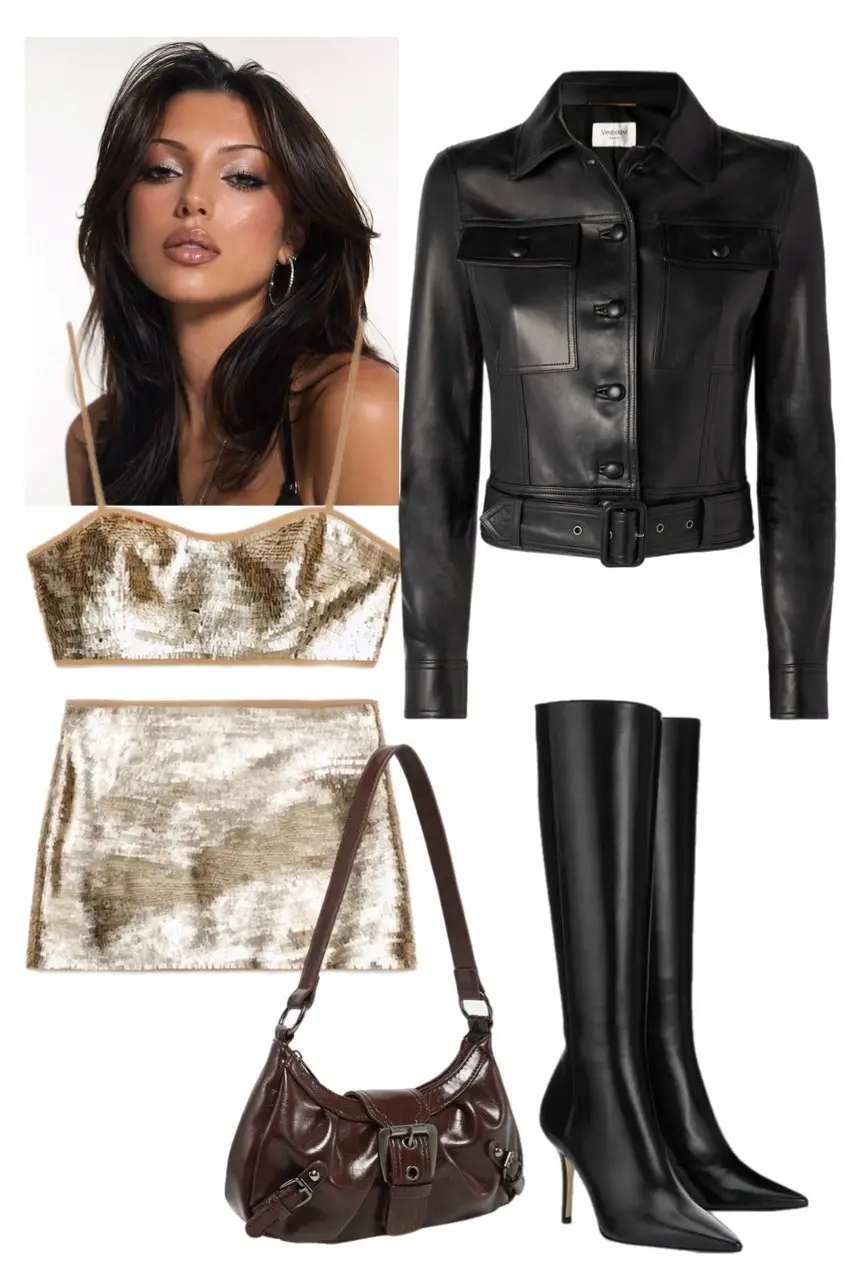
The person who has internalized the aesthetic versus the person wearing the reference board: the reference board person would wear the sequin set with sparkly accessories and call it a night. The person who owns it layers the most structured, least festive piece — a black leather jacket — on top, and then the sequins underneath become the reveal rather than the entire statement.
Champagne gold sequins have a specific warmth that reads differently than silver — they photograph amber under warm light and gold under flash, which means this look is both photogenic and adaptable to different venues. Find a gold sequin two-piece set and you have something that works as separates too — the top with dark jeans, the skirt with a simple knit. The leather jacket completes the look as described in how statement jackets anchor an outfit.
Rule 15: The Butterfly Top — Y2K’s Most Maximal Motif
A pink embellished butterfly halter top — feathered, sequined, sculptural — worn with a navy sequin mini skirt, black fold-over knee boots with a wedge heel, a burgundy grommet shoulder bag, rhinestone-embellished shield sunglasses with a bronze frame, and Juliette Has a Gun perfume. The butterfly motif is the most literal Y2K reference available, and yet this look doesn’t feel like costume because the navy-burgundy-bronze color story keeps it grounded.
The butterfly top in Y2K fashion was never just decoration — it was aspiration. It appeared on everything from graphic tees to actual sculptural tops like this one because it captured something about the era’s emotional register: optimism, metamorphosis, a kind of earnest belief that things were going to be beautiful. Wearing it now with self-awareness and a strong color story makes it fashion rather than fancy dress.
The fold-over knee boot with a low wedge heel is a specific early-2000s boot silhouette that’s been circling back. It’s slightly less architectural than the stiletto knee boot and has a softer, more relaxed quality that works with a very short skirt without feeling aggressive. For anyone interested in the sequin-on-sequin pairing, the key is that the two sequin pieces need to be in clearly different colors — here pink and navy — or different scales of sequin. A pink butterfly halter top is the Y2K piece that gets the most attention, full stop.
Rule 16: The Embellished Halter + Jorts — Y2K’s Most Casual Power Move
A black backless halter top with dramatic plunging open back, layered sequin fringe and rhinestone chain detailing across the neckline, worn with light-wash straight-leg bermuda shorts, a dark chocolate patent buckle shoulder bag, a rhinestone western belt, and brown wedge flip-flops. The reference image is Jessica Alba circa 2004 — straight brown hair, diamond necklace, completely unposed.
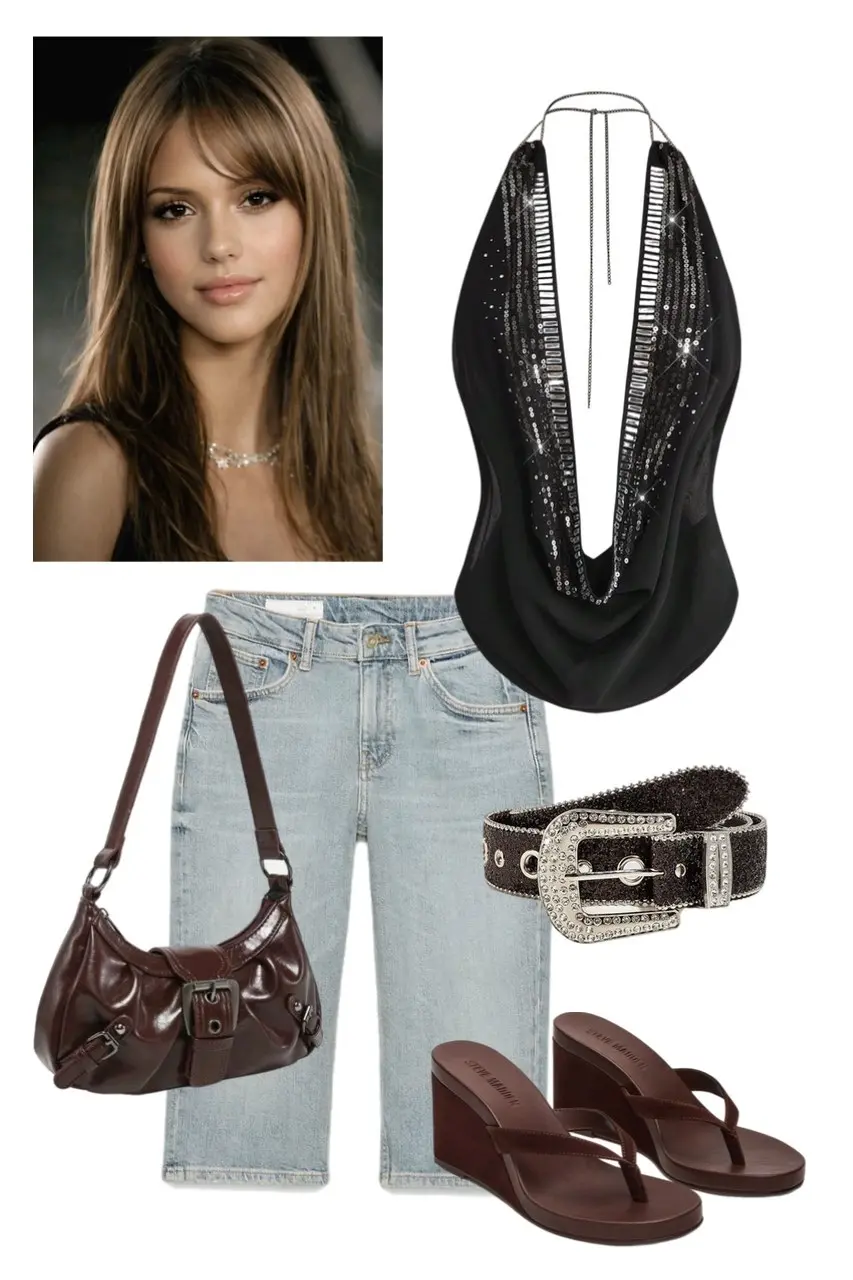
This is Y2K dressing at its most instinctive: a show-stopping top with whatever denim is comfortable. The early 2000s had a specific comfort with the idea that you could wear something extraordinary with something completely ordinary — the extraordinary piece did not need the ordinary piece to dress up to match it. If anything, the mismatch was the point. The jorts ground the halter; the halter elevates the jorts; neither one dominates.
The backless halter is the element that makes this look work. All the drama is in the back — the chain, the fringe, the plunge — which means the front view is relatively understated until you turn around. That element of reveal was deeply embedded in Y2K party dressing. Find a backless rhinestone chain halter top and you have the anchor piece for this specific formula. Pair it with something from the wider denim family for maximum contrast.
Rule 17: The Lace Cami + Slip Skirt — Y2K’s Softest Exit
A teal lace-trimmed ribbed cami worn with a powder blue asymmetric satin slip skirt with lace hem, brown wedge flip-flops, a red structured mini shoulder bag, Chanel tortoiseshell shield sunglasses, and silver hoop earrings. This is the final rule: Y2K wasn’t only loud. It also had a mode that was quietly sensual — slip skirts, lace details, fluid fabrics — that looked almost underdressed until the accessories made their entrance.
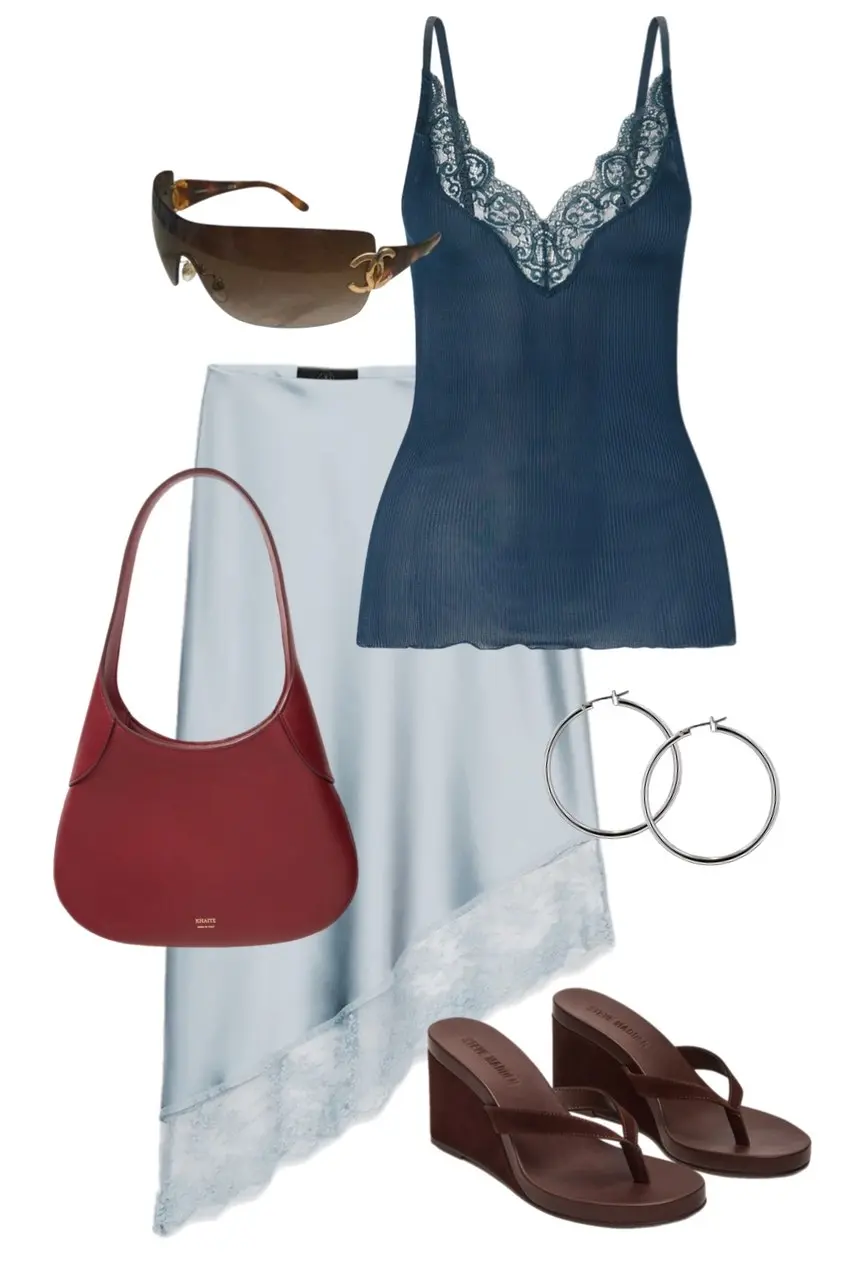
The teal and powder blue combination is surprisingly sophisticated — it’s a monochromatic play within the cool blue family that gives the look cohesion without uniformity. The lace trim on both the cami and the skirt hem creates a deliberate echo that makes the pairing feel considered. Then the red bag disrupts it just enough to feel like a real person dressed this way and not a stylist.
The slip skirt with lace hem is a piece that transcends its Y2K origins — it works for wedding guest dressing, for a summer evening, for anything that needs feminine energy without obvious effort. Styling it with a lace-trimmed cami rather than a plain one creates the kind of intentional detail that separates a well-dressed person from someone who just picked clothes. The lace-trimmed ribbed cami in a rich teal is the key piece here — the color depth is what makes it look expensive.
\n
The Rules Behind the Aesthetic — What Actually Makes Y2K Work
The Y2K aesthetic runs on contradiction. It took gym clothes and made them status symbols. It took underwear and made it eveningwear. It took the loudest possible accessories and paired them with the simplest possible bases. Understanding these contradictions is what moves you from wearing Y2K references to actually speaking the language. The people who wore this the first time around weren’t following rules — they were following their instincts, which were calibrated to a specific cultural moment. Recreating the instinct is harder than recreating the wardrobe, but it’s the only thing that makes it work.
The most consistent principle across all 17 looks above is the idea of a mismatch that’s clearly intentional. A rhinestone belt on a business casual outfit. A Paddington bag with a velour tracksuit. Orange heels with an olive military dress. In each case, one piece has no business being there — and that’s the piece that makes the outfit Y2K rather than just early-2000s-coded. The mismatch signals that the wearer is operating on their own logic, not following a dress code. That signal is confidence, and confidence is the actual aesthetic.
The accessories in Y2K dressing are not supporting cast — they’re co-leads. The shield sunglasses, the rhinestone belt, the logo bag, the wedge flip-flop: these items carry as much narrative weight as the clothing. This is where most contemporary recreations fall short. People spend money on the clothing and then reach for generic accessories, which deflates the entire effect. If you can only invest in one Y2K-specific piece, make it the shield sunglasses — they do more work per square inch than almost anything else in the aesthetic vocabulary. The eyewear conversation happening right now is directly connected to Y2K’s sunglasses obsession.
The line between inspired and pastiche is sharper than people think, and it comes down to whether the outfit has a point of view beyond the reference. Pastiche is dressing as if you are a person from 2002. Inspired is dressing as a person in 2025 who finds the logic of 2002 genuinely interesting and filters it through a current sensibility. The difference is visible in how the pieces are combined — pastiche tends toward completeness (every piece simultaneously Y2K), while inspired tends toward disruption (a few specific Y2K elements doing the work, grounded by contemporary pieces that give it context). The best looks in this guide live firmly in the second category.
\n
The Bottom Line on Y2K Party Dressing
Y2K party outfits work when they’re treated as a point of view and not a dress code. The aesthetic is genuinely rich — it has more internal logic than its reputation suggests, and it translates to 2025 more naturally than people expect because so much current fashion is already drawing from it. The shield sunglasses are back. The micro denim skirt never fully left. The logo bag is having its strongest moment in two decades. The foundation pieces are available; what this guide is meant to provide is the reasoning behind how they’re combined.
For a full Y2K party look that reads as fashion rather than costume, start with one strong anchor piece — the butterfly top, the sequin set, the lace bustier, the velour tracksuit — and then build the rest of the outfit around a single contradiction: something that has no business being there but that you can completely defend. A serious leather jacket over a full sequin look. A flat sandal with a party dress. A working-woman’s satchel with a club-ready crop. The contradiction is the aesthetic, and once you internalize that, Y2K becomes one of the most expressive vocabularies in contemporary dressing. For more party outfit inspiration, the baddie aesthetic guide and the coquette aesthetic breakdown both cover adjacent territory worth exploring.
FAQ
What should I wear to a Y2K themed party?
The most reliable Y2K party formula is a statement top — sequin, butterfly motif, lace bustier, or rhinestone embellishment — paired with a micro skirt or low-rise jeans, shield sunglasses, and either knee-high boots or wedge sandals. The key is one piece that reads unmistakably Y2K, surrounded by pieces that support rather than compete with it. Avoid trying to make every single element Y2K at once — that’s how you end up in costume territory.
What are the must-have accessories for a Y2K party outfit?
Shield or wrap sunglasses are the single most important Y2K accessory — they photograph immediately as the era and they work with almost any outfit. After that: a rhinestone western belt, a logo or hardware-heavy bag (Chloe Paddington style, Guess studded, or grommet shoulder bag), and silver hoop earrings. These four accessories can Y2K-ify an otherwise contemporary outfit without any other changes.
What colors are most associated with Y2K party fashion?
Y2K had two distinct color stories running simultaneously. The first is the warm earthy palette: chocolate brown, bronze, cognac, caramel, and olive — often interrupted by a single citrus pop like orange or lime. The second is the sweet pastel story: baby pink, powder blue, and lavender, often paired with burgundy or dark wine. Both palettes are well represented in this guide. Silver and gold metallics crossed both stories and appeared constantly in everything from accessories to full sequin looks.
How do you dress Y2K for guys at a party?
Men’s Y2K dressing pulls from a few specific territories: branded athletic wear (track jackets with logo detailing, velour separates), low-rise baggy jeans with a fitted graphic tee, chunky sneakers with visible branding, or a leather jacket over a slim logo tee. The accessories that read most Y2K for men are tinted shield sunglasses, a visible chain necklace, and a branded bag or backpack. The key is the same as it is for women: one unmistakable Y2K piece anchoring an otherwise simple outfit.
What is the difference between Y2K and 90s party outfits?
The 90s party aesthetic was more aligned with minimalism, slip dresses, and a darker, more muted palette — think Calvin Klein, grunge elements, and understated glamour. Y2K turned the volume up: it added rhinestones, logos, hardware, metallic fabrics, and louder color combinations. The 90s slip dress got a logo bag and shield sunglasses and became a Y2K outfit. Y2K also had a specific relationship with sportswear that the 90s didn’t — the velour tracksuit as party wear is entirely a Y2K construction.
Can you put together a Y2K party outfit from your own closet?
Almost certainly, with strategic additions. Most people already own at least one piece that anchors a Y2K look — a mini skirt, a fitted top, a pair of low-rise jeans. The items you likely need to add are the accessories: shield sunglasses, a rhinestone belt, and a bag with visible hardware. These three additions can turn a contemporary outfit into a convincing Y2K look without a full wardrobe overhaul. All three are available on Amazon for under $50 combined.
What did celebrities wear at Y2K era parties?
The Y2K celebrity party look was built on a few consistent elements: low-rise micro skirts or jeans, embellished or logoed tops, designer bags worn casually (Chloe Paddington, Fendi Baguette, Gucci), shield sunglasses worn indoors, rhinestone or western belts, and knee-high boots for evening. Paris Hilton was the most recognizable avatar of the aesthetic’s pink-and-logos chapter; Destiny’s Child represented the athletic luxe side; and Jessica Alba embodied the embellished-casual formula. The references in these mood boards pull directly from those cultural touchstones.
What hairstyles and makeup go with a Y2K party outfit?
Y2K hair leaned toward either very straight and glossy with face-framing layers, or low messy updos with pieces pulled out. Flat-ironed hair with chunky highlights was the apex of the era. For makeup: glossy lips in nude or pink, heavy liner on the lower lashline, and either strong brows or overly thin ones depending on the year. The beauty look was deliberately high-effort — Y2K wasn’t the no-makeup-makeup era. It wanted you to know you tried. Frosted or iridescent eyeshadow and rhinestone nail details also tracked consistently with the aesthetic.
What shoes should I wear to a Y2K themed party?
The four most Y2K shoe choices are: stiletto knee-high boots (the dressiest option), wedge flip-flops (the most casual and era-specific), pointed-toe slingback heels with metal toe detail, and platform slides. Wedge flip-flops in chocolate brown were everywhere from 2002-2006 and read immediately as the era. Knee-high boots in black with a stiletto heel are the most party-ready option. Avoid overly contemporary chunky sneakers with Y2K looks — they shift the reference to the wrong decade.
How do you do a group Y2K party outfit with friends?
The most cohesive approach for group Y2K dressing is to align on a color story rather than matching looks. For example, everyone works within the brown-bronze-cognac palette but wears completely different silhouettes and pieces — one person in a velour tracksuit, one in a sequin mini skirt set, one in wide-leg jeans with a butterfly top. Alternatively, everyone can align on a single accessory: all wearing shield sunglasses in different colors, or all wearing rhinestone western belts on different outfits. This creates group coherence without costumery.
Where can I find Y2K party outfit pieces on a budget?
Amazon is the most accessible source for Y2K accessories — shield sunglasses, rhinestone belts, and grommet shoulder bags are all available at low price points and ship quickly. For clothing, Zara and ASOS both carry pieces that fit the Y2K silhouette (micro skirts, lace camis, sequin tops) in current seasons. Thrift stores and depop are the best sources for actual vintage Y2K pieces, particularly branded items and denim. If you’re building a look for a one-time party, prioritize the accessories — they do the most Y2K signaling per dollar spent.
Is Y2K fashion appropriate for all ages at a themed party?
The Y2K aesthetic has enough range that it works across ages — the key is choosing the right expression of it for your comfort level. The micro skirt and butterfly top version skews younger. The wide-leg trousers with a satin cami and Paddington bag version is genuinely sophisticated and works for any age. The velour tracksuit interpretation is deliberately playful and fun across generations. The lace bustier with a midi skirt is arguably more flattering and age-appropriate than many contemporary party looks. The aesthetic is broad enough that age-appropriate Y2K is entirely achievable without compromise.
Have any thoughts?
Share your reaction or leave a quick response — we’d love to hear what you think!
-
 0
0 -
 0
0 -
 0
0 -
 0
0 -
 0
0 -
 0
0