

 Diana
Coordinating outfits for a couple photoshoot is genuinely one of those things that sounds easy until you’re standing in your closet at 10pm the night before, holding a camel blazer in one hand and a floral dress in the other, wondering how it all went wrong. The secret isn’t matching — it’s coordinating. There’s a huge difference between wearing the same color and actually looking like you belong in the same frame.
The looks in this roundup cover everything from full tonal dressing to subtle pattern play, and what they all share is intention. Someone thought about silhouette, about color temperature, about what reads well on camera versus what just looks fine in real life. A stark white shirt that looks crisp in the mirror can blow out completely in afternoon sun. A bold pattern that pops in person can turn chaotic in a photo. These 14 pairings were chosen because they actually work when a lens is involved.
You don’t need to shop entirely new wardrobes for this. Most of these looks are built on pieces couples already own — trench coats, black trousers, turtlenecks, white jeans. The magic is in how you put them together and how you balance one person’s outfit against the other’s. Think of it less like a costume and more like a conversation between two wardrobes.
Whether your shoot is in a Parisian alley, a coffee shop, or a parking garage with good light, the right coordination will make your photos feel effortless and timeless. Here’s exactly how to pull off 14 of the best couple outfit formulas — and what makes each one actually work.
Black Blazer and Grey Long Coat for Monochrome Power
This look is built on black turtlenecks worn by both people, which is the quiet genius of the whole pairing — one shared foundation piece that locks everything together. She layers hers under a black blazer and wears crisp white wide-leg trousers; he goes for a grey long coat over cream trousers. The vintage car backdrop gives it that timeless, slightly cinematic quality that makes the photos feel like stills from a film rather than a Saturday morning shoot.
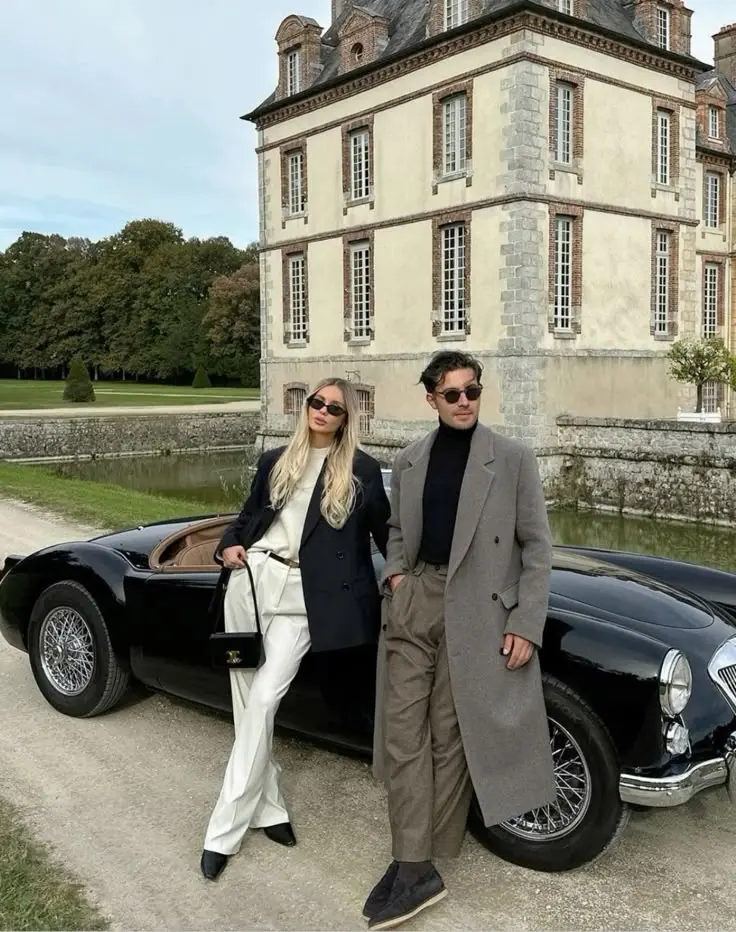
Monochromatic dressing with complementary neutrals is the most foolproof approach to couple coordination, full stop. The trick is choosing different shades within the same family — black, white, grey, cream — so the outfits feel related rather than identical. Clean, tailored silhouettes do the heavy lifting here, and that structure creates visual cohesion without anyone having to wear the exact same thing. Keep the palette to two or three colors maximum across both outfits and you simply cannot go wrong.
This pairing photographs exceptionally well because the high contrast between white and black naturally draws the eye without fighting with the faces. It works in virtually any setting — urban streets, countryside, classical architecture — and because the palette is so timeless, these photos will look just as good in twenty years as they do now. If you’re shooting an engagement or anniversary, this is the coordination to default to.
Grey Midi Skirt and Wool Jacket for Vintage Parisian Romance
The charm of this pairing comes from coordinating through era and aesthetic rather than matching colors directly. She’s in a grey midi skirt, a grey knitted cardigan, and brown ankle boots — soft, textural, distinctly vintage. He anchors the look with a black shearling jacket, a striped shirt, and a tie. Set against Parisian streets, it reads less like a photoshoot and more like a moment someone happened to capture.
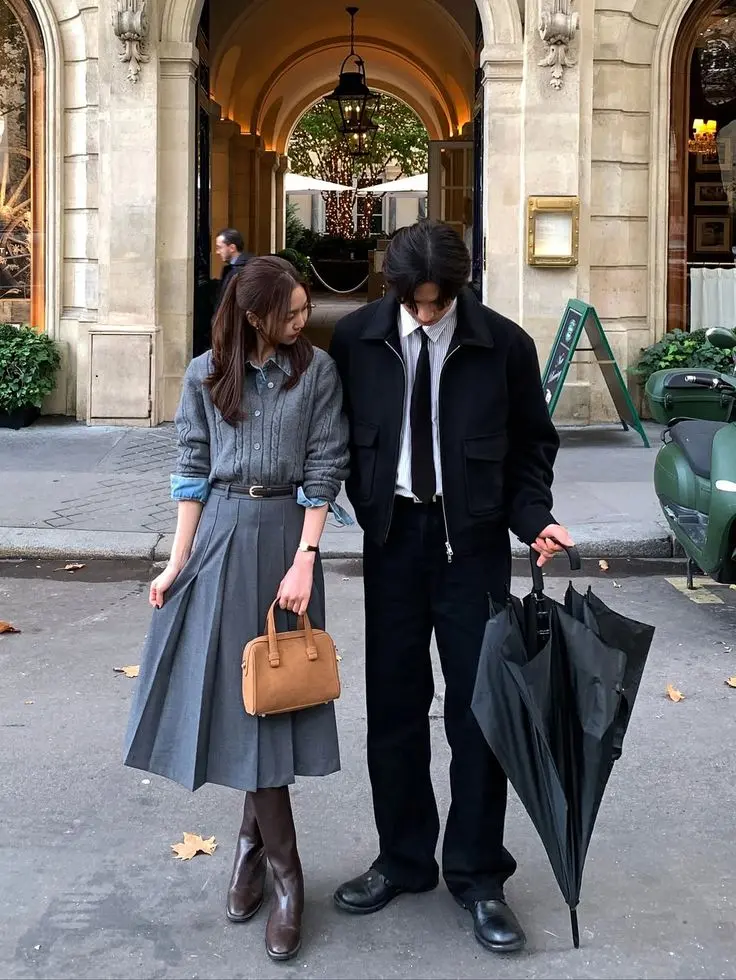
The shared brown tones — her boots and bag, his accessories — do the quiet work of connecting both outfits without anyone having to plan it too aggressively. That subtlety is what makes the look feel natural on camera. When coordinating through aesthetic rather than color, the most important rule is staying in the same style lane: both vintage, both minimal, both bohemian. Mix categories and the photos start to look like two different shoots edited together.
Props and setting matter enormously with this kind of aesthetic-led approach. Urban European streets, vintage cars, and classic architecture all reinforce the visual story you’re telling with the clothes. If the setting doesn’t match the vibe, even beautifully coordinated outfits can look a little lost. Find a backdrop that speaks the same language as your outfits and the whole shoot comes together organically.
Cropped Utility Jacket and Olive Coat for Editorial Street Style
This is for the couple who wants their photos to look like they stumbled out of a fashion editorial rather than a Sunday market. She wears a grey cropped utility jacket with black high-waisted trousers; he goes for an olive jacket with cream pleated trousers. Both sport sunglasses, and that matching accessory detail is the small move that makes the whole thing look deliberate.
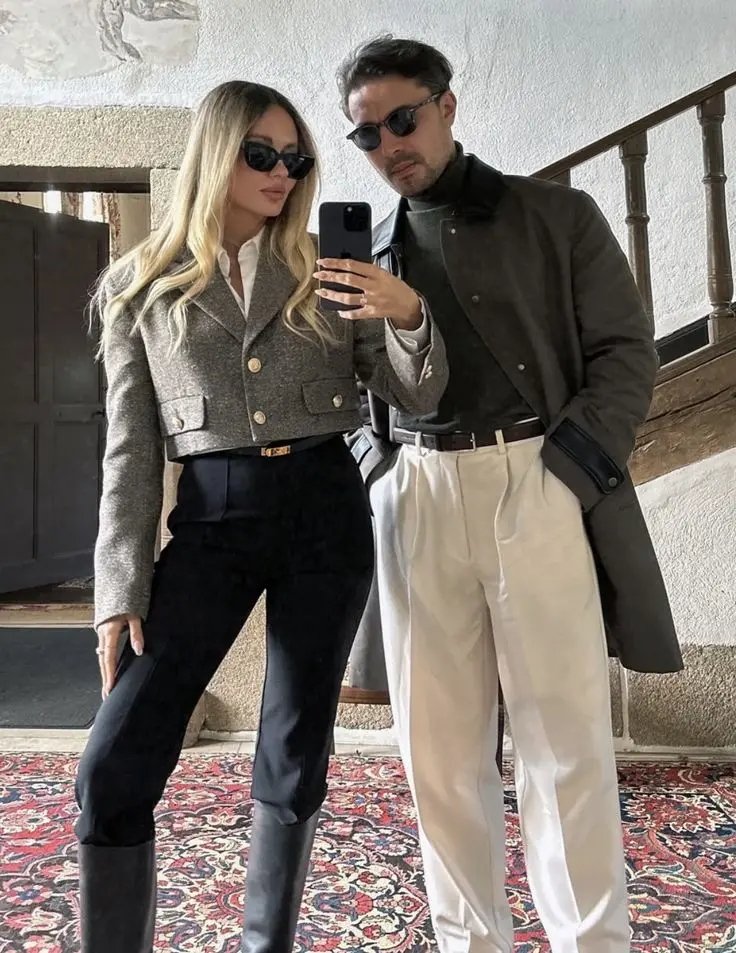
The coordination here is through silhouette, not color — both are wearing cropped or structured jackets with high-waisted, tailored bottoms, which creates parallel proportions that read as intentional on camera. The color palette is complementary neutrals: grey, olive, black, cream. These four tones always photograph well together because none of them fight for dominance. If one person wears oversized on top, the other should too; that proportion-matching rule is what elevates this from coincidence to styling.
This approach is perfect for urban photoshoots, travel content, or contemporary engagement photos where you want something that feels current without being trend-dependent. The key is both people looking equally considered — one person in a polished tailored look and one in something thrown together will always look off, no matter how good the individual pieces are. Equal effort, parallel silhouettes, complementary tones: that’s the formula.
Beige Leather Jacket and Tan Trench Over All-Black Basics
Neutral outerwear over black basics is one of those styling formulas that sounds almost too simple — and then you see it in photos and it just works. She wears a beige leather jacket with black trousers; he’s in a tan trench coat with black pants. The approach is nearly identical, which is exactly the point: same formula, different execution, effortlessly cohesive.
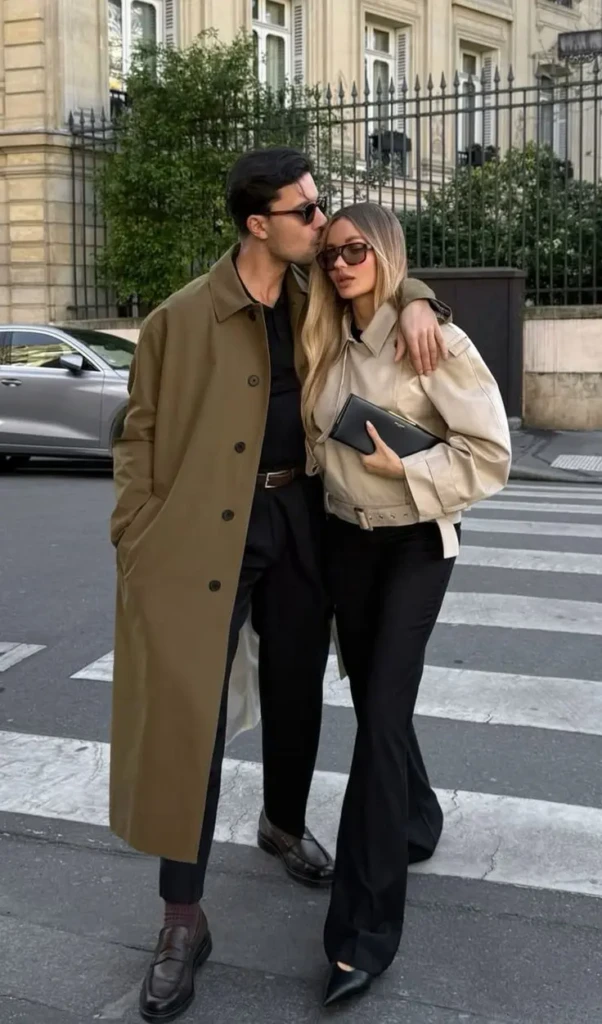
The beauty of this pairing is how little effort it requires during the actual shoot. Because the palette is so clean — neutral jackets, black bottoms — you can move from a city street to a café to an architectural backdrop and the outfits will look right in every frame. The textures do the visual work: leather versus wool creates depth and interest without introducing any color chaos. When coordinating with neutrals and black, varying textures is the move that stops the look from reading as flat.
This is also one of the most versatile seasonal coordinations in this entire list — it reads perfectly for spring and autumn shoots and can be layered up or stripped back depending on the temperature. The neutral palette keeps the visual focus on your faces and connection rather than your clothes, which is ultimately what you want from a couple photoshoot. Simple, polished, timeless.
Layered Greys and Cream Neutrals for Candid Lifestyle Shots
Not every couple photoshoot needs to look like a campaign. This layered, casual coordination is built for the shoots that feel like a real day — walking around the city, grabbing coffee, just being together. She’s in grey and cream layers with blue jeans; he’s in black and grey with a baseball cap. The shared neutral palette creates cohesion while the relaxed styling keeps everything feeling genuine.
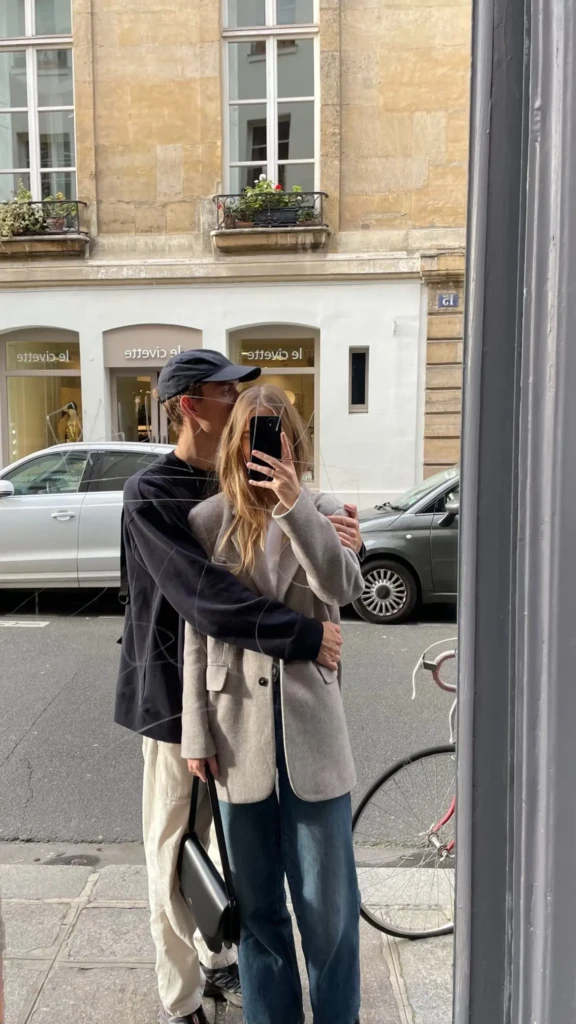
The key to making casual coordination look intentional is staying in the same family of tones — grey, black, cream, navy all live comfortably together without anyone having to overthink it. Both people should be at the same level of casualness: if one person is in a relaxed knit and jeans, the other shouldn’t show up in a structured blazer. Accessories like the baseball cap add personality without disrupting the visual harmony, and they give the photos a lived-in quality that staged formal shoots rarely achieve.
This styling is particularly effective for travel content, documentary-style engagement shoots, or any session where the goal is authenticity over polish. The layered approach also gives you a practical bonus during the shoot itself — remove a layer and you’ve essentially got a second look without changing outfits. For photographers who like variety across a session, that flexibility is genuinely useful.
Navy Pinstripe Blazer and Tan Check Jacket for Pattern-Mixed Portraits
Mixing patterns on a couple takes nerve, but this pairing shows exactly how to do it without things spiraling into chaos. She wears a navy pinstripe blazer with wide-leg jeans; he’s in a tan checked blazer with cream trousers. Both are suiting patterns in neutral tones, which is the crucial detail — shared pattern family, different scales, complementary colors.
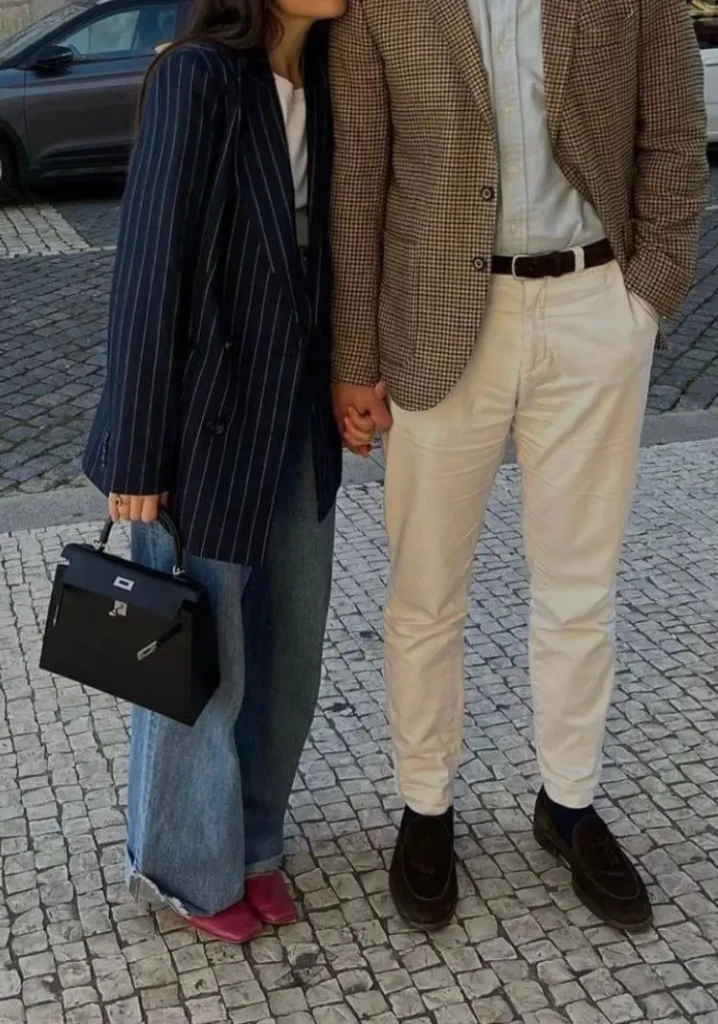
The rule when mixing patterns across two people is to keep one pattern more subtle and one slightly bolder. Fine pinstripes next to a larger check works because the eye reads them as related rather than competing. The structured blazer silhouette is the unifying element — both wearing the same jacket shape makes the different patterns feel like a deliberate choice rather than a styling accident. Navy, tan, cream, and black are genuinely harmonious on camera and won’t create any of the visual vibration that clashing patterns produce.
This coordination is perfect for couples who want more visual interest in their photos without committing to anything loud or fashion-forward. It photographs beautifully against vintage cars, classic architecture, or clean urban backdrops — anything with a timeless quality. Think of this as the middle ground between plain neutrals and bold matching: it has personality, it has dimension, and it looks considered without looking like you tried too hard.
Tan Blazer and Burgundy Jacket Paired Over Black Trousers
Warm neutral coordination creates photos that feel intimate without being soft or overly romantic — there’s a sophistication to it that works for everything from anniversary shoots to editorial portraits. She wears a tan blazer with cream pants and black loafers; he’s in a burgundy jacket with black trousers. The shared approach of pairing warm tones with black anchors both looks in the same visual language.
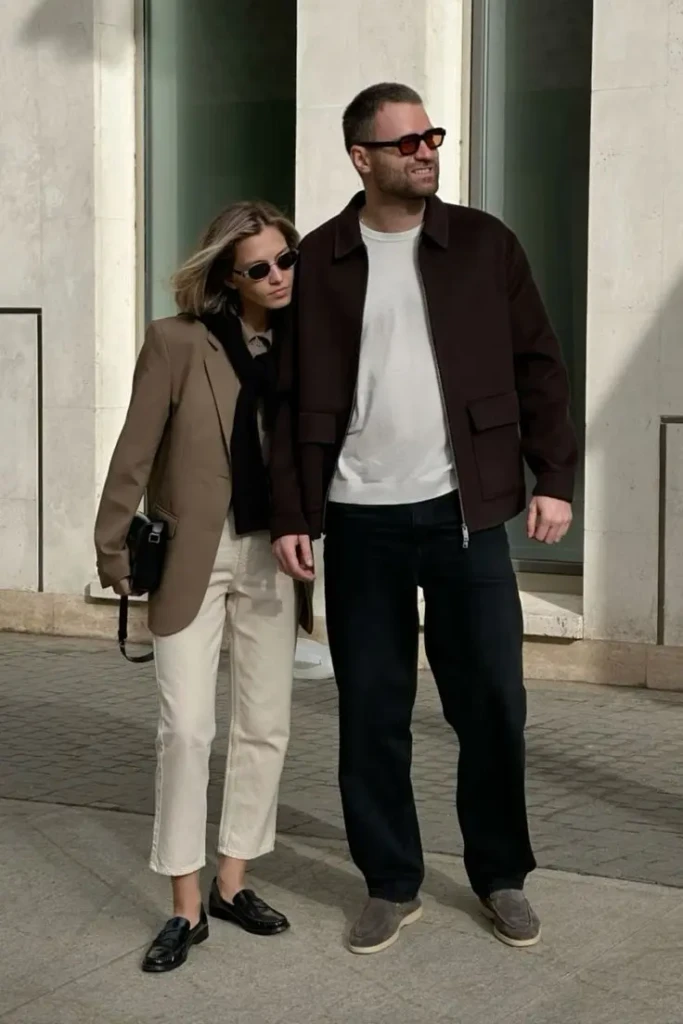
The subtle detail that really makes this pairing work is the matching shoe style — both in loafers, which adds a coordinating element that you notice in photos without being able to immediately identify. That’s the kind of detail worth paying attention to when planning outfits: shoes, bag shapes, the finish on a belt. When coordinating with warm neutrals, keep the undertones consistent — all warm, all golden — because mixing warm and cool browns can look disjointed even if the colors seem similar individually.
This palette is genuinely flattering in photos across different lighting conditions, which makes it a practical choice for shoots where you’re not fully in control of the light. Autumn shoots, European street settings, and golden hour outdoor sessions all enhance the warm, romantic feeling of these tones. The relaxed, classic styling also means the photos age well — you won’t look back at these in ten years and wince at anything.
White Shirt and Black Bomber for High-Contrast Bistro Portraits
Black and white couple coordination is a classic for a reason — it photographs well in any setting, any light, and looks exactly as good in black-and-white film as it does in color. Here, she wears a crisp white shirt with black jeans and a striped headscarf; he’s in a black bomber with cream trousers. The genius detail is the role reversal: she’s the more structured, menswear-inspired one, and he’s the more casual one, which creates genuine visual balance.
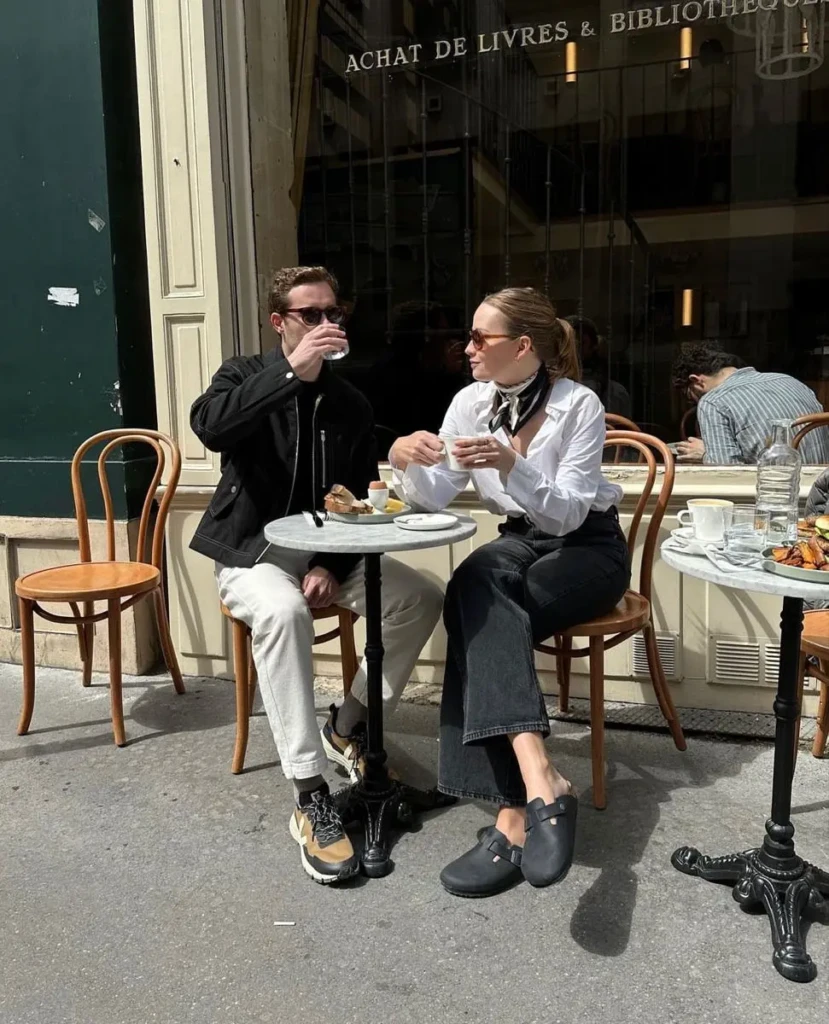
When both people are working with the same limited palette, varying the proportions and levels of formality is what stops the look from becoming too matchy. One person more dressed up, one more relaxed — or different silhouettes entirely — keeps both individuals visually distinct within the coordination. The striped headscarf adds a playful vintage touch that gives the photos a personality they’d otherwise lack. Details like that are what make photos feel specific to you as a couple rather than generic.
This palette works year-round and translates beautifully to café settings, urban streets, and modern architectural backdrops. The high contrast creates visually striking imagery without requiring any complicated styling. The one rule: both outfits need to be equally polished in their execution — equally pressed, equally fitted, equally considered. One sloppy piece will pull the whole look down in photos in a way it simply wouldn’t in real life.
Tan Jacket with Brown Turtleneck and Suede Coat for Earthy Autumn Warmth
Earth tones create photos that feel warm and genuinely inviting — there’s a softness to them that stark black and white simply doesn’t have. She’s in a tan jacket with a brown turtleneck and white jeans; he wears a brown suede jacket with a light grey cardigan and grey trousers. The whole palette — browns, tans, creams, greys — sits within the same warm neutral family, which is what makes it cohesive rather than random.
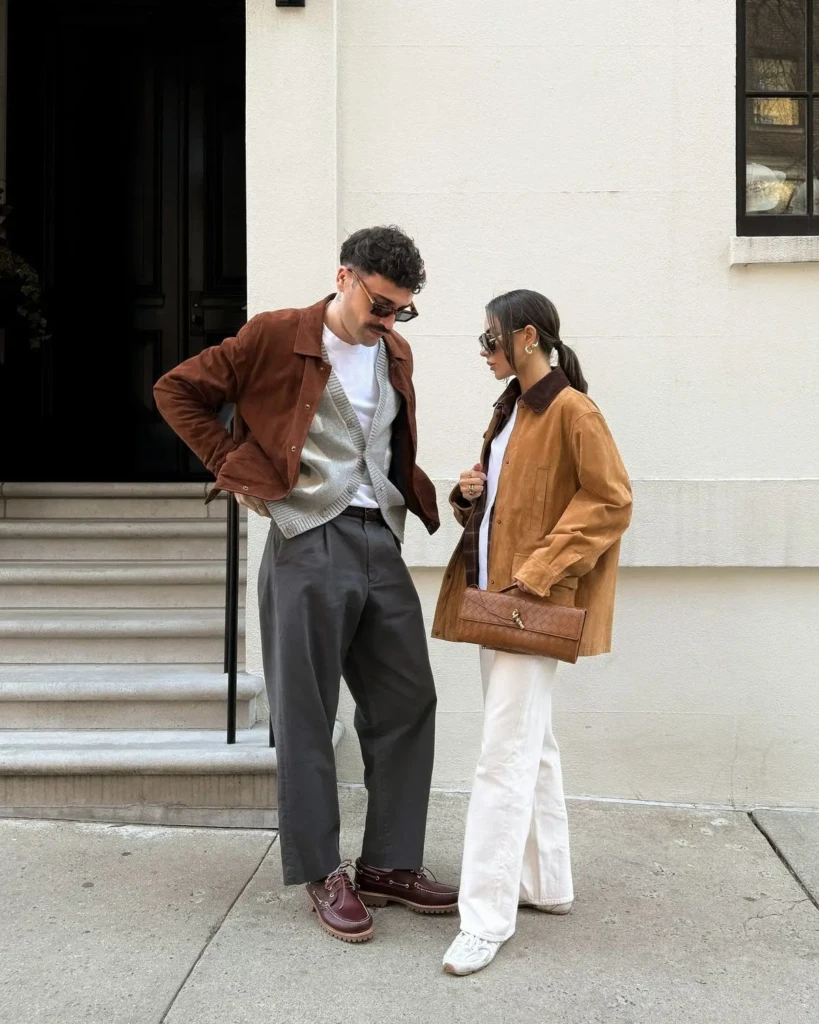
Suede and knit textures are the unsung heroes of this pairing. In photos, texture adds richness and depth that flat, smooth fabrics can’t replicate — it makes the image feel three-dimensional. When coordinating with earth tones, the critical thing is keeping the undertones aligned: warm golden browns work together beautifully, but introduce a cool-toned grey-brown into a warm palette and it will look slightly off in photos even if it’s hard to pinpoint why in person.
This styling works beautifully for outdoor autumn shoots, urban exploration, or lifestyle content where comfort matters as much as aesthetics. One practical advantage of earth tone coordination is that it’s genuinely comfortable to wear — no restrictive silhouettes, no fabrics chosen purely for appearance. When you’re relaxed in your clothes, it shows in your face and your posture, and that ease translates directly into better photos. White architectural backgrounds also provide beautiful contrast to warm earth tones, making both the clothing and the subjects pop.
Cream Coat and Brown Suede Jacket for Tonal Luxe Portraits
Tonal dressing — staying within the same color family across both outfits — produces some of the most sophisticated, editorial-quality couple photos possible. She wears a cream coat with wide-leg trousers; he’s in a brown suede jacket with white trousers and a cream turtleneck. Every piece sits somewhere in the cream-brown-white spectrum, creating cohesion through color temperature rather than exact matching.
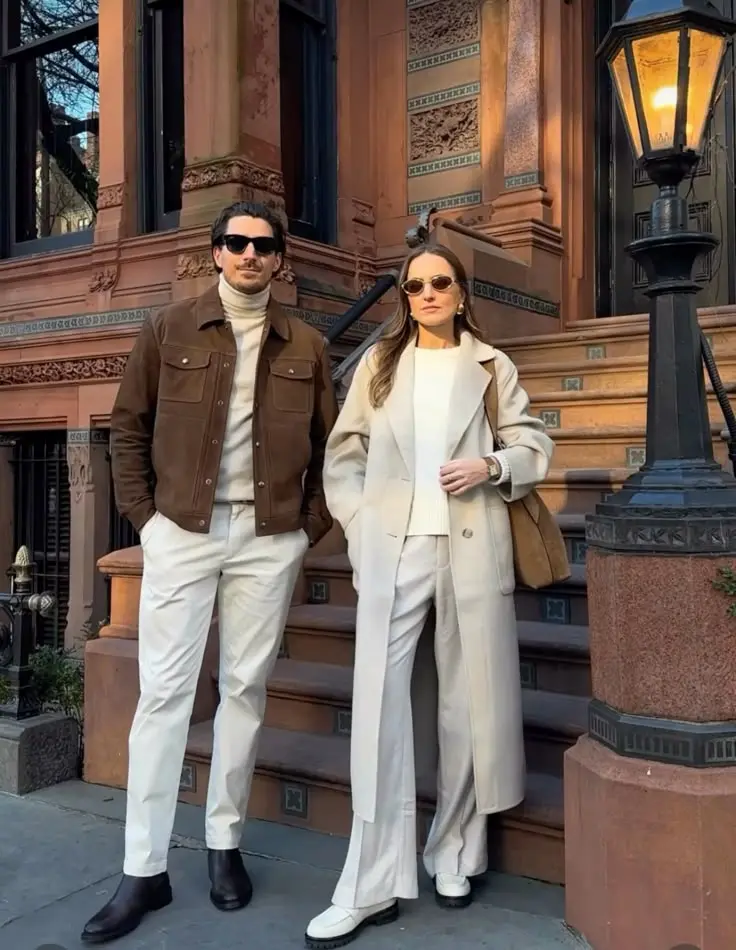
The luxe fabrics are doing essential work here. Suede, structured wool, quality knits — these are materials that photograph with weight and texture, which elevates the images in a way that fast-fashion equivalents won’t replicate. When coordinating tonally, choose fabrics with visual interest: a slight sheen, a visible weave, a rich drape. Flat, textureless fabrics in similar tones can read as washed out on camera, particularly in soft or overcast light.
Golden hour lighting is genuinely transformative with warm neutral palettes — it adds a glow to the creams and browns that makes the photos feel almost cinematic. Classic architecture and elegant streets complement this refined aesthetic perfectly. The key practical consideration is that both people should be wearing a similar level of formality: if she’s in a structured coat with wide-leg trousers, he shouldn’t be in a casual knit with joggers. The balance of polish across both outfits is what makes the coordination feel intentional rather than accidental.
Chocolate Brown Blazer and Black Coat for Cozy Autumn Layers
This is the autumn coordination that feels like it belongs in a real moment rather than a styled shoot — and that quality is exactly what makes it photograph so well. She wears a chocolate brown blazer with black flare jeans; he’s in a black coat with cream trousers. The warm palette and the mix of black, brown, and cream is a classic combination, and the cozy fabrics add a visual warmth that translates beautifully to print.
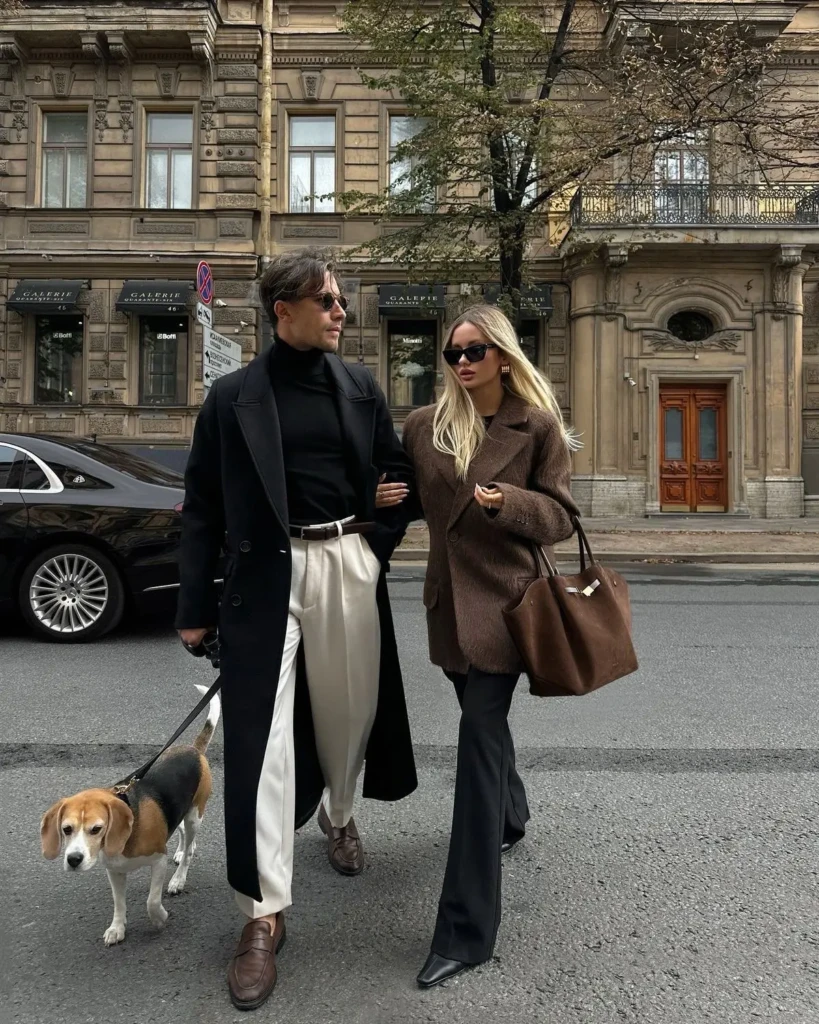
The shared brown tones — in her sweater, his shoes, and the coat details — create a subtle connection between the looks without anyone having to coordinate consciously. That subtlety is actually more effective on camera than overt matching: the outfits feel related rather than costume-like. When planning autumn photoshoots, lean into cozy textures: knits, wool, leather. These add warmth and depth to images in a way that lightweight summer fabrics simply can’t.
If the shoot involves natural movement — walking through fall foliage, sitting on steps, a dog joining the frame — this styling handles it all without looking stiff or overdone. The key thing is genuinely feeling comfortable in the clothes: overly posed photos never feel as authentic as ones where both people are actually relaxed. Choose pieces you’d wear on a real autumn day and the camera will pick up that ease in every frame.
Matching Brown Turtlenecks and White Trousers for Bold Symmetry
Sometimes deliberate, full-on matching makes the strongest visual statement — and this look commits completely. Both wear brown turtlenecks with white trousers, creating striking color-block symmetry that reads as a bold stylistic choice rather than accidental twinning. The identical silhouettes produce a visual symmetry that is genuinely arresting in photos, particularly against architectural backdrops.
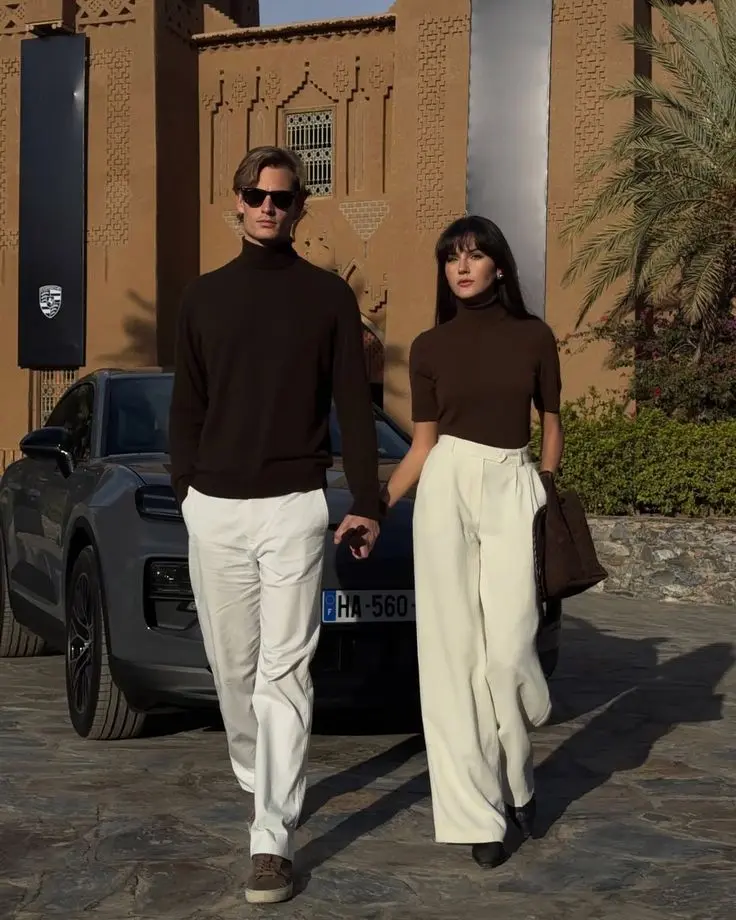
The critical rule with this level of coordination is that execution has to be impeccable. Because there are no colors or patterns to draw the eye away from fit and proportion, any sloppy tailoring will be immediately obvious. Both pieces need to be well-fitted, the turtlenecks need to sit properly, and the white trousers need to be pressed and structured. Half-hearted matching looks accidental; deliberate, polished matching looks intentional and stylish.
Golden hour lighting is particularly flattering with the brown and white palette — the warm light adds dimension to the turtlenecks and gives the whites a soft glow rather than a harsh blowout. This approach works beautifully for engagement announcements, editorial couple portraits, or content where you want immediate visual impact. It’s a bold choice, but when it’s executed well, it produces some of the most memorable couple photos you’ll take.
Black Cape Coat and Black Wool Coat for Moody All-Black Drama
All-black coordination is one of the most powerful couple styling choices you can make — it’s dramatic, sophisticated, and photographs with a moodiness that lighter palettes simply can’t achieve. She’s in a black cape coat; he’s in a black wool coat. The silhouettes are completely different, which is exactly what prevents the look from falling flat — her dramatic draped cape against his clean, structured coat creates visual tension within the monochrome.
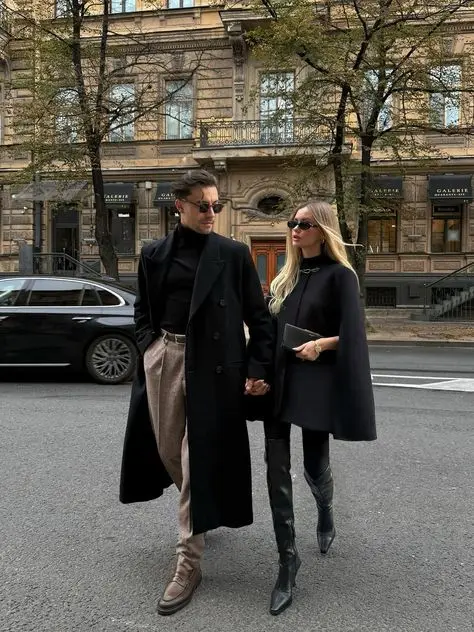
The secret to all-black working in photos is varying textures and silhouettes so the eye has something to travel across. Her cape coat versus his traditional wool coat, different pant styles, varied layering — these differences create depth within the palette. Without that variation, all-black can read as a flat, dark mass on camera, especially in lower light. Every fabric choice matters more when you’re working without the distraction of color or pattern.
When both people are dressed in all black, fit and tailoring become the primary storytelling elements. Everything needs to be impeccably fitted because there is genuinely nowhere to hide anything that doesn’t sit right. This coordination works beautifully for winter photoshoots, evening sessions, urban settings, and edgy engagement photos. The monochrome approach also keeps the absolute focus on your faces and connection — which is ultimately the point of a couple photoshoot.
Black Coat with Mini Shorts and Grey Overcoat for Classic Tailored Elegance
Classic tailored coordination creates photos that will genuinely never look dated — there’s nothing trend-dependent here, nothing that dates itself to a specific season or year. She wears a black coat with a mini shorts; he’s in a grey wool overcoat with tailored trousers and a tie. The shared formal aesthetic — structured outerwear, polished shoes, considered accessories — creates cohesion through approach rather than color.

The grey and black palette against a Parisian backdrop is almost unreasonably effective. Classic European settings enhance tailored coordination in the same way that a beautiful frame enhances a painting — the setting and the subject are speaking the same language. When coordinating for formal photoshoots, the most important thing is that both outfits sit at the same level of dressiness. Mismatched formality — one person in a wool overcoat and tie, the other in a leather jacket — reads as unintentional and will look slightly chaotic in photos regardless of how good the individual pieces are.
The practical thing about tailored coordination is that it works across a huge range of occasions — engagement shoots, anniversary photos, formal couple portraits, or even event photography. The key is feeling genuinely comfortable in the clothes: if formal wear makes you stiff and self-conscious, that tension will show in every frame. Choose pieces that fit impeccably, ensure you’ve worn them before so you know how they move, and the polish and confidence will come through naturally in the photos.
Shopping Guide for USA
Ready to coordinate your couple photoshoot outfits? Here’s where to shop at every price point.
Luxury Options ($300+ per person): For investment coats and blazers, check out The Row, MaxMara, or Theory at Net-a-Porter and Nordstrom—these pieces photograph beautifully and last for years. Toteme and The Frankie Shop offer minimalist, coordinated-friendly pieces perfect for couple shoots. For quality knitwear, try Vince or Equipment at Bloomingdale’s. Men’s tailored pieces from Sandro, Club Monaco, or Reiss offer excellent quality and timeless styling. For leather jackets, AllSaints and IRO provide styles that work for both genders with excellent coordination potential.
Mid-Range Options ($100-$300 per person): COS provides minimalist, coordinated-friendly pieces for both men and women at accessible prices—their neutral blazers, trousers, and outerwear are perfect for couple shoots. & Other Stories offers European-style pieces that coordinate beautifully across genders. Everlane provides quality basics in consistent neutral palettes, making coordination easy. For men, J.Crew and Banana Republic offer reliable tailored pieces that coordinate well with women’s contemporary brands. Madewell and Uniqlo both offer neutral basics and outerwear that work across genders for coordination.
Budget-Friendly Options (Under $100 per person): Zara offers trendy, photogenic pieces for both men and women that coordinate beautifully—shop the same color families across both sections. H&M’s Premium collections provide surprisingly sophisticated pieces under $50. Uniqlo offers excellent basics in consistent color palettes, perfect for building coordinated looks. For men, Banana Republic Factory and J.Crew Factory provide affordable tailored pieces. ASOS offers enormous selection for both genders at various price points. Rent the Runway allows you to rent designer pieces for photoshoots without the investment, perfect for one-time formal shoots.
Personal Verdict
After helping countless couples coordinate outfits for photoshoots (and going through this process myself multiple times), I’ve learned that the best coordinated looks always come from understanding your individual styles and finding the common ground. The couples whose photos turn out best are the ones where both people feel confident and comfortable, not the ones who forced themselves into matching outfits they’d never normally wear.
My approach now centers on starting with your existing wardrobes and finding pieces that already coordinate, then filling in gaps as needed. Choose a color palette first (usually 2-3 colors maximum), then build outfits around that palette in styles you both genuinely love. The coordination should enhance your natural style, not replace it entirely.
The most important lesson is this: coordination is about creating visual harmony, not identical outfits. The goal is for both of you to look amazing individually while creating cohesive photos together. Choose pieces that fit well, colors that flatter you both, and styles that make you feel confident. When you both feel great in what you’re wearing, that confidence and connection shows in every photo. Start planning early, try on multiple combinations, take test photos in similar lighting to your shoot, and don’t be afraid to adjust. The best couple photos capture genuine connection and emotion—the coordinated outfits just provide a beautiful frame for that story.
FAQ
Do couple photoshoot outfits have to match exactly?
No — and exact matching often looks more costume-y than coordinated. The goal is for both outfits to feel like they belong in the same frame, which you achieve through shared color palette, complementary silhouettes, or a consistent aesthetic. Deliberate coordination almost always looks better than identical outfits.
What colors photograph best for couple portraits?
Neutral palettes — black, white, cream, grey, tan, brown — are the most reliable because they don’t create color vibration or distract from faces. Black and white combinations photograph beautifully in virtually any setting and any lighting condition. Earth tones add warmth and work particularly well in natural or golden hour light.
Should both people wear the same level of formality?
Yes — this is one of the most important rules of couple coordination. If one person is in a structured wool overcoat and tie and the other is in a leather jacket and jeans, the photos will look like two different shoots edited together. Match the formality level, even if the specific pieces are quite different.
How do I coordinate patterns without the looks clashing?
Keep both patterns within the same style family — both suiting patterns, both florals, both stripes — and vary the scale. One person wears a fine pattern, the other wears a bolder version of a similar pattern. Make sure the color palettes of the two patterns are complementary, not competing.
What’s the best way to coordinate for an autumn photoshoot?
Earth tones are your most reliable option — browns, tans, creams, burgundies, warm greys. Incorporate cozy textures like knits, suede, and wool, which add visual warmth and depth to photos. Avoid very cool-toned outfits in autumn settings as they can look slightly disconnected from warm fall backdrops.
Can we both wear all black for a couple photoshoot?
Absolutely, and it’s one of the most powerful couple styling choices available. The key is varying textures and silhouettes so both outfits read as distinct within the monochrome palette. Impeccable fit is non-negotiable with all-black because there are no colors or patterns to draw attention away from anything that doesn’t sit right.
How many outfit changes should we plan for a photoshoot?
For a standard session, two coordinated looks is usually ideal — enough variety without losing momentum during the shoot. Layered outfits that can be partially removed mid-session are a smart way to create a second look from the same pieces, which saves time and keeps the energy going.
Does the shoot location affect which outfits we should choose?
Significantly. Urban settings with grey architecture suit cooler palettes and tailored, structured silhouettes. Autumn parks and warm-stone European streets work beautifully with earth tones and warm neutrals. White architectural interiors let monochrome or tonal coordination pop. Match your palette to your backdrop whenever possible.
What’s the biggest mistake couples make with photoshoot outfits?
Mismatched formality levels — one person very dressed up, one very casual — is probably the most common error and the hardest to fix on the day. The second most common is choosing outfits that look great in person but haven’t been checked against each other in a photo. Always photograph your planned outfits together before the shoot.
Have any thoughts?
Share your reaction or leave a quick response — we’d love to hear what you think!
-
 0
-
 0
-
 0
-
 0
-
 0
-
 0